1. The End of National Skill Sovereignty
For centuries, skills were governed implicitly by the nation-state. Education systems, professional licenses, labor laws, and borders defined who was “qualified” to work and where. A civil engineer in one country was not automatically an engineer in another. Skills were local, slow, and institutionally gated.
AI broke this equilibrium.
Today, a machine-learning engineer in Nairobi can train a model used by a startup in Berlin, paid by a company registered in Delaware, deployed on servers in Singapore. The labor market no longer respects borders, but skill governance still pretends they exist. This mismatch is not a bug it is the central crisis of the AI labor economy.
The question is no longer how to learn skills, but who defines, validates, prices, and enforces them.
2. Skills as a New Economic Primitive
In an AI-driven economy, skills behave less like credentials and more like assets:
- They generate recurring income
- They depreciate or compound over time
- They can be bundled, recombined, or automated away
- They can be verified (or faked)
This shifts skills from being educational outcomes to economic units. And once something becomes an economic unit, governance becomes unavoidable.
The problem: there is no global institution designed to govern skills at planetary scale.
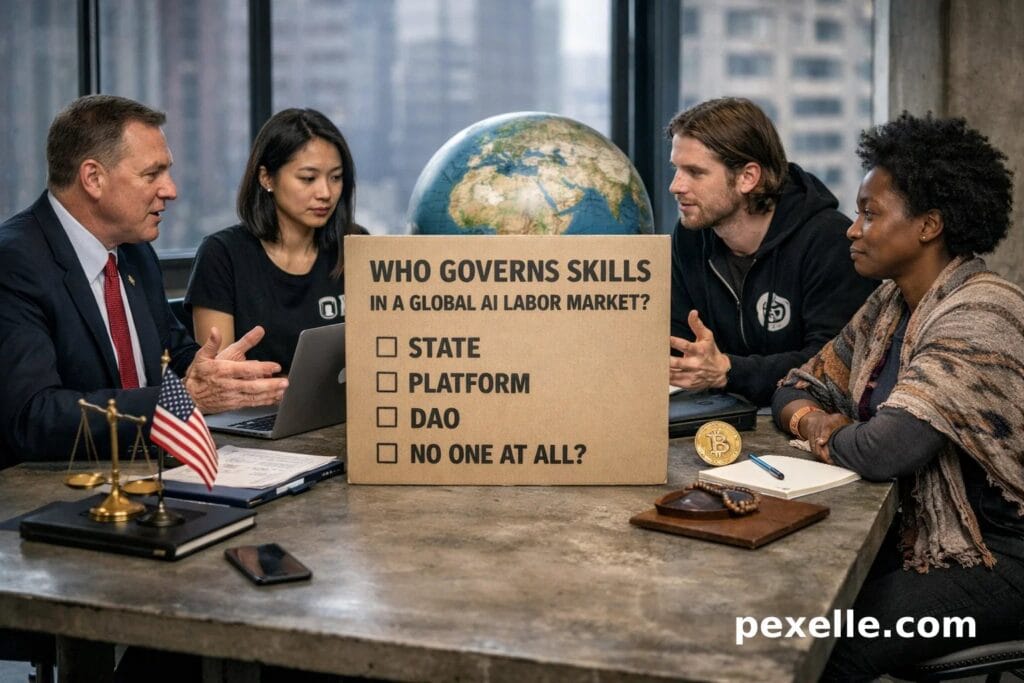
3. Option One: The State Too Slow, Too Local
Nation-states still regulate visas, labor contracts, and taxation. But they are structurally incapable of governing global skills.
Why?
- Jurisdictional limits: States govern territory, not networks
- Update latency: Skill taxonomies change yearly; laws change over decades
- Credential inertia: Degrees lag real-world competence by years
- Exclusion bias: Informal, self-taught, or cross-disciplinary skills are invisible
At best, governments can regulate employment. They cannot regulate capability in a fluid, AI-mediated market.
The state is a downstream actor now not the source of truth.
4. Option Two: Platforms De Facto Governors Without Accountability
Platforms stepped into the vacuum. They did not ask for legitimacy; they accumulated it.
Today, platforms:
- Rank talent
- Define skill labels
- Control discovery algorithms
- Enforce opaque reputation systems
- Decide who is visible and who is invisible
This is private governance masquerading as neutral infrastructure.
The issue is not that platforms govern skills it’s that they do so unilaterally:
- No due process
- No portability of reputation
- No auditability of algorithms
- No ownership of one’s skill graph
A platform ban can erase a decade of labor history overnight. In economic terms, platforms are central banks of attention issuing and destroying skill-liquidity at will.
5. Option Three: DAOs Governance Without Ground Truth
Decentralized Autonomous Organizations promise collective governance, token-based voting, and global coordination. On paper, they seem ideal.
In practice, DAOs face hard problems:
- Who verifies skills?
- How do you prevent reputation gaming?
- What stops plutocracy via token accumulation?
- How do you resolve disputes across cultures and legal systems?
Most DAOs confuse governance of software with governance of human capability. Skills are contextual, probabilistic, and often tacit. You cannot vote them into existence.
DAOs solve coordination not epistemology.
6. The Hard Truth: No One Can Govern Skills Centrally
This leads to an uncomfortable conclusion:
There is no single legitimate governor of skills in a global AI labor market.
And that is not a failure. It is a design constraint.
Skills emerge from practice, not permission. Any centralized authority state, platform, or DAO will eventually lag reality, distort incentives, or exclude edge cases.
The correct question is not who governs skills, but:
What must be governed and what must remain free?
7. A New Model: Protocols, Not Authorities
The future of skill governance looks less like a government and more like the internet itself.
Key properties:
- Open protocols, not centralized registries
- Evidence-based verification, not credentials
- Portable skill graphs, not platform-locked profiles
- Market-driven pricing, not fixed wage bands
- Plural validation, not single sources of truth
In this model:
- No one owns skills
- Everyone can attest to them
- Anyone can challenge them
- Markets decide their value in real time
Governance shifts from command to consensus.
8. Evidence Is the New Regulator
When skills are backed by cryptographic, verifiable, and contextual evidence code commits, shipped products, peer attestations, performance data the need for centralized trust collapses.
You do not need permission to claim a skill.
You need proof that survives scrutiny.
This is governance by transparency, not authority.
9. The Role of AI: Judge, Not Governor
AI should not decide who is skilled. That is a political and ethical dead end.
But AI can:
- Evaluate evidence
- Detect inconsistency or inflation
- Map skill adjacency and transferability
- Forecast skill decay or relevance
AI becomes an instrument of analysis, not power.
10. Conclusion: Skills as Public Infrastructure
In a global AI labor market, skills must be treated as public infrastructure:
- Open, but verifiable
- Neutral, but contextual
- Portable, but accountable
No single entity should govern skills.
But everyone must be able to verify them.
The future does not belong to governments, platforms, or DAOs alone.
It belongs to systems where skills govern themselves through evidence, markets, and open protocols.
That is not utopian.
It is inevitable.
Source : Medium.com