
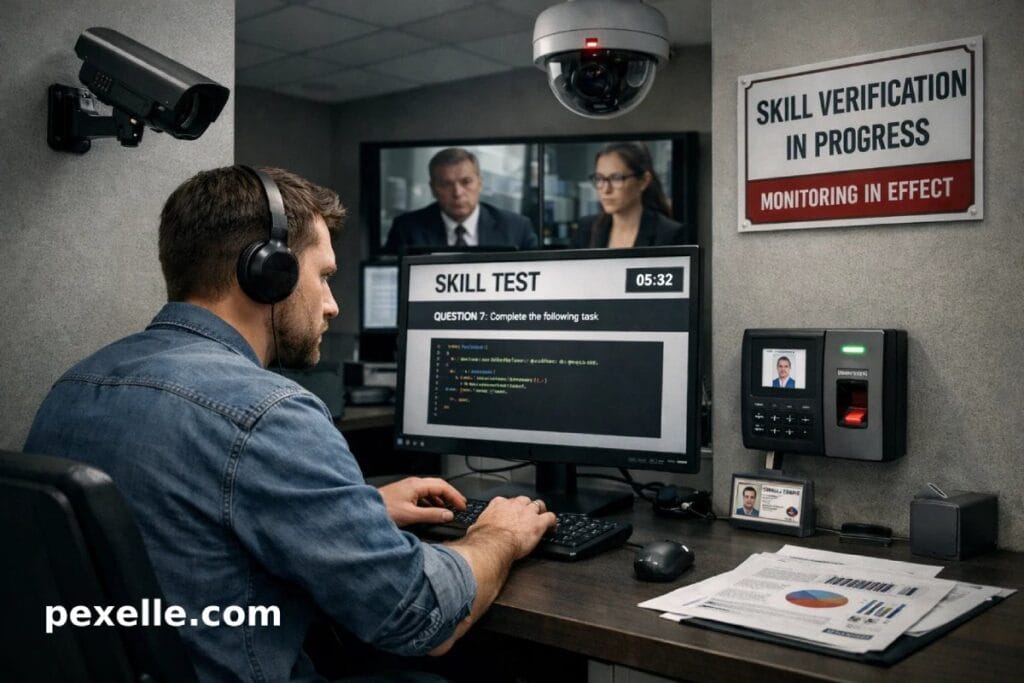
1. From Trust Infrastructure to Monitoring Infrastructure
Skill verification was supposed to solve a real problem:
credentials lie, resumes exaggerate, and talent especially from outside elite institutions remains invisible.
But systems rarely stop at their stated purpose.
When verification becomes continuous, centralized, and mandatory, it stops being a trust layer and starts behaving like a surveillance layer.
Not surveillance of behavior but surveillance of capability.
This is more dangerous.
Because behavior can be hidden.
Skills cannot.
2. What Is Skill Surveillance?
Skill surveillance is not about assessing competence once.
It is about persistent observation, classification, and scoring of human capability.
It emerges when systems:
- Continuously track skill acquisition and decay
- Tie skill metrics to economic access
- Enforce platform-defined standards of “valid” competence
- Penalize non-participation or deviation
At that point, the system is no longer asking “Can you do this?”
It is asking “Are you still allowed to do this?”
3. The Shift from Proof to Permission
Traditional credentials were static.
Degrees, certificates, licenses flawed, but inert.
Skill surveillance introduces revocability.
If a system can continuously re-evaluate your skills, it can also:
- Downgrade you
- Flag you
- Freeze your opportunities
- De-rank your visibility
This transforms skill from proof of ability into permission to participate.
Permission systems always centralize power.
4. Continuous Verification Is Not Neutral
Advocates argue that continuous verification improves accuracy.
Technically, they’re right.
Politically, they’re wrong.
Because who defines “current,” “relevant,” and “acceptable” skills?
- Platforms
- Employers
- Governments
- Algorithms trained on biased labor data
When verification never ends, neutrality disappears.
The system’s worldview becomes law.
5. Skill Scores Are Social Control in Disguise
Once skills are quantified, they become comparable.
Once comparable, they become rankable.
Once rankable, they become enforceable.
This is how soft metrics turn into hard constraints.
Examples:
- Hiring pipelines filtering by dynamic skill scores
- Immigration systems linking visas to skill activity
- Gig platforms suppressing workers whose skills “decay”
- Insurance, credit, or access pricing adjusted by competence profiles
None of this requires malicious intent.
Only incentives.
6. The Invisible Punishment: De-Visibility
The most effective control systems do not ban.
They silence.
In skill surveillance regimes, punishment often looks like:
- Reduced search visibility
- Fewer recommendations
- Lower matching priority
- “No longer a fit” status
No explanation.
No appeal.
Just disappearance.
The individual is not rejected.
They are unseen.
7. Global Inequality Amplifier
Skill surveillance disproportionately harms:
- The Global South
- Informal learners
- Self-taught professionals
- Career switchers
- Neurodivergent workers
Why?
Because surveillance systems reward continuous platform presence, not actual competence.
If you learn offline, work informally, or step away even temporarily you fall behind.
The system interprets absence as obsolescence.
8. When AI Becomes the Gatekeeper
AI-driven skill assessment introduces a new layer of opacity.
Models infer skill from:
- Interaction patterns
- Task completion styles
- Linguistic signals
- Behavioral proxies
These are correlations, not truth.
Yet they increasingly determine:
- Job matching
- Training eligibility
- Pay bands
- Opportunity access
Appealing an algorithmic skill judgment is almost impossible.
You cannot argue with a probability distribution.
9. The Psychological Cost: Self-Censorship of Growth
When skills are constantly watched, people stop experimenting.
They avoid:
- Risky learning paths
- Unconventional careers
- Cross-disciplinary exploration
- Temporary skill regression
Why?
Because failure becomes permanent data.
Surveillance systems punish learning noise the very thing innovation requires.
10. Open vs Closed: The Power Divide
Closed skill systems claim safety and standardization.
In reality, they concentrate control.
Open systems behave differently:
- Verification logic is inspectable
- Scoring rules are contestable
- Evidence is portable
- Identity is not owned by the platform
The question is not whether skill verification exists.
It already does.
The question is who controls it.
11. What a Non-Surveillant Skill System Requires
To avoid becoming an instrument of control, a skill system must:
- Separate evidence from authority
- Allow voluntary disclosure
- Support selective visibility
- Be revocation-resistant
- Enable exit without penalty
- Treat skills as claims, not scores
Anything else will drift toward coercion.
Not because of ideology.
Because of economics.
12. The Hard Truth
Skill surveillance will not arrive with uniforms or force.
It will arrive as:
- Efficiency
- Fairness
- Meritocracy
- Optimization
And by the time it is recognized as control, participation will no longer be optional.
13. Final Warning
A system that knows what you can do
and controls where you are allowed to do it
does not need to control your behavior.
It already controls your future.
The danger is not skill verification itself.
The danger is forgetting that skills belong to people, not platforms.
And people should never be continuously audited just to remain visible.
Source : Medium.com