The Resume Was Built for a World That No Longer Exists
For over a century, the resume has served as the primary gateway to employment. It was designed during an industrial era when work was stable, roles were fixed, and career paths were linear. Employers needed a simple document that summarized education, past job titles, and years of experience. At that time, this system worked reasonably well because the labor market was slower, localized, and easier to verify.
Today, that foundation is collapsing.
Work is becoming global, remote, decentralized, project-based, and increasingly AI-augmented. Careers no longer follow predictable ladders. People shift industries, combine roles, freelance across borders, and constantly update their skills. The resume, however, remains frozen in a static, narrative format that fails to capture real capability, real progress, or real evidence of work.
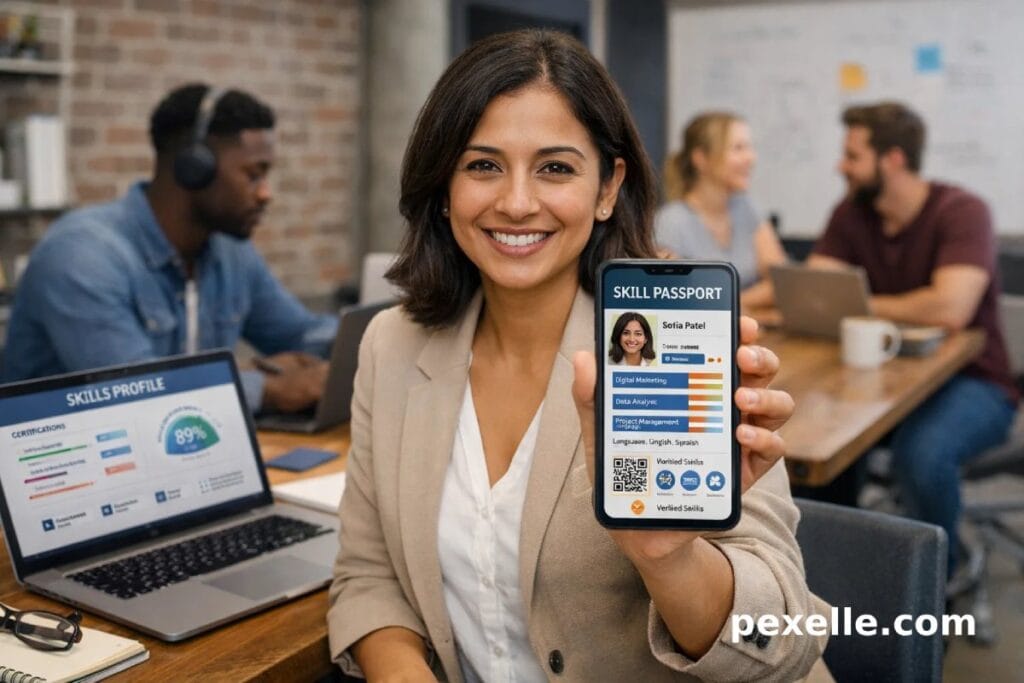
The future of employment requires a new form of professional identity one that reflects verified skills, continuous learning, and measurable contributions. That identity is what we can describe as a Skill Passport.
The Resume Is a Story. The Skill Passport Is Evidence.
A resume is fundamentally a self-reported document. It is shaped by storytelling, keyword optimization, and formatting strategies designed to pass automated screening systems. While resumes can highlight experience, they rarely prove competence.
Skill Passports operate differently. Instead of relying on descriptions, they rely on verifiable evidence. They answer questions that resumes cannot:
- What can this person actually do?
- Where was this skill demonstrated?
- How recently was it validated?
- Under what real conditions was it applied?
Skill Passports shift professional identity from narrative claims to verified performance data. They transform employment records into structured, portable, and continuously updated skill datasets.
The Collapse of Degree-Centric Hiring
For decades, degrees functioned as proxies for competence. Universities acted as gatekeepers that validated knowledge and signaled employability. However, three structural problems have weakened this model.
First, the speed of technological change has shortened the lifespan of academic knowledge. Many university programs cannot update fast enough to match industry evolution. Graduates often enter the workforce with outdated or incomplete skills.
Second, the cost of formal education has risen dramatically in many countries, creating accessibility barriers and excluding talented individuals who cannot afford traditional pathways.
Third, digital learning platforms, open-source contributions, and real-world project work increasingly produce highly skilled individuals without formal degrees.
Skill Passports allow the labor market to recognize these alternative pathways by measuring demonstrated ability rather than institutional affiliation.
AI Is Exposing the Weakness of Resumes
Artificial intelligence is transforming hiring processes at an unprecedented pace. Automated recruitment systems analyze thousands of applications using pattern recognition, predictive analytics, and behavioral modeling.
Ironically, AI is accelerating the obsolescence of resumes for two reasons.
First, resumes are easy to fabricate or exaggerate. Generative AI tools can now create polished resumes within seconds, reducing their credibility as trust mechanisms.
Second, AI hiring models require structured, high-quality data. Free-text documents like resumes introduce ambiguity, bias, and inconsistencies that reduce algorithmic accuracy.
Skill Passports provide standardized, machine-readable, and verifiable data layers that allow AI hiring systems to make fairer and more precise evaluations.
Work Is Becoming Modular
Modern employment is shifting from permanent roles toward modular work structures. Professionals increasingly participate in:
- Short-term projects
- Multi-client freelance contracts
- Platform-based gig work
- Remote collaboration across countries
- Micro-task and digital contribution economies
Resumes struggle to represent fragmented work experiences. They emphasize chronology rather than capability. Skill Passports, however, are designed to track modular achievements across time, platforms, and organizations.
They allow workers to build cumulative reputations based on contributions rather than job titles.
Trust Is the New Infrastructure of the Labor Market
The future workforce operates across jurisdictions, cultures, and regulatory systems. This creates a trust deficit between employers and workers. Companies struggle to verify credentials across borders, while professionals struggle to prove their competence without local references.
Skill Passports can serve as global trust infrastructure by providing:
- Cryptographically verifiable credentials
- Standardized skill taxonomies
- Evidence-linked professional histories
- Portable and interoperable identity frameworks
Such systems reduce hiring friction and enable truly global labor mobility.
Continuous Learning Requires Continuous Identity
In fast-changing industries, professionals must constantly acquire new skills. The traditional resume updates only during job transitions, making it unsuitable for representing ongoing development.
Skill Passports evolve dynamically. They record micro-credentials, certifications, real-world project outputs, and performance metrics in near real-time. This transforms professional identity into a living system rather than a static document.
Continuous identity encourages lifelong learning by directly linking skill development to economic opportunity.
The Economic Value of Skills Is Becoming Quantifiable
The modern economy increasingly treats skills as measurable assets. Organizations seek to understand workforce capabilities at granular levels to optimize productivity, innovation, and risk management.
Skill Passports enable workforce intelligence by mapping:
- Skill availability
- Skill gaps
- Skill evolution trends
- Cross-industry capability transfers
At a macro level, governments and institutions can use skill data to design education policies and economic development strategies. At a micro level, individuals gain clearer visibility into career growth opportunities.
Inclusion and Fairness Depend on Moving Beyond Resumes
Resumes often reinforce systemic inequality. They emphasize institutional prestige, geographic location, and professional networks factors that do not necessarily reflect talent.
Skill Passports shift evaluation toward measurable ability. They allow self-taught developers, remote learners, and contributors from underrepresented regions to compete based on verified work rather than social advantage.
This transformation has the potential to democratize access to opportunity across the global workforce.
Privacy and Ownership Must Be Core Design Principles
While Skill Passports promise transparency and trust, they also introduce risks related to surveillance and data control. If implemented poorly, they could allow corporations or governments to monitor workers excessively or restrict mobility.
To prevent misuse, future Skill Passport systems must prioritize:
- Individual data ownership
- Selective disclosure mechanisms
- Decentralized identity models
- Transparent governance structures
- Open interoperability standards
Workers must remain in control of their professional identity rather than becoming subjects of automated evaluation systems.
The Technology Stack Enabling Skill Passports
Several emerging technologies are converging to make Skill Passports possible:
- Blockchain and decentralized identity frameworks provide verifiable credential infrastructure.
- Artificial intelligence enables skill extraction, validation, and matching.
- Open skill taxonomies such as ESCO and O*NET create standardized classification systems.
- Decentralized storage systems ensure secure and portable evidence storage.
Together, these technologies form the backbone of a new professional identity architecture.
Skill Passports Will Reshape Hiring Itself
Recruitment is likely to transition from role-based hiring toward capability-based matching. Instead of searching for candidates with specific job titles, organizations will search for skill clusters aligned with project needs.
This transformation reduces hiring bias, improves workforce efficiency, and accelerates talent discovery. It also allows companies to assemble fluid teams optimized for specific challenges rather than static organizational hierarchies.
The Rise of the Evidence Economy
As digital verification systems mature, evidence of work will become a new economic currency. Contributions, learning milestones, peer validations, and project outputs will carry measurable market value.
Skill Passports function as personal ledgers within this evidence economy. They enable individuals to accumulate reputational capital that directly translates into opportunity, compensation, and career mobility.
Transitioning from Resumes Will Be Gradual but Inevitable
Resumes will not disappear overnight. Organizations, regulators, and education systems still rely heavily on traditional credential frameworks. However, hybrid systems are already emerging where resumes coexist with digital credential platforms and skill verification systems.
Over time, as data reliability, interoperability, and adoption increase, Skill Passports are likely to become the dominant professional identity standard.
The Future Worker Will Carry a Global Skill Identity
In the coming decades, professional identity will no longer be defined by where someone studied or which company employed them. It will be defined by verified capability, continuous learning, and measurable contribution.
Skill Passports represent a shift from institutional validation to individual evidence. They empower workers to own their professional narratives while enabling employers to make better hiring decisions.
Conclusion: From Documents to Dynamic Identity
The resume was built for stability. The future of work is built on adaptability.
Skill Passports align with a world where learning never stops, work is distributed, and trust must be programmable. They represent more than a hiring tool; they are the foundation of a new labor infrastructure designed for the digital, global, and AI-driven economy.
The transformation from resumes to Skill Passports is not merely technological. It is philosophical. It redefines how society measures value, talent, and opportunity shifting from storytelling to evidence, from static identity to dynamic capability, and from institutional control to individual empowerment.
Source : Medium.com