Introduction: From Claimed Skills to Proven Capability
Modern economies still rely on an outdated assumption: that skills can be declared, trusted, and inferred from titles, degrees, or résumés. In practice, this assumption breaks down quickly. Resumes are self-reported. Certifications are coarse. Job titles are inconsistent. And none of them reliably answer the most important question:
Can this person actually perform the skill, to what depth, and under what conditions?
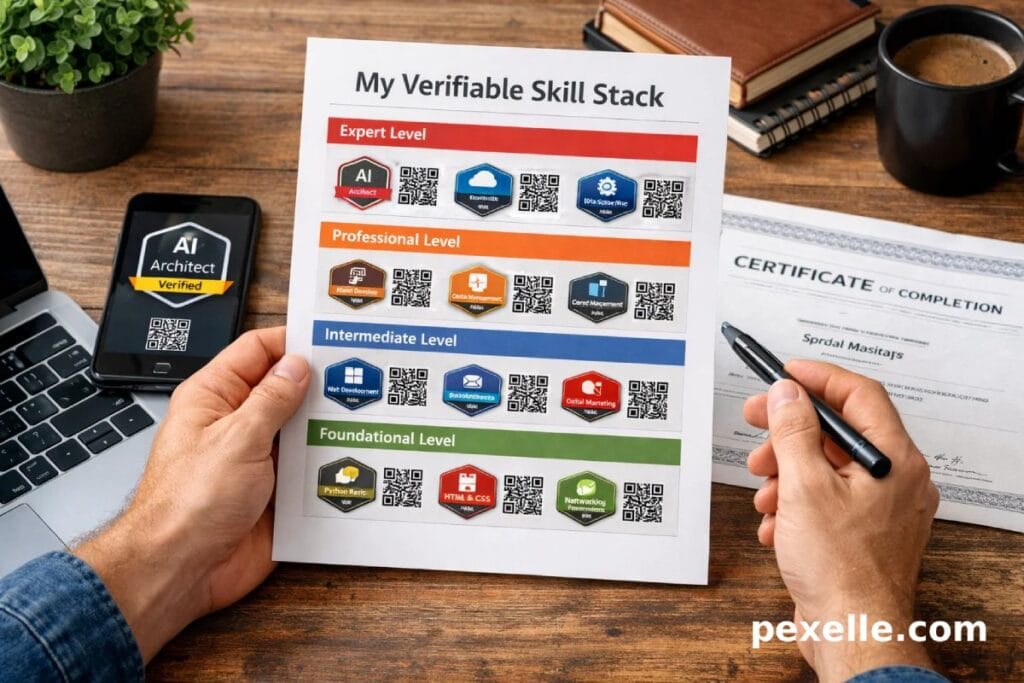
A verifiable skill stack replaces claims with evidence, abstraction with granularity, and trust by authority with trust by proof. It is not a single credential, certificate, or badge but a structured, composable system that shows what someone can do, how well, and why that claim is credible.
This article breaks down what a verifiable skill stack looks like in practice layer by layer, from raw evidence to economic outcomes.
1. The Core Principle: Skills Are Not Binary
Traditional systems treat skills as binary states:
- You either have a skill or you don’t
- You are either qualified or unqualified
Reality is continuous, contextual, and layered.
A verifiable skill stack models skills as:
- Multi-dimensional (depth, scope, recency, autonomy)
- Contextual (domain, constraints, tools, environment)
- Evolving (skills decay, adapt, and compound over time)
This means a skill is never just a word like “Python” or “Project Management”. It is a stacked structure of evidence-backed capability.
2. Layer One: Atomic Skills (The Smallest Verifiable Units)
At the foundation of the stack are atomic skills.
Atomic skills are:
- Small
- Observable
- Testable
- Context-specific
Examples:
- “Write a REST API endpoint with authentication”
- “Normalize tabular data using SQL window functions”
- “Design a non-custodial wallet key-management flow”
- “Configure TLS termination behind a reverse proxy”
Atomic skills avoid vague abstractions. They describe actions, not labels.
Why this matters:
- Atomic skills can be independently verified
- They can be reused across roles
- They avoid credential inflation
Without atomic skills, verification collapses into guesswork.
3. Layer Two: Evidence Objects (Proof, Not Promises)
An atomic skill is meaningless without evidence.
Evidence objects are concrete artifacts that demonstrate skill execution:
- Code commits
- Pull requests
- Design documents
- Test results
- Deployed systems
- Incident reports
- Recorded simulations
- Cryptographically signed submissions
Key properties of good evidence:
- Attributable – clearly linked to the individual
- Timestamped – shows when the skill was exercised
- Contextualized – includes constraints and objectives
- Tamper-resistant – integrity can be verified
Crucially, evidence does not need to be public. It needs to be verifiable under permissioned access.
4. Layer Three: Validation & Attestation
Evidence alone is not trust. Verification requires validation.
Validation can take multiple forms:
- Peer review
- Automated testing
- Expert attestation
- Reputation-weighted feedback
- Cryptographic proof of execution
- Cross-verification from independent sources
Importantly, validation is pluralistic, not centralized.
A verifiable skill stack does not rely on:
- A single authority
- A single platform
- A single institution
Instead, it allows multiple validators, each with visible credibility and scope. Trust becomes composable, not absolute.
5. Layer Four: Skill Composition (From Atoms to Capabilities)
Real work is never atomic. It is compositional.
A verifiable skill stack groups atomic skills into capabilities:
- Backend engineering
- Secure infrastructure design
- Financial modeling
- Applied data analysis
- Distributed systems reliability
Each capability is:
- Explicitly defined
- Traceable back to atomic skills
- Backed by multiple evidence objects
This prevents the résumé problem where broad labels hide shallow ability. Instead, anyone can inspect which sub-skills exist, which are missing, and which are strong.
6. Layer Five: Context & Constraints
Skills without context are misleading.
A verifiable stack encodes:
- Environment (startup, enterprise, regulated sector)
- Scale (prototype vs production)
- Constraints (time, budget, security, compliance)
- Tools and frameworks used
- Level of autonomy (assisted, independent, leading)
For example:
“Designed a cryptographic key-rotation system”
is incomplete without knowing:
- For how many users?
- Under what threat model?
- With what regulatory constraints?
- As an individual or as part of a team?
Context turns skill claims into credible signals.
7. Layer Six: Time, Decay, and Skill Freshness
Skills are not permanent assets.
A verifiable skill stack tracks:
- When a skill was last exercised
- Frequency of use
- Evidence recency
- Evolution of complexity over time
This allows:
- Skill decay to be acknowledged
- Continuous learning to be rewarded
- Stale credentials to lose weight naturally
Trust becomes dynamic, not frozen in time.
8. Layer Seven: Economic & Real-World Integration
A verifiable skill stack is not just informational it is economic infrastructure.
In practice, it enables:
- Skill-based hiring without resumes
- Fairer freelance marketplaces
- Transparent contractor selection
- Portable professional identity
- Proof-of-work for compensation
- Reduced credential fraud
Most importantly, it allows skills to be recognized across borders, institutions, and systems without re-verification from scratch.
9. What This Replaces (and What It Doesn’t)
A verifiable skill stack does not eliminate:
- Education
- Mentorship
- Institutions
- Credentials
It replaces:
- Blind trust
- Proxy signals
- Inflated titles
- Gatekeeping by opacity
Institutions remain relevant but their role shifts from issuing authority to providing validation and context.
Conclusion: Skills as Living Infrastructure
A verifiable skill stack is not a profile.
It is not a CV.
It is not a badge collection.
It is a living system of proof, built from atomic skills, grounded in evidence, validated through trust networks, and updated through real work.
In practice, it answers a simple but powerful question:
“What can you actually do and how do we know?”
Once that question can be answered credibly, at scale, and without centralized control, the foundations of hiring, education, and economic participation fundamentally change.
And that is why verifiable skill stacks are not a feature.
They are infrastructure.
Source : Medium.com