
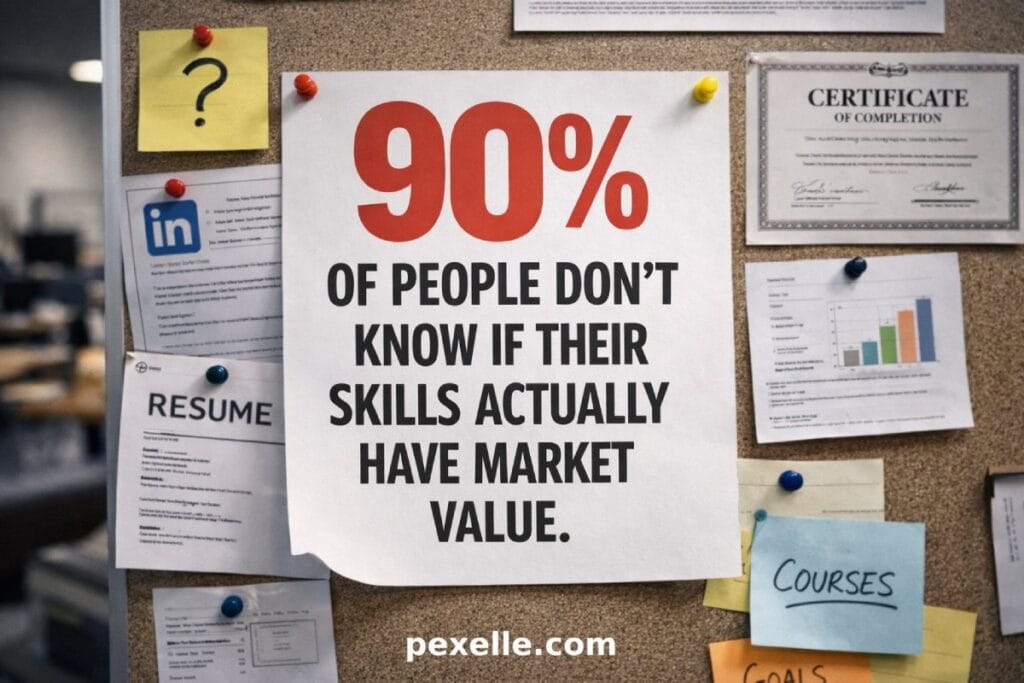
Most people believe they understand their own skills.
They list them on resumes.
They collect certificates.
They complete courses.
They add buzzwords to LinkedIn.
And yet, when it comes to the job market, most of them are guessing.
Not because they are lazy.
Not because they lack talent.
But because they are measuring the wrong thing.
Skill Ownership Is Not the Same as Skill Value
Having a skill does not automatically mean it has value.
Value is not defined by:
- How much time you spent learning
- How confident you feel
- How many certificates you hold
- How often you repeat the skill’s name
Value is defined by demand, scarcity, and timing all of which exist outside your control.
The uncomfortable truth is this:
Most people have no visibility into how the market evaluates their skills right now.
The Market Doesn’t Care About Effort
The market does not reward effort.
It rewards alignment.
You can be highly skilled in something that:
- Was valuable three years ago
- Is oversupplied today
- Is being automated
- Is misunderstood by employers
- Is poorly positioned against real demand
From the inside, everything feels fine.
From the market’s perspective, your skill might be invisible.
And most people never find this out until it’s too late.
Resumes, Profiles, and Search Are Not Market Signals
People rely on tools that were never designed to measure real market value.
Resumes are static narratives.
LinkedIn is self-reported.
Job descriptions are noisy and inconsistent.
Search results are fragmented and misleading.
None of these answer the only question that matters:
If I lost my job today, which of my skills would actually help me recover and which wouldn’t?
For most people, that answer is a blind spot.
The Dangerous Assumption: “If I Learn More, I’ll Be Safer”
When uncertainty grows, people default to accumulation:
- More courses
- More credentials
- More skills
But without feedback from the market, learning becomes a gamble.
You might be doubling down on something with declining value.
You might be ignoring a skill with rising demand.
You might be investing months where weeks would have been enough or weeks where years are required.
Without visibility, learning feels productive but stays disconnected from reality.
The Real Problem Is Not Skill Gaps It’s Skill Awareness
The biggest risk today is not lacking skills.
It’s not knowing which of your skills matter, to whom, and under what conditions.
Markets move faster than education systems.
Faster than resumes.
Faster than career advice.
If you don’t have a way to see how your skills map to real demand, you are navigating blind regardless of how capable you are.
This Is Why Guessing Is No Longer an Option
In a volatile job market, confidence without evidence is fragile.
People who survive disruption are not the ones who “know more.”
They are the ones who know where they stand.
They can see:
- Which skills are strong
- Which are weakening
- Which are emerging
- Which are misaligned with the market
And most importantly they don’t rely on assumptions.
If You Don’t See Your Skill Value, Someone Else Will Decide It for You
The market is already evaluating you.
You’re just not seeing the results.
Ignoring that reality doesn’t protect you from it.
Understanding your real position does.
And without the right tools, that understanding simply isn’t possible.
Source : Medium.com