
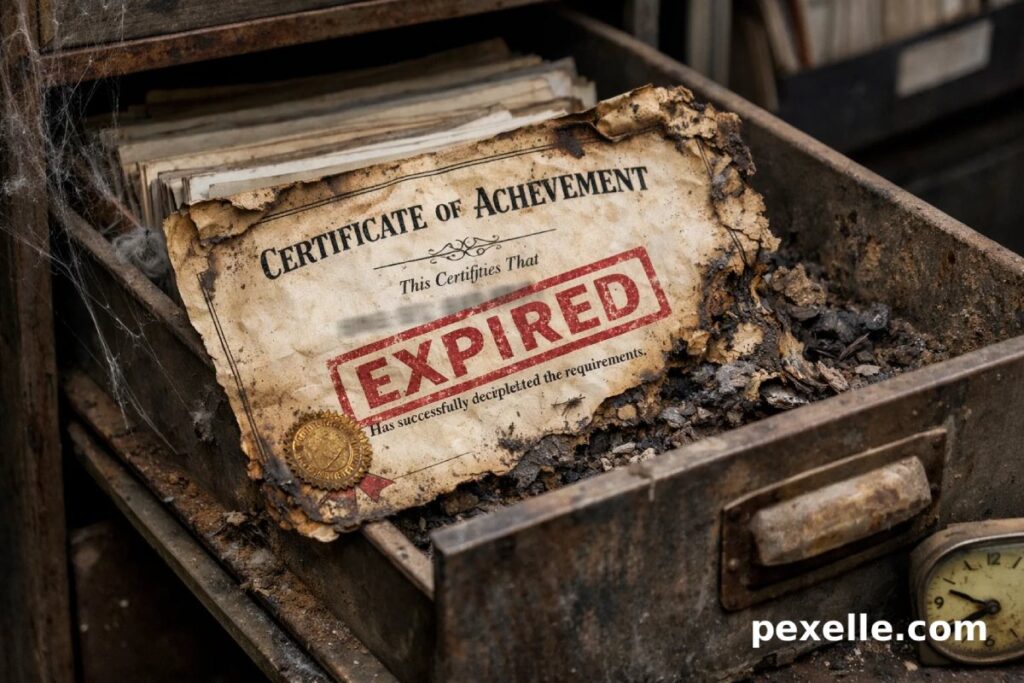
You earn them.
You frame them.
You list them on your resume.
You assume they protect your future.
But the market does not treat certificates as permanent assets.
It treats them as time sensitive signals.
And most of them start losing value much earlier than people expect.
A Certificate Is a Snapshot, Not a Guarantee
A certificate proves one thing only.
That at a specific moment in time, you met a defined standard.
It does not prove:
- Current relevance
- Ongoing demand
- Scarcity
- Adaptability
The market changes continuously.
Certificates do not.
The moment the environment shifts, the signal weakens.
The Market Moves Faster Than Certification Systems
Certification systems are slow by design.
They require:
- Standardization
- Approval cycles
- Stable curricula
- Predictable outcomes
Markets do not wait for this.
Tools change.
Workflows evolve.
Priorities shift.
Automation absorbs tasks.
By the time a certificate becomes widespread, the market has already adjusted around it.
Popular Certificates Devalue the Fastest
The more popular a certificate becomes, the faster it loses leverage.
Why?
Because popularity increases supply.
When thousands of people hold the same credential:
- It stops differentiating
- It becomes a baseline
- Employers raise expectations
- Value shifts elsewhere
What once signaled advantage turns into a minimum requirement.
Expiration does not happen on paper.
It happens through saturation.
Certificates Age Even When Skills Improve
This is the uncomfortable part.
You can become better at the skill.
You can gain experience.
You can deepen your understanding.
And the certificate still loses value.
Because the market does not measure effort or progression through certificates.
It measures alignment.
A strong skill attached to a weak signal still underperforms.
The Illusion of Safety
Certificates feel safe because they are visible.
They can be listed.
They can be verified.
They can be explained.
But visibility is not the same as relevance.
Many professionals mistake possession for protection.
They assume that because something was valuable when they earned it, it will remain valuable.
Markets do not work that way.
When Certificates Stop Working, Feedback Arrives Late
Most people discover certificate decay indirectly.
Through:
- Fewer interview callbacks
- Increased competition
- Lower salary offers
- Vague rejection reasons
The certificate did not disappear.
Its influence did.
And by the time this becomes obvious, adaptation is harder.
Certificates Lag Reality
Certificates validate past alignment.
The market rewards present alignment.
That gap grows every year.
The faster the industry moves, the shorter the lifespan of static credentials.
What used to last a decade now lasts a few years.
What used to last years now lasts months.
Not because the certificate is bad.
But because time is no longer on its side.
The Question Most People Avoid
Not:
“Is this certificate recognized?”
But:
“How long will this signal remain relevant?”
Those are very different questions.
One looks backward.
The other looks forward.
Most people only ask the first.
Expiration Is Structural, Not Personal
When a certificate loses value, people often blame themselves.
They assume they chose the wrong one.
They assume they should have studied more.
They assume they fell behind.
In reality, expiration is structural.
Markets evolve faster than static validation systems.
No certificate escapes this.
What Really Expires Is the Signal
The paper does not expire.
The knowledge may not expire.
The signal expires.
And without understanding how the market currently reads that signal, confidence becomes assumption.
Your certificates may still look impressive.
But the market is not impressed by history.
It reacts to relevance now.
And certificates age faster than most people are willing to admit.
Source : Medium.com