
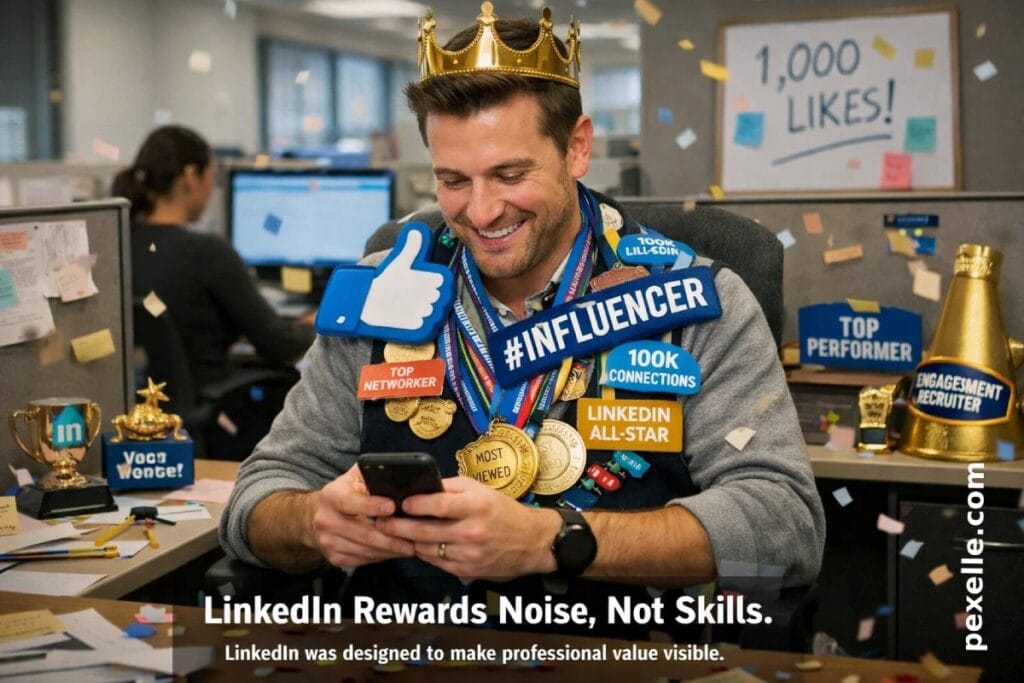
Today, it does the opposite.
It rewards noise.
The loudest voices rise.
The most consistent posters spread.
The most polished narratives win.
Skill is optional.
Visibility Has Been Replaced by Activity
On LinkedIn, visibility is no longer tied to capability.
It is tied to:
- Frequency of posting
- Engagement tactics
- Algorithm timing
- Emotional framing
None of these measure skill.
They measure attention.
People who build real systems, solve complex problems, or create durable value often disappear in the feed.
Not because they lack skill.
But because they don’t perform activity.
Performance Theater Beats Performance
LinkedIn favors performance about work, not performance in work.
Stories outperform substance.
Opinions outperform outcomes.
Narratives outperform evidence.
You can be excellent and invisible.
You can be average and everywhere.
The platform does not ask:
“Can this person deliver?”
It asks:
“Will this post generate reactions?”
Skill Is Hard to Compress into a Post
Real skill is slow.
It lives in:
- Systems
- Trade-offs
- Long-term decisions
- Accumulated judgment
LinkedIn compresses everything into:
- A paragraph
- A carousel
- A quote
The deeper the skill, the harder it is to display.
So the feed fills with what can be shown, not what matters.
Engagement Is Not Validation
Likes feel like confirmation.
Comments feel like recognition.
But engagement is not evaluation.
It reflects:
- Relatability
- Timing
- Emotion
- Familiarity
Not competence.
A post can perform well while the author struggles in real work.
Another can perform poorly while the author builds something valuable.
LinkedIn does not distinguish between the two.
The Algorithm Rewards Consistency, Not Accuracy
The system favors repetition.
Post often enough and you become visible.
Repeat familiar ideas and you become safe.
Original thinking is risky.
Nuance is punished.
Uncertainty underperforms.
Over time, the platform trains users to simplify, exaggerate, and conform.
Skill does not thrive in that environment.
Career Identity Becomes a Brand, Not a Capability
People learn to market themselves before understanding themselves.
Titles become personas.
Opinions become positioning.
Engagement becomes currency.
But branding without substance is fragile.
When real evaluation happens hiring, promotion, delivery the gap appears.
And LinkedIn cannot protect you from it.
Silence Is Not a Skill Signal
Many highly capable people avoid noise.
They focus on execution.
They prioritize depth.
They don’t optimize for visibility.
On LinkedIn, this reads as absence.
The platform does not interpret silence as skill.
It interprets it as irrelevance.
The Cost of Confusing Attention with Ability
When platforms reward noise:
- People over-invest in presence
- Under-invest in leverage
- Optimize for optics
- Mistake momentum for value
The result is a distorted professional ecosystem.
One where being seen replaces being capable.
LinkedIn Didn’t Break. It Optimized.
The platform is doing what it was designed to do.
Maximize engagement.
Skill was never the metric.
Attention was.
And attention does not correlate with competence.
The Market Knows the Difference
The real market does not care about your feed.
It evaluates:
- Outcomes
- Reliability
- Scarcity
- Replaceability
Quietly.
LinkedIn rewards noise.
The market rewards value.
Confusing the two is expensive.
LinkedIn is not a measure of skill.
It is a measure of visibility behavior.
And when noise is rewarded more than capability,
those who rely on the platform for validation are learning the wrong lessons.
Source : Medium.com