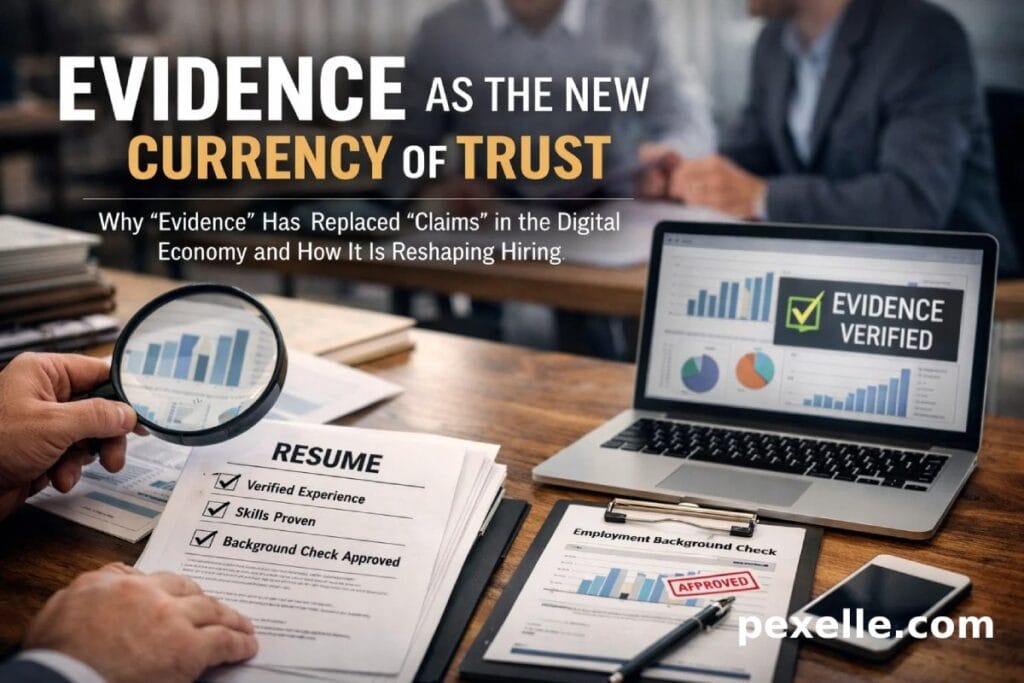
Why “Evidence” Has Replaced “Claims” in the Digital Economy and How It Is Reshaping Hiring
Introduction
The digital economy has changed the way trust is built. For many years, individuals and companies relied heavily on claims. A person could say they were skilled, experienced, creative, or reliable, and in many cases that was enough to open doors. Businesses could present polished branding, attractive slogans, and strong promises, and customers or employers would often accept those messages at face value. Today, that model is breaking down. In a world shaped by platforms, data, AI, remote work, and global competition, trust can no longer depend mainly on what people say about themselves. It increasingly depends on what they can prove.
This shift has made evidence one of the most valuable assets in the digital economy. Evidence is now the new currency of trust because it reduces uncertainty. It helps employers, clients, investors, and collaborators evaluate capability in a more direct and measurable way. Instead of listening only to declarations, they look for signals such as completed projects, verified outcomes, public portfolios, peer endorsements, code contributions, certifications, case studies, customer reviews, and learning records. The question is no longer only “What do you claim you can do?” but rather “What can you show?”
This transformation is especially important in hiring. Traditional recruitment systems were built around resumes, job titles, and self description. But digital work environments demand something more reliable. As talent markets become more global and roles become more dynamic, employers are under pressure to identify real capability faster and with greater accuracy. Evidence based hiring is emerging as the answer. It changes how people present themselves, how companies evaluate talent, and how careers are built over time.
The Collapse of Claim Based Trust
Claim based trust worked better in slower and less transparent economies. In traditional systems, access to information was limited. Employers often had no easy way to validate an applicant’s real abilities beyond a CV, a short interview, and a few references. Credentials and titles acted as shortcuts. They were not perfect, but they helped reduce risk in a world where better alternatives were unavailable.
The digital economy has exposed the weakness of that model. Today, almost anyone can write an impressive profile, use strong language, or optimize a resume for keywords. Personal branding has become easier, but that also means exaggeration has become easier. The gap between presentation and actual capability can now be very large. A polished online identity does not necessarily reflect practical competence, consistency, or real outcomes.
At the same time, companies themselves face the same problem. Businesses can no longer rely only on marketing claims because users now expect proof. Reviews, usage data, public feedback, security reports, case studies, and performance records matter more than slogans. The same logic applies to individuals. In the digital age, visibility is abundant, but credibility is scarce. That is why evidence matters more than ever.
Why Evidence Has Become More Valuable
Evidence has become central because digital environments create both higher opportunity and higher uncertainty. Employers can now access talent from almost anywhere in the world. This expands the talent pool, but it also makes comparison harder. When hundreds or thousands of candidates can apply for the same role, traditional signals become less useful. A degree, a title, or a confident summary may not be enough to differentiate real ability from surface level positioning.
Evidence solves this problem by increasing trust through verification. It allows decision makers to see work, not just hear descriptions of work. A designer can show a portfolio with measurable outcomes. A developer can present repositories, shipped products, and contribution history. A marketer can provide campaign results, growth data, and case studies. A product manager can point to documented roadmaps, launches, and cross functional outcomes. Each piece of evidence reduces ambiguity and makes the evaluation process more grounded.
Another reason evidence is rising is the influence of platforms and digital records. Modern work leaves traces. Projects, collaborations, learning activities, certifications, client feedback, code commits, published writing, and performance metrics can all be recorded and shared. This creates an economy where proof is easier to produce and easier to inspect. As a result, people who can demonstrate capability clearly gain a major advantage over those who rely only on verbal claims.
The Role of AI in Accelerating This Shift
Artificial intelligence is making the move from claims to evidence even faster. AI systems can generate text, improve resumes, draft cover letters, and help candidates sound more polished than ever before. While this increases accessibility, it also weakens the value of self presentation as a trust signal. When language can be optimized automatically, words alone become less reliable.
This creates a paradox. As communication becomes easier to enhance, proof becomes more important. Employers know that a beautifully written resume may reveal more about a person’s use of tools than about their real capability. That does not mean resumes are useless, but it means they are no longer enough. The more AI improves the language of self description, the more organizations will seek evidence that cannot be easily fabricated.
AI also helps employers analyze evidence at scale. Instead of screening only for keywords, companies can begin evaluating work samples, project histories, learning pathways, verified achievements, and behavioral patterns across professional records. In this way, AI does not simply replace one hiring tool with another. It amplifies the transition toward evidence based trust by exposing the weakness of claims and increasing the value of verifiable signals.
What Counts as Evidence in the Digital Economy
Evidence in the digital economy is broader than traditional credentials. A university degree still matters in many contexts, but it is now only one part of a larger trust framework. Real evidence can include completed products, freelance work, open source contributions, internal project records, verified certifications, customer satisfaction scores, video demonstrations, practical assessments, peer reviews, and documented problem solving.
The strongest evidence is usually contextual. It does not only show that someone knows something in theory. It shows that they applied knowledge in a real or realistic situation. For example, saying “I am a great frontend developer” is a claim. Showing three live products, explaining the architecture decisions, sharing performance improvements, and demonstrating how user experience changed is evidence. Saying “I am a strong leader” is a claim. Presenting examples of team delivery, decision making under pressure, conflict resolution, and measurable business outcomes is evidence.
This changes the meaning of professional credibility. Credibility is no longer built only through institutional approval. It is increasingly built through a living record of demonstrated capability. In this new model, reputation becomes more dynamic, more observable, and more closely tied to actual performance.
How Hiring Is Being Transformed
Hiring is being reshaped because evidence reduces bad decisions. A resume can tell employers what a candidate wants them to believe. Evidence helps show what the candidate has actually done. This matters because hiring mistakes are expensive. They cost time, money, productivity, and team morale. In digital businesses, where roles often require adaptability and independent execution, the cost of misjudging talent is even higher.
As a result, more employers are moving toward practical evaluation. Instead of relying only on interviews and CVs, they use portfolio reviews, assignment based screening, structured assessments, trial projects, verified references, and proof of outcomes. In some cases, companies now prefer a strong body of evidence over a traditional background. A candidate without a prestigious degree may outperform another candidate if they can demonstrate real impact clearly and consistently.
This also changes the interview itself. Interviews are becoming less about rehearsed self description and more about evidence interpretation. Employers ask candidates to explain decisions, reflect on tradeoffs, discuss outcomes, and show how they solved specific problems. The goal is not simply to hear confidence. It is to inspect competence.
The Decline of the Resume as a Standalone Tool
The resume is not disappearing, but its role is changing. For decades, it served as the primary document of professional identity. It summarized experience, education, and selected achievements in a compact format. That format still has value, but it is no longer sufficient as a standalone trust instrument.
In the digital economy, a resume increasingly functions as an index rather than proof itself. It points toward evidence that should exist elsewhere. A strong resume now works best when it leads naturally to portfolios, project links, certifications, repositories, publications, or demonstrable results. Without that supporting layer, many claims inside a resume feel incomplete.
This is particularly true in fields shaped by digital production. Employers often expect to see work directly. They want proof that a candidate can execute, learn, adapt, and create value. A resume that only lists responsibilities is weaker than one connected to visible achievements. The future of hiring is not anti resume. It is post resume in the sense that the resume alone no longer carries enough trust.
A New Opportunity for Skilled but Overlooked Talent
One of the most positive effects of evidence based hiring is that it can create new paths for talent that traditional systems ignored. Many capable people were historically excluded because they lacked formal credentials, elite networks, or conventional career paths. In a claims based system, they were often filtered out before they had a chance to prove themselves.
Evidence changes that dynamic. A person can now build credibility through actual work, not only through institutional status. Someone who learned independently, completed real projects, contributed to communities, solved practical problems, or built a meaningful portfolio can compete more fairly if employers are willing to recognize evidence. This opens doors for self taught professionals, career changers, freelancers, remote workers, and individuals from underrepresented backgrounds.
However, this benefit depends on how evidence is evaluated. If companies only replace one rigid filter with another, the system may still exclude many people. Evidence based hiring must be designed carefully. It should reward demonstrated capability, not merely polished presentation or access to privileged opportunities. True progress requires employers to distinguish between real signals of skill and superficial signals of visibility.
The Risks of an Evidence First World
Although the rise of evidence is powerful, it is not automatically fair or perfect. Evidence can also be unevenly distributed. Some people have more chances to produce visible work than others. A person working inside a confidential organization may have strong capability but limited public proof. Another person may be highly talented but early in their career and still building their record. In these cases, the absence of visible evidence does not necessarily mean the absence of ability.
There is also the danger of reducing people to what is measurable. Not every valuable capability is easy to document. Judgment, empathy, resilience, ethical thinking, leadership under uncertainty, and long term strategic insight often emerge over time and in context. If employers become too narrow in their definition of evidence, they may miss important human qualities that still matter deeply.
That is why evidence based hiring should be thoughtful rather than mechanical. Evidence should strengthen human evaluation, not replace it entirely. The best hiring systems will combine proof of capability with structured interviews, contextual understanding, and careful interpretation. The goal is not to create a cold metric driven process. The goal is to build a more honest and accurate one.
The Rise of Continuous Reputation
In the digital economy, trust is becoming continuous rather than static. In the past, a person’s professional identity was updated occasionally through a new degree, a job change, or a yearly review. Today, evidence can accumulate continuously. Every meaningful project, contribution, credential, endorsement, and outcome can become part of a living reputation.
This creates a major cultural shift. Careers are no longer defined only by where someone worked. They are increasingly defined by what they can demonstrate over time. Professional value becomes more dynamic, more portable, and more transparent. People build trust not only through status, but through an ongoing record of contribution and proof.
For hiring, this means recruitment may become less about snapshots and more about trajectories. Employers will increasingly ask not just “What has this person claimed?” but “What has this person consistently demonstrated?” That question is far more powerful because it focuses on patterns of action rather than polished self narrative.
What This Means for Individuals
For professionals, the message is clear. In the new economy, it is no longer enough to say you are capable. You need to build a body of evidence that makes your capability visible. This does not require self promotion in a shallow sense. It requires documentation, clarity, and proof. People who understand this early can create a major advantage for themselves.
Building evidence can take many forms. It can mean creating a portfolio, documenting case studies, publishing work, recording learning achievements, showing before and after impact, collecting testimonials, contributing to communities, or maintaining a credible track record across platforms. The key is not quantity alone. The key is relevance, authenticity, and consistency.
This also changes how people should think about learning. Learning is no longer complete when knowledge is acquired privately. In many cases, it becomes valuable when it is translated into demonstrable capability. The future belongs not only to those who know, but to those who can show.
What This Means for Companies
For employers, the shift toward evidence is both a challenge and an opportunity. It requires redesigning hiring systems that were built for a different era. Companies must move beyond keyword matching and impression based interviews if they want to identify real talent. They need frameworks that help them evaluate evidence fairly, efficiently, and contextually.
This may include structured work sample reviews, skill based assessments, verified project analysis, clearer role definitions, and better ways to interpret nontraditional career paths. Organizations that adopt evidence based hiring well will likely make better decisions, reduce bias related to prestige alone, and improve quality of hire.
At the same time, companies must be careful. Evidence should not become a new excuse for over filtering or endless unpaid labor from candidates. The process must remain humane and proportional. Good evidence based hiring respects candidates while improving accuracy. It seeks clarity, not exploitation.
Conclusion
The digital economy is changing the foundation of trust. Claims still exist, but they no longer carry the same weight they once did. In a world of abundant information, AI generated language, global competition, and measurable digital activity, evidence has become the new currency of trust. It is more persuasive because it is more grounded. It reduces uncertainty by showing what people and companies can actually do.
This shift is transforming hiring from a process centered on self description to one centered on demonstrated capability. Resumes, titles, and branding are not disappearing, but they are losing their monopoly. They must now be supported by proof. Employers want to see outcomes, context, execution, and consistency. Individuals who can provide that proof will stand out more clearly in the future job market.
Ultimately, this transformation may lead to a healthier labor market if it is handled wisely. When evidence replaces empty claims, hiring becomes more connected to reality. Talent becomes easier to recognize across different backgrounds. Trust becomes less about polished language and more about demonstrated value. In the long run, that is not just a change in recruitment. It is a change in how credibility itself is built in the digital age.
Source : Medium.com