
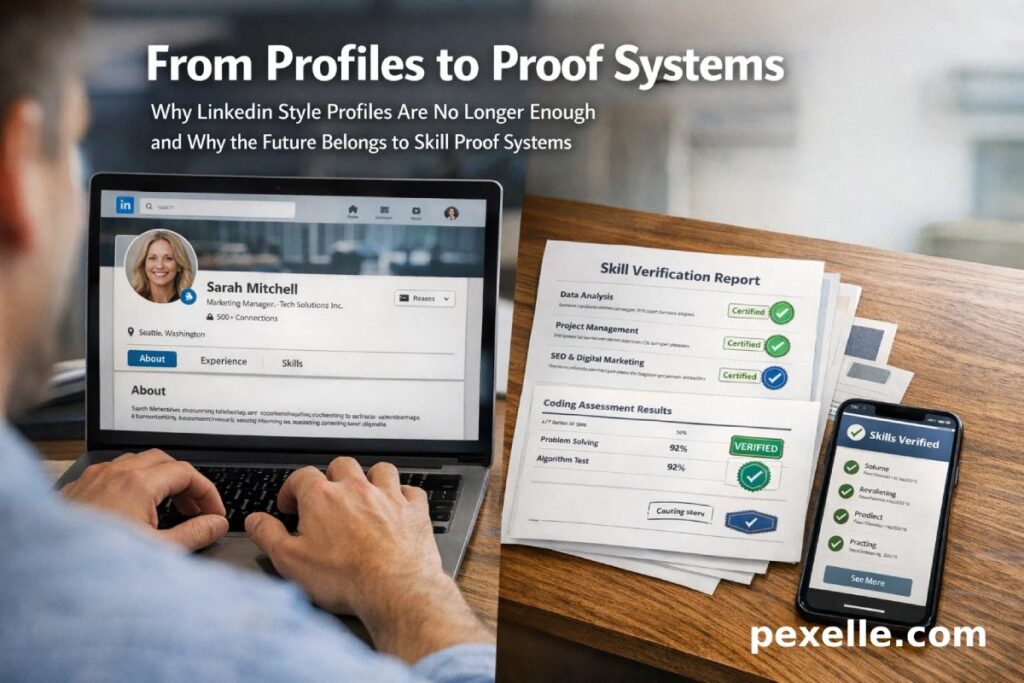
Introduction
For more than a decade, digital profiles have been treated as the public identity layer of professional life. Platforms modeled around resumes, job titles, endorsements, short bios, and self-declared skills created a standard way for people to present themselves online. They helped organize labor markets, supported networking at scale, and gave employers a quick way to scan backgrounds. For a time, this model worked well enough because the digital economy was still comfortable with summaries, labels, and reputation signals.
That era is ending. Modern work is becoming too dynamic, too distributed, and too specialized to be represented accurately by static profiles. A list of job titles does not show what someone can actually do. A set of endorsements does not prove competence. A polished personal brand does not demonstrate execution. In fast-changing industries, organizations increasingly need verifiable evidence rather than narrative claims. As a result, professional identity is shifting away from profile-centric systems and toward proof-based systems that can validate skills through real artifacts, actions, and outcomes.
The future of hiring, collaboration, and trust will not be built on better profiles alone. It will be built on systems that can show what a person has done, how well they did it, under what conditions, and whether that evidence remains relevant over time. This is the rise of the skill proof system.
The Original Promise of Professional Profiles
When digital professional profiles first became popular, they solved a real problem. Before them, talent discovery was fragmented, local, and slow. A profile made it possible to gather key details in one place: education, work history, certifications, interests, and network connections. It turned career identity into something searchable and portable. Recruiters could find candidates quickly, and individuals could present themselves without relying only on traditional gatekeepers.
These platforms also introduced social proof into the labor market. Recommendations, endorsements, mutual connections, and visible employment histories created a sense of legitimacy. Even if these signals were imperfect, they made online trust easier. For many employers, they were better than having no information at all. For many workers, they opened doors that would otherwise have remained closed.
However, the profile model was designed for an economy where work could still be approximated through institutions and titles. If someone worked at a recognized company, studied at a known university, and described themselves with the right keywords, that was often enough to pass an initial credibility test. But in today’s landscape, where capability often matters more than pedigree, this abstraction has become too shallow.
Why Profiles Are No Longer Sufficient
The central weakness of a profile is that it is a claim surface. It tells a story, but it does not reliably prove the story. A person can write that they are skilled in product strategy, machine learning, growth marketing, cybersecurity, or operations, but the profile itself cannot verify depth, recency, or real-world performance. Even endorsements often reflect social behavior more than actual assessment.
This problem becomes more serious as the market becomes more competitive and more remote. When teams are distributed across countries and collaboration happens across platforms, trust cannot depend on polished summaries alone. Employers want to know whether a developer can actually ship production-grade code, whether a designer can solve interface problems under constraints, whether an analyst can turn noisy information into decision-ready insights, and whether a manager can coordinate execution across complex systems. Profiles rarely answer these questions with enough precision.
Another issue is that profiles are static representations of dynamic capabilities. Skills evolve quickly. Tools change. Frameworks are replaced. Entire categories of work are redefined within a few years. A profile might say that someone knows a technology or discipline, but it often fails to show whether that knowledge is current. In many cases, what matters most is not whether a skill was once acquired, but whether it is actively usable now.
The Inflation of Self-Reported Competence
One of the biggest reasons profiles are losing value is the inflation of self-reported competence. Over time, professional platforms encouraged people to optimize for visibility. This produced a culture in which adding more skill labels, stronger headlines, and broader claims often generated better exposure than demonstrating focused excellence. As a result, professional identity became partially performative.
This inflation affects everyone in the system. Job seekers feel pressure to overstate. Recruiters must filter through exaggerated claims. Employers spend more time validating than discovering. The signal-to-noise ratio declines. In that environment, the profile becomes less of a trust layer and more of a marketing layer.
The problem is not that people are intentionally dishonest in every case. Often the issue is that there is no shared measurement standard. Two people can both list the same skill while meaning very different levels of competence. One may have watched tutorials, while the other may have led high-stakes implementation in production. On a profile, these differences can look nearly identical.
The Limits of Titles, Degrees, and Brand Associations
Traditional profile systems rely heavily on proxies. Job titles, company names, degrees, and certificates are all treated as indicators of likely competence. Sometimes they are useful. But as direct signals of ability, they are incomplete. A title can vary dramatically between organizations. A degree can reflect broad education without proving operational skill. A well-known employer can increase credibility, but it cannot prove what a person individually contributed inside that organization.
In the modern economy, many highly capable people build expertise outside formal pathways. They learn through open source projects, independent practice, creator ecosystems, community work, online programs, freelance execution, or hybrid careers that do not fit old institutional patterns. Profile systems struggle to evaluate these trajectories fairly because they were built around conventional markers of legitimacy.
This creates a paradox. Some of the most capable individuals are underrepresented by their profiles, while some of the most polished profiles overrepresent real ability. That mismatch is one reason organizations are turning toward evidence-first evaluation.
What a Proof System Actually Means
A proof system for skills is not just a nicer portfolio. It is a structured method for connecting identity with verifiable evidence of capability. Instead of asking a person to simply declare what they know, a proof system asks: what did you produce, what standards did it meet, who validated it, under what conditions was it created, and what does it reveal about your actual competence?
Proof can take many forms. It can be a shipped product, a code repository, a design artifact, a simulation result, a customer outcome, a technical audit, a peer-reviewed contribution, a resolved incident, a completed assessment, a learning path with observed performance, or a body of evidence tied to a well-defined skill framework. The key difference is that proof is anchored in observable outputs and contextual metadata.
Strong proof systems go beyond artifact collection. They organize evidence into interpretable structures. They link pieces of work to specific capabilities. They distinguish between beginner, intermediate, and expert performance. They show recency. They record validation methods. They make trust more granular and less dependent on narrative self-presentation.
From Identity Pages to Capability Graphs
The next generation of professional systems will likely move from flat profiles to capability graphs. A flat profile is a page. A capability graph is a living structure. It maps a person’s evidence, contributions, assessments, peer validations, learning progression, and domain context into a dynamic model of what they can actually do.
This matters because work itself is graph-shaped. A person’s capability is not one label. It is a network of related skills, performance contexts, dependencies, and applied outcomes. Someone may be strong at research synthesis, weak at public presentation, advanced in backend systems, growing in security practices, and exceptional in debugging under pressure. These distinctions matter in real hiring and team formation, but classic profiles flatten them into a vague list.
A proof system can preserve the richness of real competence. It can show not only what skill exists, but how that skill interacts with other capabilities. This creates a more honest representation of talent and a more useful basis for matching people to opportunities.
Why Employers Are Moving Toward Evidence
Organizations are under pressure to make better talent decisions with less margin for error. Hiring mistakes are expensive. Team mismatches slow execution. Credential-based filtering excludes strong candidates and includes weak ones. In knowledge work especially, the cost of misjudging competence can affect product quality, customer trust, security, and strategic speed.
That is why many employers are increasingly interested in work samples, trial projects, practical assessments, structured interviews, skill demonstrations, and portfolio-based review. These methods are not perfect, but they move closer to observed capability. The trend is clear: employers want less identity theater and more operational evidence.
In the future, companies will not only ask whether someone has experience. They will ask whether there is proof of capability in contexts similar to the role. A marketing lead may be evaluated through measurable campaign strategy and execution. A software engineer may be evaluated through architecture decisions, code quality, debugging logic, and collaboration signals. A product manager may be evaluated through prioritization evidence, requirement clarity, cross-functional coordination, and delivered outcomes. The market is becoming less impressed by summary claims and more dependent on performance visibility.
Why Individuals Also Benefit From Proof Systems
Proof systems do not only benefit employers. They also create a fairer environment for individuals, especially those who are overlooked by traditional filters. A person without a famous degree, elite employer, or powerful network can still demonstrate competence if the system allows evidence to speak clearly. That opens pathways for talent that would otherwise remain invisible.
This is particularly important for global and emerging markets, where millions of capable people are excluded not because they lack skill, but because they lack recognized institutional packaging. A proof-based model reduces reliance on prestige and increases reliance on demonstrated ability. That can expand opportunity in a much more meaningful way than profile optimization ever could.
Proof systems also support lifelong learning better than static profiles do. Instead of treating development as a sequence of credentials, they can show progression through evidence. A learner can move from guided practice to assisted execution to independent delivery. Their identity becomes a record of growth, not just a snapshot of claims. This is far more aligned with how real competence develops.
The Role of Verification and Trust Infrastructure
For proof systems to work at scale, verification is essential. Evidence without trust standards can become just another form of noise. The future therefore belongs not only to evidence collection, but to trust infrastructure around evidence. This includes validation methods, provenance tracking, evaluator credibility, timestamping, contextual metadata, and protection against manipulation.
In practice, this means a proof system should be able to answer important questions. Was the evidence actually produced by the person it is attached to? Was it independently reviewed? Was it created recently? Was it generated under real constraints or artificial conditions? Was the assessment comparable to others? Without these layers, proof systems risk becoming portfolio galleries without measurement integrity.
This is where technology can play a decisive role. Secure logs, verified issuers, signed artifacts, transparent scoring models, peer consensus mechanisms, and tamper-resistant records can all strengthen the credibility of skill evidence. In other words, the shift from profiles to proofs is not just a UX change. It is an infrastructure change.
Why AI Accelerates This Transition
Artificial intelligence is making the weaknesses of profile systems even more obvious. As AI tools make it easier to generate polished text, optimized resumes, synthetic portfolios, and highly convincing self-presentation, narrative-based professional identity becomes less trustworthy. If anyone can produce an impressive-looking summary in minutes, then summaries lose value as a differentiator.
At the same time, AI increases the need for fine-grained proof because many roles are being redefined around judgment, integration, adaptability, and applied execution. It is no longer enough to say someone can write, code, analyze, or design. The real question is how they work with tools, how they reason through ambiguity, how they validate results, and how they produce reliable outcomes in real conditions.
AI can also help build proof systems. It can analyze artifacts, map them to skill frameworks, detect patterns across evidence, assess progression, and generate more nuanced capability views. But the role of AI here should not be to replace human judgment blindly. It should be to improve the structure, scalability, and interpretability of evidence-based trust.
From Networking Platforms to Skill Infrastructures
One of the most important shifts ahead is conceptual. We should stop thinking of professional platforms merely as social networks for careers. The more important future role is that of skill infrastructure. An infrastructure system does not just display identity. It supports validation, discovery, interoperability, assessment, and trust.
In this model, the professional platform becomes a place where work history, learning history, verified artifacts, peer review, competency frameworks, and opportunity matching are integrated. The user is no longer represented mainly by what they say about themselves, but by a structured body of evidence that evolves with them.
This shift also changes the economics of opportunity. In a profile-driven system, attention often flows to those who are best at signaling. In a proof-driven system, opportunity can flow more directly to those who can demonstrate value. That does not eliminate inequality, but it changes the basis of competition in a healthier direction.
The Future of Hiring and Work Matching
As proof systems mature, hiring will become less like document screening and more like capability resolution. Instead of matching keywords on resumes to job descriptions, systems will match verified evidence to actual task requirements. A role will no longer be understood as a title alone, but as a bundle of required capabilities with measurable proof thresholds.
This can improve not only selection, but also team design. Managers will be able to build complementary teams based on demonstrated strengths and gaps. Learning platforms will be able to recommend the shortest path from current evidence to target role readiness. Workers will be able to understand not just what role they want, but what proof they still need to become credible candidates for it.
That makes labor markets more actionable. A profile says who you claim to be. A proof system says what you are ready for.
Challenges That Must Be Solved
Even though proof systems are promising, they are not automatically fair or effective. Evidence can be unevenly distributed. Some people have more chances than others to produce visible work. Not all skills are easy to capture through artifacts. Team contributions can be hard to isolate. Privacy concerns can arise when work evidence is too deeply tracked. Over-measurement can also create new distortions if people begin optimizing only for what is recorded.
There is also the risk of turning every human capability into a mechanical score. That would be a mistake. Some qualities, such as integrity, resilience, leadership under uncertainty, moral judgment, or trustworthiness in relationships, are not fully reducible to simple evidence units. A strong proof system should improve evaluation without pretending that every valuable human trait can be captured perfectly.
The goal is not total quantification. The goal is better grounding. We need systems that reduce false claims, improve visibility for real talent, and make professional trust more evidence-based without eliminating nuance.
Conclusion
The age of the professional profile is not disappearing completely, but its dominance is fading. Profiles will remain useful as interfaces for identity and discovery. However, they are no longer enough to support trust in a complex digital economy. Titles, summaries, endorsements, and curated narratives cannot carry the full weight of modern capability assessment.
The future belongs to systems that can connect identity with proof. These systems will not ask only what a person says about themselves. They will ask what evidence exists, how it was validated, what it demonstrates, and how current it is. That shift will redefine hiring, education, talent mobility, and the meaning of professional credibility itself.
In the coming years, the most important question in the world of work will not be, “What does your profile say?” It will be, “What can you prove?”
Source : Medium.com