
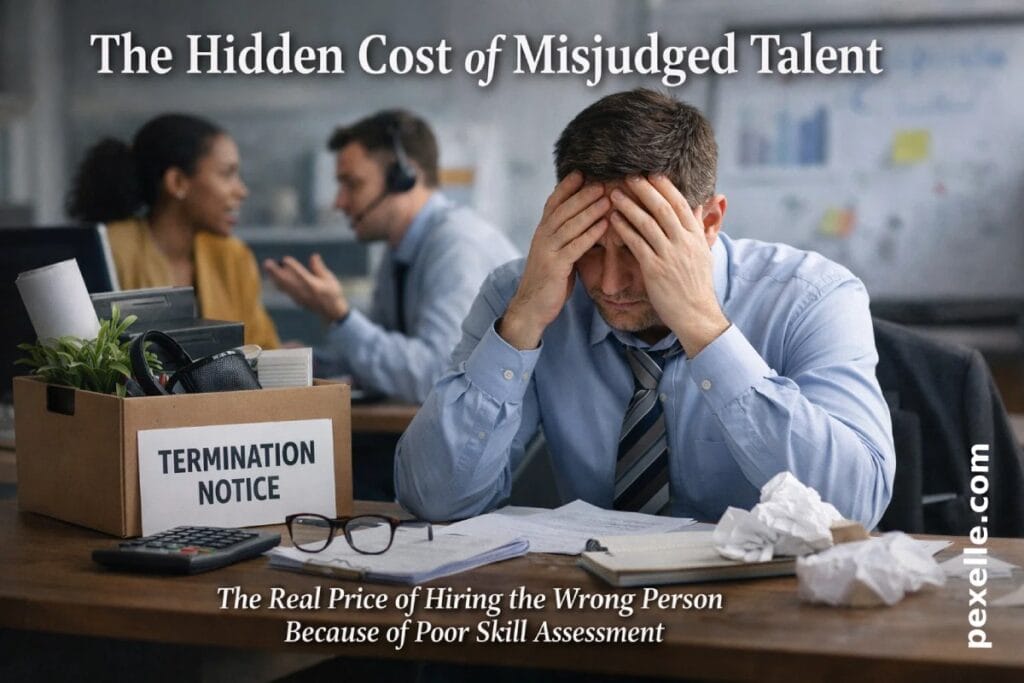
The Real Price of Hiring the Wrong Person Because of Poor Skill Assessment
From Financial, Team, and Product Perspectives
In modern companies, especially startups and fast-moving digital businesses, talent is often described as the most valuable asset. Yet many organizations still make one of their most expensive decisions using weak evaluation methods. Resumes are scanned too quickly, interviews focus too much on confidence and communication style, and hiring managers often mistake polished self-presentation for real capability. When this happens, companies do not simply make a bad hiring choice. They create a chain of damage that spreads across budgets, teams, timelines, customer trust, and product quality.
The problem becomes even more serious when companies believe the cost of a bad hire is limited to salary. Salary is only the visible part. The hidden cost is much larger. It includes onboarding time, management attention, delayed execution, broken collaboration, technical debt, missed product opportunities, team frustration, and the replacement process that comes later. A single misjudged hire can quietly drain momentum from an entire organization while leaders are still wondering why progress feels slower than expected.
At the center of this problem is poor skill assessment. Many hiring processes still rely on signals that are weak predictors of actual performance. A candidate may speak confidently, describe impressive projects, or present an attractive online profile, yet still lack the practical depth needed for the role. In other cases, companies test the wrong things. They assess memorization instead of judgment, presentation instead of execution, or isolated tasks instead of real-world work conditions. The result is a mismatch between the talent the company thinks it hired and the talent it actually brought in.
From a financial perspective, the damage begins almost immediately. Recruitment itself is already costly. Job postings, recruiter time, interview coordination, technical assessments, management involvement, and administrative setup all consume money before the person even starts. Once the hire is made, onboarding adds another layer of cost. Team members spend hours transferring knowledge, documenting workflows, answering questions, reviewing work, and helping the new hire integrate. If the employee turns out to be the wrong fit, all of that investment produces little or no return.
Then comes the cost of underperformance. A poor hire rarely fails in a dramatic way on day one. More often, the problem appears as low-quality output, slow decision-making, repeated mistakes, or dependence on others for basic execution. Because the person remains in the role, the company continues paying salary while also paying an invisible tax through lost productivity. Managers spend extra time supervising. Senior staff spend more time correcting. Deadlines begin to move. The organization pays twice: once for the person who was hired, and again for the people required to compensate for the gap.
The financial loss grows even larger when the wrong hire occupies a critical role. In engineering, one underqualified developer can create fragile architecture, poor code quality, and maintenance burdens that cost far more to fix later than they would have cost to prevent. In product management, a weak hire can misread priorities, delay decisions, and push teams toward low-impact work. In sales or customer-facing roles, a bad hire can damage relationships that took years to build. In leadership roles, the cost multiplies because poor judgment spreads downward into many other decisions.
But the hidden cost is not only financial. It is deeply human. From a team perspective, a misjudged hire changes how people work together. Strong teams depend on trust, consistency, and confidence in each other’s competence. When one person cannot deliver at the level expected, the rest of the team notices quickly. High performers start carrying more than their share. Collaboration becomes uneven. Meetings become longer because someone is not fully prepared. Reviews become heavier because work needs extra correction. Over time, reliable employees begin to feel that they are paying the price for someone else’s limitations.
This creates emotional and cultural damage that many leaders underestimate. Team members do not lose motivation only because of hard work. They lose motivation when they feel that performance standards are unclear or unfair. If weak execution is tolerated for too long, strong contributors begin asking silent questions. Why am I doing more than others? Why is poor work accepted? Why are obvious capability gaps ignored? Once those questions appear, trust in leadership starts to weaken. The company no longer has only a hiring problem. It now has a credibility problem.
Poor hiring decisions can also distort communication patterns inside teams. When a role is filled by someone with less ability than expected, teammates often adapt in unhealthy ways. Some reduce collaboration because they do not want delays. Some avoid depending on that person at all. Some become overly controlling to reduce risk. Others stop sharing ideas because they no longer believe execution will be strong enough to support them. The team may still look functional from the outside, but underneath, it becomes fragmented, defensive, and less creative.
In product organizations, the long-term damage can be even more severe. Products are shaped by countless small decisions. Every assumption, prioritization choice, technical implementation, design tradeoff, and customer interpretation affects the final outcome. When the wrong person is placed in a role that influences product direction or product execution, errors do not stay isolated. They accumulate. Features may be built incorrectly. Important customer signals may be misunderstood. Quality assurance may become reactive instead of preventive. Technical shortcuts may be taken without understanding their future cost. All of this slows down the product while increasing the cost of future improvement.
One of the most dangerous effects of poor skill assessment is false confidence. When a company believes it hired the right person, it plans based on that assumption. Roadmaps are created, deadlines are committed, responsibilities are assigned, and dependencies are built around expected performance. If that expectation is wrong, the company does not just lose output. It makes business decisions on a false foundation. Leaders may think the strategy is failing when the real issue is that the role was not filled with the capability level required. This causes confusion at the management level and can lead to even worse decisions, including unnecessary restructuring, overhiring, or misguided blame.
Startups are especially vulnerable to this problem because every hire carries more weight. In a large company, one weak hire may be absorbed more easily by the system. In a startup, one wrong person can affect product speed, investor confidence, customer delivery, and internal morale all at once. Startups usually operate with limited cash, limited time, and limited room for error. They need people who can execute with clarity, adapt quickly, and solve real problems under imperfect conditions. If hiring is based mainly on impressive talking, brand-name experience, or shallow testing, the business can lose precious momentum that may never fully return.
There is also a reputational cost that companies often notice too late. Poorly assessed hires can influence external outputs that customers, investors, partners, and users see directly. A weak engineer may contribute to unstable releases. A weak support lead may create poor customer experiences. A weak marketer may communicate the product badly. A weak hiring manager may bring in more weak hires, creating a cycle of decline. Over time, the market does not see the internal hiring mistake. It only sees a company that looks inconsistent, slow, or less trustworthy.
Another hidden issue is opportunity cost. When the wrong person fills a position, the company does not just suffer from what that person does poorly. It also loses what the right person could have created in the same time. The missed value is often greater than the visible loss. The right engineer might have simplified infrastructure, improved performance, and enabled faster releases. The right product manager might have identified a more valuable direction. The right operator might have prevented chaos before it spread. Poor hiring steals not only money but also possibility.
Why do companies keep making this mistake? One reason is that traditional hiring systems are still too dependent on proxies. Degrees, years of experience, famous company names, polished CVs, and confident interviews are useful signals, but they are not proof of skill. Another reason is speed pressure. Many teams need to hire quickly and convince themselves that partial evidence is enough. There is also a human bias problem. Interviewers often favor people who sound like them, think like them, or present themselves well under social pressure, even when the job itself requires something very different from interview charisma.
This is why companies need to move from assumption-based hiring to evidence-based hiring. Real skill assessment should not ask only, “Does this person seem impressive?” It should ask, “What proof do we have that this person can perform under the actual conditions of this role?” That means using better work samples, realistic simulations, scenario-based problem solving, collaborative exercises, portfolio verification, reference validation focused on execution, and structured interview methods tied to actual job outcomes. The goal is not to make hiring more complicated for the sake of formality. The goal is to reduce uncertainty where mistakes are expensive.
A better hiring system also understands that skill is multidimensional. Capability is not just technical knowledge. It includes judgment, consistency, learning speed, communication, ownership, context awareness, and the ability to operate in real teams. A candidate may be excellent in isolation and weak in collaboration. Another may know the theory but fail in ambiguity. Another may have strong output but poor reliability. Strong assessment does not look for perfect people. It looks for evidence that the candidate’s strengths match the real demands of the role.
Companies should also audit their hiring outcomes, not just their hiring process. It is not enough to ask whether interviews felt professional. Leaders need to ask whether their assessments actually predicted performance. Which interview stages correlated with success after six months? Which signals turned out to be misleading? Which hires succeeded despite mediocre interview impressions? Which hires looked strong during interviews but underperformed in real work? Without feedback loops like these, hiring remains a ritual rather than a learning system.
The most effective organizations treat hiring as a risk management function, not just an HR task. They understand that every hiring decision is a product decision, a culture decision, and a capital allocation decision. A poor hire can slow product development, distort team dynamics, and waste limited resources. A strong hire can unlock velocity, improve standards, and create compounding value. The difference between these two outcomes often comes down to how seriously the company takes skill evaluation before the offer is made.
In the coming years, companies that continue relying on self-description and surface-level signals will pay an increasingly high price. Work is becoming more complex, faster, and more interconnected. The margin for misjudging talent is shrinking. Businesses that win will be the ones that build hiring systems based on evidence, context, and demonstrable ability. They will understand that talent is not something to be guessed from appearance. It is something to be verified through proof.
The hidden cost of misjudged talent is real because the consequences rarely stay hidden forever. They eventually appear in financial reports, missed deadlines, exhausted teams, unstable products, and lost market trust. By the time those symptoms are visible, the original hiring error has already become much more expensive than it seemed at the start. That is why better skill assessment is not a minor improvement. It is a strategic necessity.
In the end, hiring is not simply about filling seats. It is about protecting the future of the company. Every role shapes execution. Every execution shapes product quality. Every product outcome shapes trust. And trust, once damaged by repeated poor decisions, is far harder to rebuild than a hiring pipeline. The companies that understand this will stop treating skill assessment as a formality and start treating it as one of the most important systems in the business.
Source : Medium.com