
The Difference Between Real Contribution and Professional Theater
1. The New Problem of Modern Work
In modern workplaces, not all visible activity creates real value. Some people produce measurable outcomes, solve hard problems, improve systems, and move projects forward. Others appear constantly busy, speak confidently in meetings, generate noise across communication channels, and create the impression of productivity without producing meaningful results.
2. What Observable Work Means
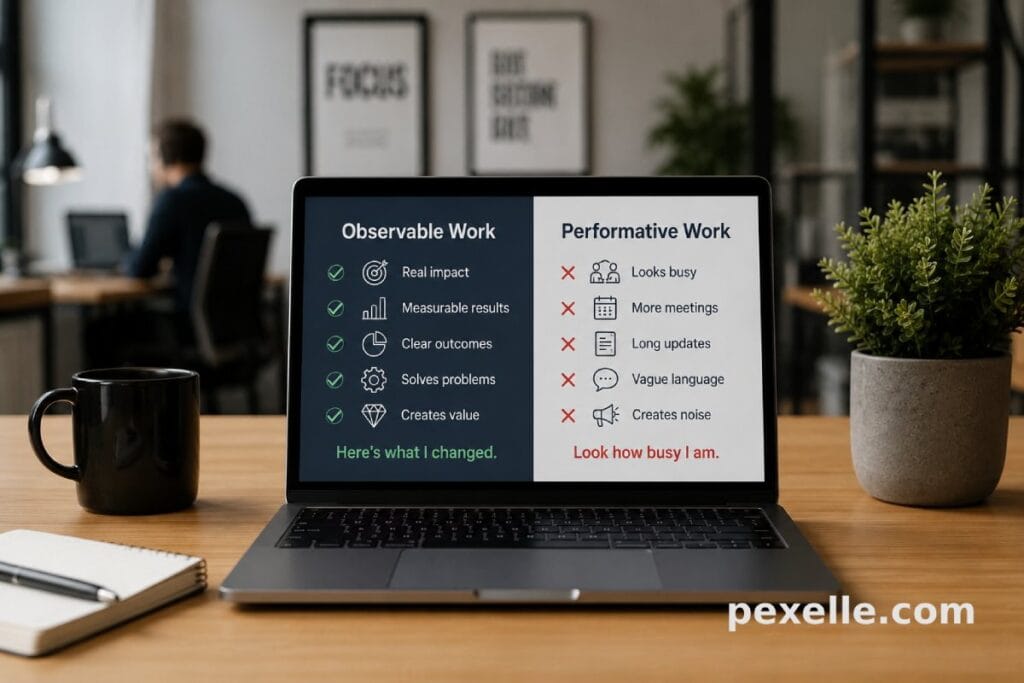
Observable work is work that can be seen through evidence. It leaves a trace: a shipped feature, a resolved customer issue, a tested process, a documented decision, a closed task, a useful design, a validated experiment, or a measurable improvement. The work does not need constant explanation because the evidence shows its value.
3. What Performative Work Means
Performative work is the performance of professionalism. It is the appearance of effort without enough substance behind it. It often appears through excessive meetings, long status updates, vague strategic language, unnecessary complexity, constant self-promotion, and activity that looks impressive but does not clearly improve the business.
4. Communication Is Not the Enemy
This does not mean communication is bad. Strong communication is essential for alignment, trust, and coordination. The problem begins when communication replaces execution. A team can talk about priorities every day and still fail to deliver meaningful progress.
5. Why Remote Work Made This More Important
The rise of remote work, digital tools, and AI has made this distinction more important. In distributed teams, managers cannot always observe effort directly. As a result, many organizations overvalue visible signals such as fast replies, frequent messages, meeting participation, and polished updates.
6. The Core Question of Real Contribution
Observable work connects effort to evidence. It asks simple but powerful questions: What changed because of this work? What problem was solved? What decision was made? What risk was reduced? What customer pain was removed? What system became better?
7. When Visibility Replaces Value
Performative work often grows in environments where outcomes are unclear. When teams do not define success clearly, people protect themselves by looking busy. Visibility becomes a substitute for value, and professional performance becomes a survival strategy.
8. The Role of Poor Leadership
This problem becomes worse when leadership rewards confidence more than evidence. If the loudest voices get more recognition than the most useful contributors, the culture slowly shifts toward performance. People learn that appearing valuable is safer than doing difficult, quiet, meaningful work.
9. Making Real Work Naturally Observable
A healthy organization should not force people to prove their worth through constant noise. Instead, it should create systems where real work becomes naturally observable. This means connecting communication, tasks, decisions, documents, code, customer feedback, and business outcomes into a clear operational picture.
10. Observable Work in Software Teams
In software teams, real work can be observed through shipped releases, code quality, review cycles, incident resolution, test coverage, technical debt reduction, and customer impact. The best engineers are not always the loudest in meetings, but their work improves the product, the system, and the team’s ability to move faster.
11. Observable Work in Marketing and Operations
In marketing, real contribution can be observed through campaign performance, audience growth, conversion quality, content durability, and brand trust. In operations, it can be seen through faster processes, fewer errors, clearer workflows, reduced costs, and better customer experience.
12. The Cultural Risk of Performative Work
The danger of performative work is that it can become culturally contagious. When people see that appearance is rewarded more than substance, they adapt. Meetings increase, updates become longer, reports become more polished, and language becomes more strategic while actual progress slows down.
13. Why Observable Work Builds Trust
Observable work builds trust because it reduces ambiguity. Leaders do not need to rely only on charisma, self-reporting, or personal impressions. Teams can evaluate contribution based on evidence, which creates a fairer environment for both visible and quieter contributors.
14. Evidence Is Not Surveillance
Observable work should not become surveillance. The goal is not to monitor every action or turn people into metrics. The goal is to make meaningful contribution visible in a fair, contextual, and respectful way. Good evidence should help teams understand progress, not punish people for not performing busyness.
15. The Future of Evidence-Based Contribution
The future of work will increasingly depend on evidence-based contribution. As AI automates more routine tasks, the value of human work will be judged less by time spent and more by judgment, creativity, problem-solving, ownership, and impact.
16. The Professional of the Future
The strongest professionals will not be the ones who perform productivity the best. They will be the ones whose work creates visible, verifiable, and meaningful impact. Performative work says, “Look how busy I am.” Observable work says, “Here is what changed because I contributed.”
Source : Medium.com