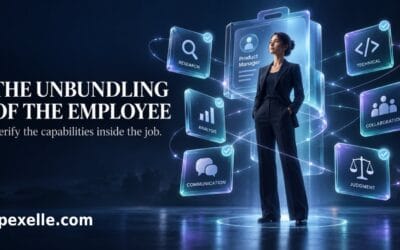

The labor market in 2025 is no longer shaped by traditional degrees, long-form resumes, or generic job descriptions. Organizations are now shifting their hiring focus from broad skill labels to what actually matters: the ability to perform specific tasks, under real conditions, with measurable outcomes. This shift marks the rise of the Micro-Skills Economy, where value is defined not by what someone claims to know, but by what they can demonstrate they can do.
1. From Skills to Micro-Skills
For decades, the term “skill” has been treated as a broad category. Someone could say they “know Python,” “have leadership skills,” or “are good at communication,” without providing real clarity on what that means in practice. A micro-skill breaks this down into precise, observable, and executable components.
- “Python” becomes: building REST APIs, writing asynchronous jobs, or optimizing database queries.
- “Leadership” becomes: running one-on-ones, facilitating feedback loops, or planning execution sprints.
- “Communication” becomes: structuring concise reports, conducting stakeholder briefings, or simplifying technical information.
Hiring decisions are moving to this granular level because organizations want predictability, not guesswork.
2. Task Readiness Over Theoretical Knowledge
In traditional hiring, candidates are evaluated by:
- Years of experience
- University degrees
- Certifications
- Job titles
In the Micro-Skills Economy, the key evaluation metric is Task Readiness:
Can this person complete this task, in this environment, under the expected conditions, without supervision?
This shift is happening because modern work cycles are fast. Teams need contributors who can perform immediately, not after months of onboarding and retraining.
3. Why Resumes Are Losing Relevance
Resumes compress years of professional life into bullet points and job titles, which tell very little about real competence. Two candidates may have the same role title, but completely different capabilities. Companies have realized this, and they are abandoning resume-first hiring in favor of evidence-based skill verification.
This is where Proof-of-Skill replaces self-reported skill.
Examples of Proof-of-Skill include:
- Git contributions
- Real project artifacts
- Work samples
- Test-based task evaluations
- Peer or client validation
- Blockchain-based verifiable credentials
The more direct and verifiable the proof, the higher its value.
4. How This Change Impacts Talent and Education
Universities and corporate training programs are losing influence because they certify exposure to knowledge, not execution ability. Learners no longer ask:
“Where should I study?”
They now ask:
“What tasks must I be able to execute to get hired?”
As a result:
- Learning is becoming modular.
- Training programs are moving toward project-based assessment.
- Individuals build stackable micro-skill portfolios, not degrees.
5. The Emerging Role of Platforms Like Pexelle
Most systems still lack infrastructure for verifying skill provenance and maintaining a continuously updated skill identity. This is where Pexelle aligns directly with 2025 labor dynamics:
| Problem in Market | What Pexelle Enables |
|---|---|
| Skills are claimed, not proven | Skills are verified through evidence and tasks |
| Credentials can be forged or inflated | Credential provenance is anchored and traceable |
| Resumes are static | Skill identity evolves dynamically as new achievements are recorded |
| Employers cannot benchmark capability | Micro-skill frameworks map to task readiness |
Pexelle’s model shifts the individual from “I claim I know” to “Here is the proof that I can.”
6. The Future of Hiring: Resume-Less Talent Markets
In the coming years, hiring will increasingly resemble competitive marketplaces where:
- Individuals present verifiable proof-of-work portfolios
- Companies filter by task-specific readiness
- Matching systems evaluate competence signals, not keywords
The platforms that define and standardize micro-skills taxonomy will control the talent ecosystem.
Conclusion
The Micro-Skills Economy is not a trend; it is a structural evolution in how work is defined, measured, and rewarded. Organizations want precision, reliability, and clarity. Individuals want fair recognition of real capability, not brand names or degrees.
The future belongs to:
- Verifiable skill identity
- Task-based hiring
- Proof-of-skill ecosystems
Pexelle is positioned directly at the center of this shift.
If you execute the communication right, this is where your platform stops being “just another project” and becomes a category leader.
Source : Medium.com