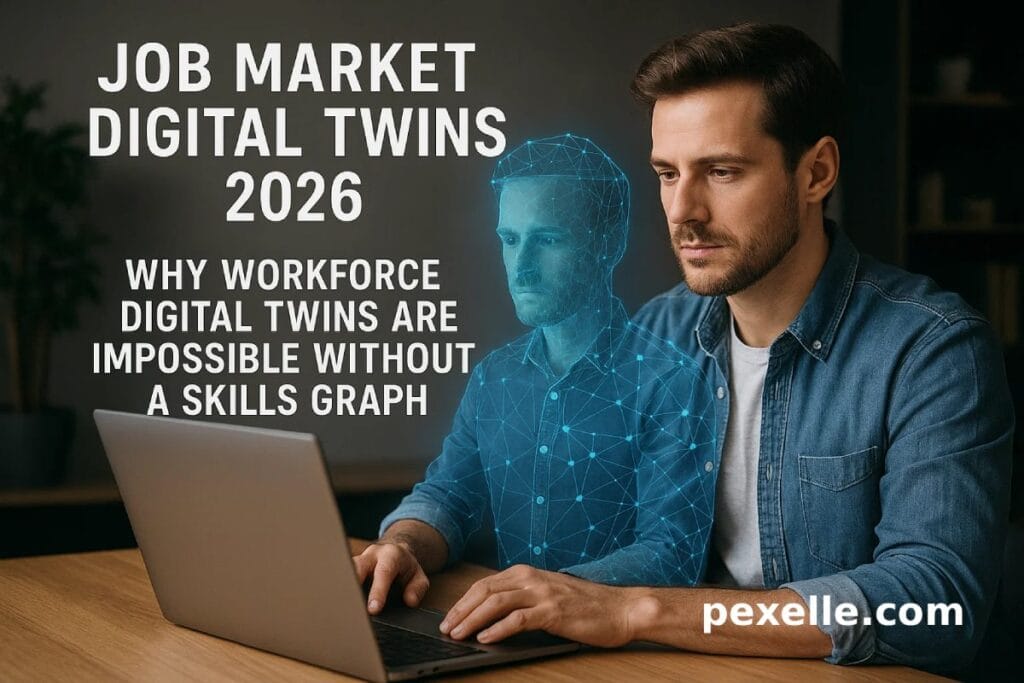
In 2026, companies around the world are building Digital Twins of their workforce a virtual, data-driven replica of their entire talent ecosystem. These Workforce Digital Twins allow organizations to simulate hiring needs, predict skill shortages, model organizational changes, and forecast future workforce capabilities long before they occur in the real world.
But here’s the critical truth:
A Workforce Digital Twin is meaningless without a Skills Graph.
You cannot simulate a workforce if you cannot accurately model skills, dependencies, talent flows, capability gaps, and skill evolution over time.
This article explains what a Workforce Digital Twin really is, why it’s becoming essential in 2026, and why the foundation must be a properly structured Skills Graph something platforms like Pexelle are uniquely positioned to deliver.
1. What Is a Workforce Digital Twin?
A Workforce Digital Twin (WDT) is a dynamic, computational model of an organization’s human capital, representing:
- employee skills
- roles and responsibilities
- experience histories
- learning trajectories
- capability maturity
- team structures
- productivity patterns
- skill decay and skill growth
- mobility pathways
- future skill predictions
It is essentially a living simulation of the company’s current and future talent ecosystem.
With a WDT, companies can:
- simulate hiring plans
- predict talent shortages
- test reorganizations
- model workforce upskilling
- forecast project success or failure
- identify high-impact talent gaps
- prepare for emerging technologies
This is HR’s version of predictive engineering.
2. Why Companies Are Building Workforce Digital Twins in 2026
The shift is driven by three forces:
A) AI-driven business operations
Everything in the enterprise is becoming predictive: supply chains, finance, cybersecurity.
Human capital is the last major blind spot.
B) Skill volatility
Skills expire faster than job titles.
Cloud, AI, security, data, DevOps each evolves monthly.
Without forecasting, companies fall behind.
C) Global talent competition
Remote work has turned hiring into a global battlefield.
Companies need simulations to stay competitive.
Workforce Digital Twins make talent strategy scientific instead of instinctive.
3. The Critical Problem: Most Workforce Digital Twins Are Fake
Here’s the uncomfortable reality:
Most companies trying to build WDTs in 2026 are creating beautiful dashboards with garbage underneath.
Why?
Because they don’t have a Skills Graph.
They model:
- job titles instead of skills
- outdated HR data instead of skill evidence
- simplified org charts instead of capability networks
- résumé claims instead of verified competence
A Digital Twin that doesn’t understand skills is not a twin it’s a spreadsheet with fancy graphics.
4. Why a Workforce Digital Twin Is Impossible Without a Skills Graph
A Skills Graph is a structured, validated representation of:
- skills
- sub-skills
- dependencies
- domain relationships
- proficiency levels
- timelines
- decay rates
- evidence links
- connections between skills, roles and tasks
This is the semantic backbone that gives meaning to workforce simulation.
Without a Skills Graph:
❌ You can’t predict skill shortages
❌ You can’t detect redundant capabilities
❌ You can’t model learning pathways
❌ You can’t simulate job transitions
❌ You can’t measure workforce readiness
❌ You can’t identify skill gaps for future projects
A Digital Twin without a Skills Graph is like a robot without a brain.
5. What a Skills Graph Enables Inside a Workforce Digital Twin
When a Skills Graph is integrated, the company gains superpowers:
A) Skill-Based Workforce Simulation
Predict exactly:
- when a skill will peak
- when it will become obsolete
- how long upskilling takes
- which teams will fail without new skills
- how technology adoption affects staff
B) Project Capability Forecasting
Before starting a project, simulate:
- “Do we have the right skills?”
- “How many experts will we need in 6 months?”
- “Which roles must be hired externally?”
C) Scenario Modeling
Companies can model:
- automation impact
- AI adoption
- mergers and acquisitions
- department restructuring
- workforce expansion or downsizing
D) Internal Talent Mobility
The graph shows:
- who can transition into what role
- which upskilling route is fastest
- who will be ready for leadership in 12–18 months
E) Organizational Risk Management
Skill risk is now a corporate risk category.
The graph identifies:
- single points of failure
- vanishing expertise
- aging skill clusters
- unstable knowledge hubs
In other words:
Prediction replaces guesswork.
6. Pexelle’s Role: The Skills Graph Engine Behind Workforce Digital Twins
Pexelle can become the infrastructure powering real Workforce Digital Twins by providing:
A) The Unified Global Skills Graph
Integrating:
Into a unified, versioned ontology.
B) Verified Skills Data
Not claims verified evidence:
- portfolios
- code commits
- performance tasks
- employment histories
- learning pathways
C) Workforce Graph Modeling Tools
Pexelle can build:
- talent capability maps
- skill contagion models
- team capability networks
- organizational maturity scoring
D) Prediction & Simulation Engine
AI models simulate:
- skill demand
- skill decay
- organizational restructuring
- market-driven skill shifts
E) Talent Mobility Engine
Graph-based recommendations:
- role transitions
- personalized upskilling paths
- workforce reskilling strategy
This makes Pexelle not just a validation platform
but the computational brain behind Enterprise Workforce Digital Twins.
7. Without Verification, Digital Twins Become Delusions
If skills are:
- unverified
- fabricated
- outdated
- exaggerated
- AI-generated
then the Digital Twin becomes a digital hallucination.
Companies will make catastrophic decisions based on false inputs.
Verified skills are the difference between:
Digital Twin
vs.
Digital Fantasy
8. The Future: Workforce Digital Twins Become Standard by 2030
By the end of the decade:
- Enterprises will maintain Digital Twins of their entire workforce
- Governments may build Digital Twins of national labor markets
- Job platforms will adapt to Skills Graph representations
- AI hiring systems will rely on simulation models
- Workforce planning will become algorithmic
- Skills not degrees will be the global currency
And the platforms that control skills verification and graph modeling will define the global talent economy.
Pexelle has the potential to be that platform.
Conclusion
Workforce Digital Twins will be one of the most powerful tools in the future of organizational strategy. But they require verified, structured, graph-based skills data to be meaningful.
Without a Skills Graph, a Digital Twin is just a visualization of assumptions.
With a Skills Graph, it becomes a predictive engine for talent, capability, and organizational success.
Pexelle can become the backbone of this new workforce infrastructure
the layer that turns workforce simulation from fantasy into reality.
Source : Medium.com