
For more than a decade, hiring was sold a lie: automation would make it fair.
Algorithms would remove bias. AI would find the best talent. Data would replace gut feeling.
Instead, hiring didn’t become fairer.
It became opaque, fragile, and fundamentally untrustworthy.
Today, candidates don’t trust employers.
Employers don’t trust resumes.
Recruiters don’t trust AI.
And AI doesn’t understand humans.
This isn’t a tooling problem.
It’s a trust architecture failure.
1. The Original Sin: Automating a Broken System
Hiring was already flawed before AI arrived.
- CVs were inflated
- Job titles were meaningless
- Keywords mattered more than capability
- Interviews rewarded confidence over competence
AI didn’t fix this. It scaled it.
Applicant Tracking Systems (ATS) didn’t evaluate people they filtered text.
Machine learning models didn’t measure skill they learned historical bias.
Ranking systems optimized for similarity, not truth.
The result?
A system that looks scientific but behaves like superstition.
2. AI Hiring Models Don’t “Judge Skill” They Infer It
Here’s the uncomfortable reality:
AI does not see skill.
It infers probability from weak signals.
Those signals include:
- Past job titles
- Brand-name companies
- Writing style
- Keyword density
- Career continuity
None of these prove capability.
They prove pattern compliance.
So when companies say “AI helped us hire better,” what they actually mean is:
“AI helped us hire people who look like our past hires.”
That’s not intelligence.
That’s automated conservatism.
3. The Trust Collapse Nobody Talks About
Three trust failures now coexist:
❌ Employers don’t trust candidates
Because resumes are optimized, ghostwritten, or AI-generated.
❌ Candidates don’t trust employers
Because hiring feels arbitrary, silent, and dehumanized.
❌ Everyone distrusts AI
Because no one can explain why a decision was made.
This is the quiet crisis:
Hiring decisions now lack legitimacy.
And legitimacy is more important than accuracy.
4. The Resume Is Dead But Nobody Replaced It Properly
Everyone agrees the CV is broken.
Almost no one agrees on what replaces it.
Portfolios? Too fragmented.
GitHub? Only for engineers.
Certificates? Easily gamed.
Assessments? Expensive and narrow.
So we kept the CV.
Then asked AI to “understand” it.
That’s like asking a microscope to fix a lie.
5. Why More AI Will Make This Worse (If Nothing Changes)
The next wave is already here:
- AI-written resumes
- AI-generated cover letters
- AI interview prep
- AI interview bots
- AI candidate screening
Soon, AI will talk to AI, and humans will just wait.
This creates a paradox:
The smarter hiring AI becomes, the less human trust survives.
Efficiency rises.
Confidence collapses.
6. What Actually Comes Next: From Credentials to Verifiable Skill
The future of hiring is not:
- More automation
- Better prompts
- Smarter ranking
It’s verifiability.
The hiring system must answer one brutal question:
“How do we know this person can do the work?”
Not claims.
Not signals.
Not history.
Proof.
7. Skill as a Verifiable Economic Unit
The next hiring layer is built on three pillars:
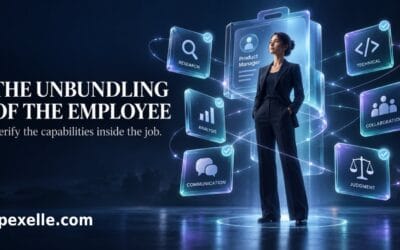
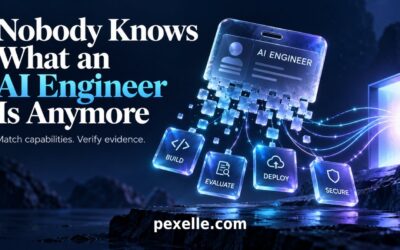
1️⃣ Atomic skills
Not job titles. Not roles.
Concrete, testable, observable abilities.
2️⃣ Evidence-backed proof
Each skill must be supported by:
- Real work
- Measurable output
- Time-bounded activity
3️⃣ Independent verification
Not self-reported.
Not recruiter-assumed.
Not AI-guessed.
Trust must be earned, not inferred.
8. Why This Is Bigger Than Hiring
Once skills become verifiable:
- Resumes become optional
- Degrees lose monopoly power
- Career gaps stop being suspicious
- Global talent becomes comparable
Hiring stops being subjective negotiation
and becomes capability matching.
This isn’t just HR evolution.
It’s labor market infrastructure.
9. The Role of AI After Trust Is Restored
AI is not the villain.
It was misused.
In the next system, AI doesn’t decide.
It assists.
- Maps skills to opportunities
- Detects gaps honestly
- Recommends growth paths
- Explains decisions transparently
AI becomes an auditor, not a judge.
10. The Hard Truth Companies Must Accept
If your hiring process:
- Can’t explain decisions
- Can’t prove fairness
- Can’t show evidence
- Can’t earn candidate trust
Then your “AI-powered hiring” is just automation theater.
And talent will leave or never apply.
11. The New Hiring Contract
The future contract looks like this:
- Candidates prove skill, not pedigree
- Companies justify decisions, not hide behind tools
- AI operates on evidence, not assumptions
- Trust is structural, not emotional
Anything less will collapse under scale.
Final Thought: Trust Is the Real Product
Hiring was never about resumes.
It was about belief.
AI didn’t fix hiring because hiring isn’t a prediction problem.
It’s a trust problem.
And trust cannot be guessed.
It must be built deliberately, transparently, and verifiably.
The next era of hiring won’t be louder.
It will be provable.
Source : Medium.com