
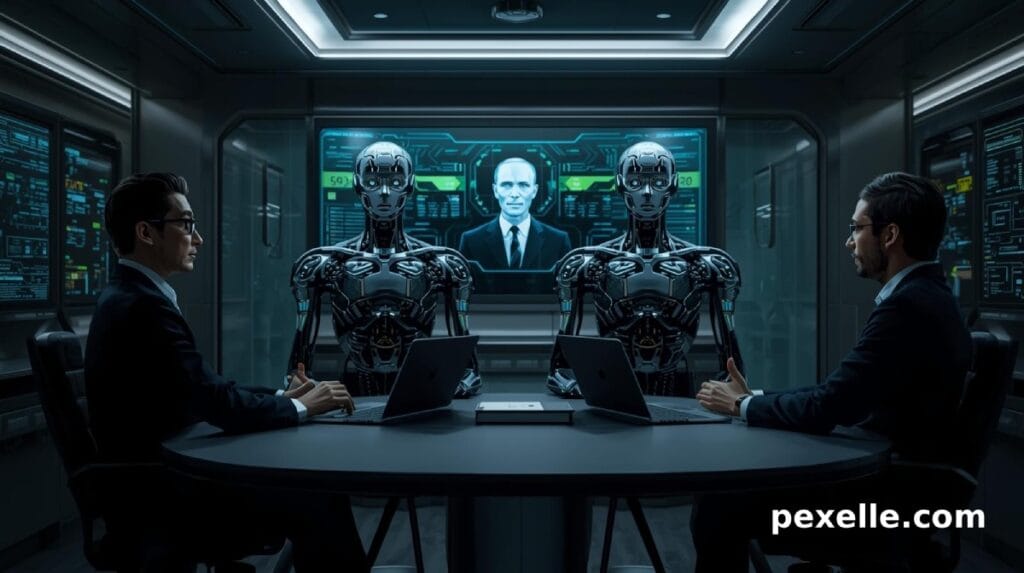
1. The Crisis Is Not About Jobs It’s About Comparison
The term talent crisis is misleading. What we are witnessing is not a shortage of skilled humans, but the arrival of non-human candidates that outperform them under the same evaluation criteria.
For decades, humans were compared only against other humans. That comparison has ended. Today, AI systems write better documentation, debug faster, analyze larger datasets, and operate without fatigue, ego, or delay. Once performance becomes measurable, sentiment becomes irrelevant.
This is the first time in economic history where the benchmark itself is synthetic.
2. Why AI Candidates Win (Under Current Rules)
AI does not win because it is “smarter.” It wins because modern work has been optimized for machine-compatible outputs.
AI candidates:
- Never forget prior knowledge
- Scale instantly across domains
- Learn continuously without retraining costs
- Operate without context switching penalties
- Produce consistent, auditable outputs
Human candidates:
- Require onboarding
- Carry cognitive limits
- Degrade under stress
- Learn slowly relative to system iteration cycles
If hiring is based on output volume, accuracy, speed, and cost, AI wins by default.
That is not bias. That is math.
3. Recruitment Systems Are Accidentally Pro-AI
Most hiring pipelines were not designed to select humans they were designed to filter risk.
Automated screening, skills tests, coding challenges, take-home tasks, and KPI-driven evaluations unintentionally favor entities that:
- Perform deterministically
- Have no emotional variance
- Can retry infinitely
- Optimize for the test, not the role
AI does exactly that.
When you optimize for measurable performance, you silently disqualify human traits that are hard to quantify but essential.
4. The Hidden Collapse of “Potential”
Humans historically competed on potential, not raw output.
Potential assumes:
- Growth over time
- Contextual judgment
- Long-term adaptability
AI breaks this assumption.
An AI model ships fully trained. There is no “junior” phase. No ramp-up. No mentorship. The moment it is deployed, it operates at peak capacity.
As a result, potential becomes economically invisible.
5. The Psychological Displacement of Human Talent
This crisis is not only economic. It is psychological.
When humans are outperformed by systems that:
- Do not care
- Do not aspire
- Do not struggle
The traditional narratives of effort, merit, and career progression fracture.
The result is:
- Impostor syndrome at scale
- Loss of professional identity
- Resistance disguised as ethics
- Nostalgia masquerading as regulation
None of these stop the trend.
6. Why “AI as a Tool” Is an Incomplete Model
The phrase “AI is just a tool” is no longer accurate.
A tool does not:
- Compete for the same tasks
- Replace decision-making loops
- Self-improve across domains
AI systems increasingly function as autonomous contributors, not extensions of human labor.
Pretending otherwise delays adaptation it does not prevent disruption.
7. The New Hiring Question Is Brutal
The real hiring question is no longer:
“Is this person qualified?”
It is:
“What can this human do that a synthetic candidate cannot and can we prove it?”
If the answer is vague, emotional, or philosophical, the role will be automated.
8. Where Humans Still Win (For Now)
Humans retain advantage only in domains where:
- Context is unstable
- Goals are ambiguous
- Values conflict
- Trust must be socially constructed
- Responsibility cannot be offloaded
These are not entry-level roles.
They are high-accountability, high-judgment positions.
Ironically, the middle layer of knowledge work is the most exposed.
9. The Emergence of Synthetic Peers
The future is not AI replacing humans.
It is AI becoming a peer.
Teams will consist of:
- Human contributors
- Synthetic contributors
- Hybrid decision loops
Status will no longer be tied to role, but to unique contribution density.
Those who cannot articulate or demonstrate their uniqueness will be replaced silently.
10. The Hard Conclusion
This is not a temporary disruption.
It is not a cycle.
It is not a bubble.
It is a structural redefinition of talent.
The Synthetic Talent Crisis does not end when humans “catch up.”
It ends when we stop pretending that performance alone defines value or accept that it does.
Both paths have consequences.
Avoiding the choice is not one of them.
Final Reality Check
If your value can be benchmarked, optimized, and reproduced it will be.
The future belongs not to humans or machines,
but to those who understand the difference early enough to act.
Source : Medium.com