
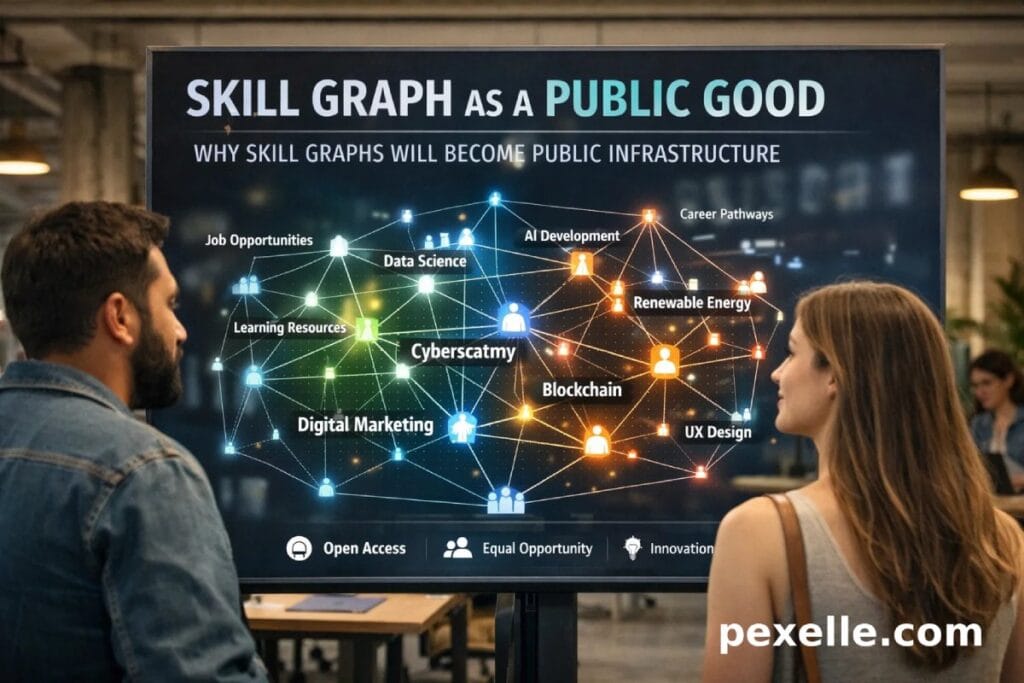
1. The Hidden Failure of the Global Labor Market
The global labor market does not fail because of a lack of talent.
It fails because skills are invisible, fragmented, and unverifiable.
Degrees are blunt instruments. CVs are self-reported narratives. Job titles are ambiguous proxies. Platforms like LinkedIn optimize for signaling, not truth. As a result, trillions of dollars are lost annually to mis-hiring, underemployment, credential inflation, and wasted retraining.
This is not a platform problem.
It is an infrastructure problem.
Just as modern economies required public roads, standardized currencies, and identity systems, the digital labor economy now requires a shared, neutral, machine-readable representation of skills. That representation is the Skill Graph.
2. What a Skill Graph Actually Is (and Is Not)
A Skill Graph is not a list of skills.
It is not a taxonomy spreadsheet.
It is not a résumé parser.
A true Skill Graph is a living knowledge network where:
- Skills are nodes
- Relationships encode dependency, transferability, and progression
- Evidence anchors skills to real, observable actions
- Context (industry, tools, environment) is preserved
- Time and decay are explicit
In a Skill Graph, “Python” without context is meaningless.
“Python for ETL pipelines using Airflow in production for 18 months” is a verifiable capability.
This graph is designed for machines first, humans second. Humans read narratives. Machines need structure.
3. Why Skill Graphs Cannot Remain Private Platforms
Here is the uncomfortable truth:
Any private company that fully controls a Skill Graph becomes a gatekeeper of human opportunity.
That is unacceptable at a civilizational level.
We already learned this lesson with:
- Identity systems
- Financial rails
- Internet protocols
- GPS and maps
When foundational infrastructure is privatized:
- Access becomes paywalled
- Standards fragment
- Bias becomes embedded
- Innovation slows
- Power centralizes
If one platform owns the definition of “what skills matter,” it effectively controls hiring, migration, education, and economic mobility.
That is why Skill Graphs must evolve as public goods, not proprietary assets.
4. Skill Graphs Meet the Definition of a Public Good
Economically and structurally, Skill Graphs fit the criteria:
Non-rivalrous
One person using the graph does not reduce its availability to others.
High positive externalities
Every improvement benefits employers, educators, governments, and workers simultaneously.
Systemic risk if fragmented
Multiple incompatible skill graphs recreate the same silos we already suffer from.
Network effects demand neutrality
The value of the graph increases with universal adoption, not platform lock-in.
Like maps, standards, and protocols, Skill Graphs become more valuable the more boring, stable, and shared they are.
5. Why Governments Will Eventually Care (Even If They Don’t Yet)
Governments already struggle with:
- Skills shortages
- Migration mismatches
- Youth unemployment
- Reskilling programs with no measurable ROI
- Fraudulent credentials
Without a Skill Graph, governments operate blind.
They fund education without feedback loops.
They design visas based on job titles instead of capabilities.
They guess future workforce needs using outdated classifications.
A public Skill Graph enables:
- Evidence-based workforce planning
- Real-time labor market signals
- Skills-based immigration systems
- Transparent public reskilling outcomes
Once governments realize this, Skill Graphs move from “innovation” to infrastructure necessity.
6. Education Loses Its Monopoly on Credentialing
This part makes institutions uncomfortable.
When skills are graph-based and evidence-anchored:
- Learning becomes modular
- Credentials become granular
- Informal learning becomes visible
- Time-served loses importance
Universities will not disappear, but their monopoly over signaling competence will.
A Skill Graph does not ask where you learned.
It asks what you can do, how well, and under what conditions.
That is a profound shift and an inevitable one.
7. Why AI Makes Skill Graphs Non-Optional
Without Skill Graphs, AI systems:
- Hallucinate capability matches
- Reinforce biased hiring patterns
- Optimize for keywords, not competence
With Skill Graphs, AI can:
- Reason over transferable skills
- Generate explainable career pathways
- Match talent across industries and borders
- Simulate workforce futures
AI without structured skill data is noise.
AI with a Skill Graph becomes a labor intelligence system.
8. The Governance Problem (and the Only Viable Answer)
A public Skill Graph cannot be:
- Fully state-controlled (too slow, too political)
- Fully corporate-controlled (too biased, too extractive)
- Fully anarchic (no trust, no standards)
The only viable model is multi-stakeholder governance, similar to:
- Internet standards bodies
- Open financial protocols
- Global data commons
Core layers must be:
- Open
- Auditable
- Extensible
- Jurisdiction-agnostic
Value creation happens on top, not at the core.
9. Where Companies Like Pexelle Actually Fit
Here’s the hard truth many startups avoid saying:
The real opportunity is not owning the Skill Graph.
The real opportunity is building on it.
Examples:
- Skill verification engines
- Evidence capture tooling
- AI career reasoning layers
- Privacy-preserving skill wallets
- Employer-specific inference models
Pexelle-class systems succeed by respecting the public core while delivering private value at the edges.
That’s how you scale without becoming the villain.
10. The Inevitable Outcome
Whether built intentionally or by crisis, the Skill Graph will emerge as public infrastructure.
Because:
- Labor markets are too inefficient
- Education is too disconnected
- AI demands structured truth
- Mobility requires trust without intermediaries
The only open question is who helps shape it early and who is forced to adapt later.
Skill Graphs are not a feature.
They are the missing layer of the digital economy.
And like all true infrastructure, once they exist, it will be impossible to imagine how we ever functioned without them.
Source : Medium.com