
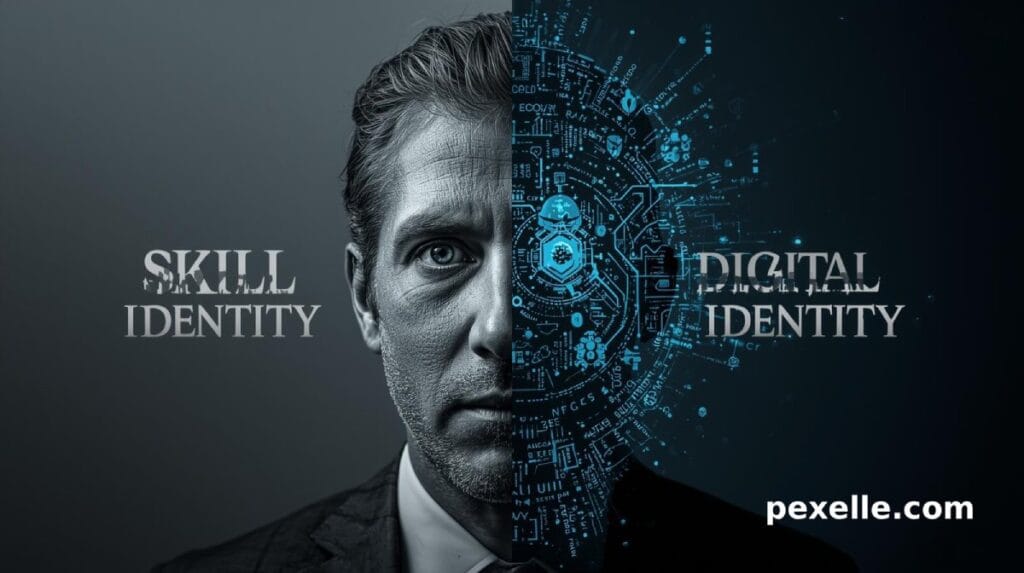
1. The Identity Illusion
Digital identity was supposed to solve trust on the internet. It didn’t.
Emails, usernames, OAuth logins, wallets, government IDs these only answer who you claim to be, not what you can actually do. Digital identity is static, binary, and shallow. It proves presence, not capability.
In a global, AI-mediated labor market, this is a fatal limitation. Work is no longer assigned based on titles or credentials it’s assigned based on demonstrable competence. Digital identity stops exactly where real value begins.
2. What Skill Identity Actually Is
Skill identity is not a résumé.
It is not a LinkedIn profile.
It is not a PDF certificate.
Skill identity is a living, verifiable graph of what you can do, backed by evidence, assessment, and contextual validation. It answers hard questions:
- Can this person perform this task at this level under these constraints?
- Has this skill been demonstrated, not claimed?
- Is the evidence current, portable, and independently verifiable?
Skill identity is dynamic, granular, and outcome-oriented. It evolves as skills decay, improve, or branch. Digital identity never does.
3. Why Digital Identity Fails at Scale
Digital identity systems fail for three structural reasons:
- They are ownership-based
Platforms own your identity. Lose the account, lose the proof. - They are claim-based
Titles, degrees, endorsements none prove execution. - They are context-blind
A “software engineer” label means nothing without scope, depth, and constraints.
At global scale, these flaws compound. Hiring becomes noisy. Matching becomes probabilistic. Bias fills the gaps left by missing signal.
4. Skill Identity Is a Signal System, Not a Label
A skill identity system behaves more like a signal network than a profile:
- Skills are nodes
- Evidence artifacts are edges
- Assessors, peers, and real-world outcomes reinforce or weaken trust
This creates skill-resolution, not just identity resolution. Two people may share the same digital identity attributes, but their skill graphs will never be identical and that’s the point.
5. Evidence Is the Core Primitive
Without evidence, skill identity collapses into marketing.
Real skill identity requires:
- Work samples
- Task outputs
- Versioned artifacts
- Peer or expert assessment
- Temporal validity (skills expire)
Evidence must be:
- Attachable to specific skills
- Auditable by third parties
- Portable across platforms
Anything else is just reputation theater.
6. Why Skill Identity Beats Credentials
Credentials are proxies. Skill identity is direct measurement.
| Credentials | Skill Identity |
|---|---|
| Static | Continuously updated |
| Institution-owned | User-owned |
| Title-based | Task-based |
| Hard to verify | Cryptographically verifiable |
| Easy to fake | Expensive to fake |
In fast-moving domains, credentials decay faster than skills. Skill identity adapts. Credentials don’t.
7. AI Changes Everything (and Exposes the Weakness)
AI doesn’t care about your name, nationality, or diploma.
It cares about capability fit.
As AI systems increasingly:
- Match talent to tasks
- Generate personalized learning paths
- Evaluate outputs automatically
They need machine-readable skill identity, not human-readable profiles. Digital identity is useless here. Skill identity is native.
8. Skill Identity as Economic Infrastructure
Once skills become verifiable primitives, new systems emerge:
- Skill-based hiring without résumés
- Outcome-priced work markets
- Learning paths derived from verified gaps
- Financial instruments tied to skill growth
- Global mobility without credential lock-in
This is not social media. This is infrastructure.
9. Ownership Is Non-Negotiable
If a platform owns your skill identity, you don’t have one you’re renting it.
True skill identity must be:
- User-owned
- Platform-agnostic
- Permissionless to verify
- Resistant to censorship and lock-in
Otherwise, it repeats the exact failure mode of digital identity just with better marketing.
10. The Hard Truth
Digital identity helps platforms manage users.
Skill identity helps humans prove value.
One optimizes access.
The other optimizes opportunity.
In a world where work is global, AI-assisted, and outcome-driven, identity without skill is noise. Skill identity is the signal the future is already demanding.
The question is no longer if skill identity replaces digital identity as the primary trust layer
but who builds it correctly, and who gets trapped maintaining the old illusion.
Source : Medium.com