
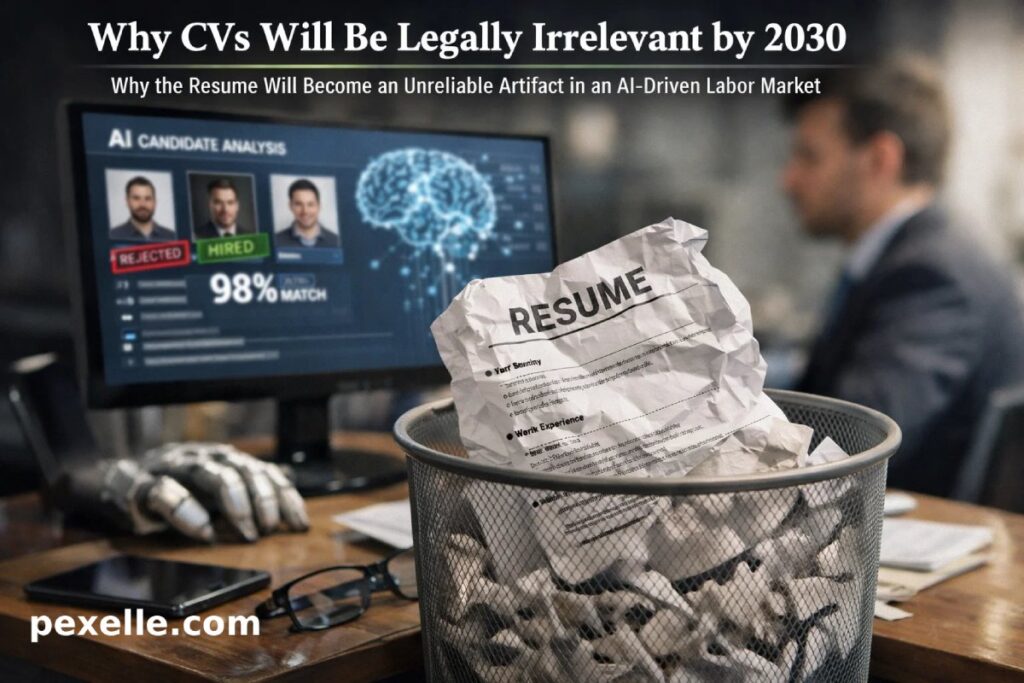
Why the Resume Will Become an Unreliable Artifact in an AI-Driven Labor Market
1. The CV Was Never a Trustworthy Document AI Just Exposed It
Let’s be blunt: the CV has always been a weak signal. It is self-reported, selectively curated, unverifiable at scale, and optimized for storytelling not truth. For decades, labor markets tolerated this because verification was expensive and slow. Human recruiters compensated with interviews, references, and intuition.
AI changes that equation completely. When hiring systems operate at global scale, probabilistic reasoning replaces intuition. Any artifact that cannot be verified, normalized, and audited becomes noise. CVs are noise. AI doesn’t “read between the lines”; it demands structured evidence. By 2030, relying on CVs will be legally risky not just inefficient.
2. AI Hiring Systems Don’t Evaluate Narratives They Evaluate Signals
Modern AI hiring systems don’t ask “Who are you?” They ask “What can be proven?”
They optimize for:
- Demonstrable skill execution
- Behavioral consistency over time
- Outcome-based evidence
- Peer or system-level verification
A CV fails on all four. It compresses years of complex behavior into static text, detached from context and causality. AI models trained on performance data, code repositories, project artifacts, learning logs, and verifiable credentials will treat CVs the same way modern finance treats handwritten balance sheets: historically interesting, operationally useless.
3. Legal Liability Is the CV’s Real Death Sentence
The real collapse of the CV won’t be technological it will be legal.
By 2030, hiring decisions will increasingly be audited under:
- Anti-discrimination laws
- Algorithmic transparency regulations
- Explainability and fairness requirements
- Data provenance standards
A CV provides no audit trail.
If an employer cannot prove why a candidate was selected using objective, traceable, and reproducible signals the decision becomes legally vulnerable. CVs cannot support explainable AI pipelines. Evidence graphs can.
When courts ask, “On what verifiable basis did this system decide?”, a CV is not an answer. It’s a liability.
4. Skill Claims Without Proof Will Be Treated as Misinformation
Today, exaggeration on a CV is tolerated. Tomorrow, it won’t be.
In an AI-mediated labor market:
- Skills are expected to be measured, not claimed
- Experience must be time-stamped and contextualized
- Competence must be continuously updated, not frozen
Unverified skill claims will be treated like unverified financial disclosures: misleading at best, fraudulent at worst. Regulatory pressure will push platforms and employers to reject unverifiable self-assertions entirely.
The CV, as a document of claims without cryptographic or evidentiary backing, does not survive this shift.
5. The Rise of Skill Graphs and Evidence-Based Identity
What replaces the CV is not a better resume it’s a different paradigm.
By 2030, hiring will rely on:
- Skill graphs that model capabilities as nodes with evidence edges
- Verifiable credentials issued by institutions, systems, or communities
- Continuous learning and performance trails
- Decentralized attestations rather than centralized endorsements
In this model, identity is not who you say you are, but what you have demonstrably done. The unit of trust shifts from documents to data structures.
6. Why Recruiters Will Abandon CVs Even Before the Law Forces Them
Recruiters don’t love CVs they tolerate them. CV screening is:
- Time-consuming
- Biased by language and formatting
- Poorly predictive of performance
- Increasingly incompatible with automation
AI-native hiring systems will outperform CV-based processes on speed, accuracy, and retention outcomes. Once that performance gap is visible, sticking to CVs becomes professionally negligent.
The market doesn’t wait for regulation when efficiency gains are obvious.
7. The CV as a Transitional Artifact (2025–2030)
Between now and 2030, CVs won’t disappear overnight. They will become:
- Optional supplements
- Human-readable summaries of machine-verified profiles
- Legacy artifacts for non-AI-mature sectors
But they will no longer be authoritative. The moment a CV conflicts with verifiable evidence, the evidence wins every time.
8. The Hard Truth Most Professionals Don’t Want to Hear
If your employability depends on how well you describe your skills rather than how well you can prove them, you are exposed.
The future labor market rewards:
- Traceability over rhetoric
- Evidence over storytelling
- Verifiable growth over static credentials
CVs fail not because AI is hostile to humans but because AI is hostile to unverifiable claims.
9. Conclusion: The CV Won’t Be Reformed It Will Be Bypassed
By 2030, CVs won’t be “banned.” They’ll be irrelevant.
Not rejected but ignored.
In an AI-driven labor market governed by data integrity, legal accountability, and performance-based trust, the resume is an anachronism. The question is no longer “How do I write a better CV?”
The real question is:
What evidence of my skills exists, who can verify it, and can a machine trust it?
If you don’t have an answer, the market will answer for you.
Source : Medium.com