By 2026, the job market is facing a crisis no one was prepared for:
AI-powered résumé fabrication has exploded.
With a few prompts, anyone can generate a flawless employment history, complete with responsibilities, achievements, KPIs, and references none of which ever existed.
Recruiters can’t detect it.
Employers can’t verify it.
And hiring systems built on keyword matching are being completely exploited.
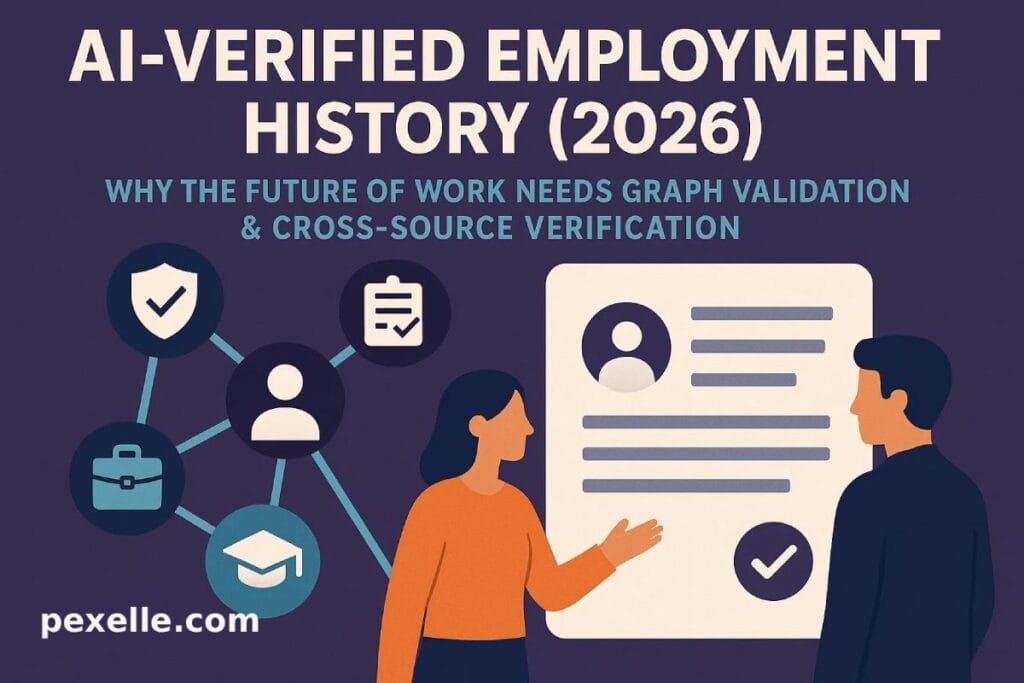
This is why AI-verified employment history backed by graph validation and cross-source verification—has become the central trust challenge of the new hiring ecosystem.
1. The Explosion of AI-Enhanced Employment Fraud
AI has lowered the barrier of entry for fraud to zero. Today:
- LLMs generate perfect job descriptions for imaginary roles
- Fake employment dates are aligned with industry norms
- Synthetic references and HR emails are created
- Fake LinkedIn work history is boosted by AI-written achievements
- Job applicants create portfolios that appear technically sound but contain AI-fabricated content
- Interview AI tools generate real-time responses simulating experienced professionals
The result?
Employment history is no longer a reliable source of truth.
In 2026, employers face a new problem:
They cannot distinguish between real experience and AI-constructed illusions.
2. Why Traditional Verification Fails
Human methods calls, emails, manual checks don’t scale.
HR teams rarely verify employment, and when they do:
- companies may have shut down
- HR inboxes are automated
- databases are incomplete
- privacy laws restrict sharing information
- international verification is almost impossible
The old model simply cannot survive AI-assisted fabrication.
We need a new layer of trust.
3. AI-Verified Employment History: A New Infrastructure Layer
AI-Verified Employment History means that every employment claim is checked not manually, but algorithmically through data triangulation, graph analysis, and multi-source confirmation.
This is not a résumé.
It’s a verifiable employment graph.
A trustworthy employment record must include:
- job role
- company identity
- dates
- responsibilities
- evidence of work output
- metadata consistency
- cross-source alignment
- peer or supervisor confirmation
If any part fails validation, the record loses trust weight.
This shifts employment history from claims to computable facts.
4. What Is Graph Validation?
Graph Validation means verifying employment history using relational consistency rather than isolated claims.
For example, an employment graph checks:
• Role → Required Skills Consistency
Did the skills required for the job match those claimed by the candidate?
• Dates → Project Timeline Alignment
Do the project timestamps actually match real work cycles?
• Company → Industry Graph Compatibility
Does the company operate in the domain the candidate claims they worked on?
• Social Graph Links
Is the candidate connected to team members from that time?
Do endorsements match the role?
Are there digital traces confirming collaboration?
• Evidence Graph
Is there real proof of work?
Commits, deliverables, emails, assets, logs, design files, performance reviews.
AI detects anomalies that humans miss because fraud leaves structural inconsistency inside graphs.
5. Cross-Source Verification: The Only Scalable Defense
One source can be faked.
Three sources can be manipulated.
But ten unrelated digital sources are nearly impossible to forge.
Cross-Source Verification means checking employment claims against:
- LinkedIn timelines
- GitHub or GitLab commits
- Slack or Microsoft Teams metadata
- Jira / Notion / Trello activity
- Email headers (not content)
- Publication dates
- Certification timestamps
- Social presence anomalies
- Payroll confirmation (where legal)
- Domain ownership and DNS records
- External testimony from colleagues
If multiple independent sources confirm the employment period, the claim becomes trustworthy.
If they contradict each other, the system detects fraud patterns instantly.
6. How Pexelle Can Lead This Revolution
Pexelle has the opportunity to become the global operating system for skill & employment verification.
Three core components enable this:
A) Pexelle Employment Graph Engine
A structured graph connecting:
- roles
- companies
- timelines
- evidence
- collaborators
- skill dependencies
This graph allows AI to detect inconsistencies at scale.
B) Multi-Source Evidence Registry
Candidates upload evidence, but Pexelle also pulls metadata from:
- project repositories
- company verification APIs
- digital collaboration tools
- timestamped artifacts
This creates immutable employment fingerprints.
C) AI-Fraud Detection Layer
Pexelle’s AI checks for:
- empty skill histories
- mismatched timelines
- synthetic text patterns
- unnatural writing style changes
- inconsistent job titles
- missing digital footprint
- unrealistic career jumps
The system can detect anomalies more accurately than human recruiters.
7. Why Companies Will Adopt AI-Verified Employment History
By 2026–2028, companies need:
- protection against hiring fraud
- accurate skill & experience profiles
- reduced hiring risks
- faster talent assessment
- AI systems that rely on verified data, not claims
Recruiters will prefer candidates with verified employment graphs, not unverified résumés.
Governments and regulators may eventually require this level of verification for high-trust positions.
8. Why Candidates Will Adopt It
Trustworthy candidates benefit massively:
- stronger profiles
- higher credibility
- easier mobility between countries
- proof against false negative assumptions
- portable employment identity
- AI-boosted career recommendations based on real experience
Employment becomes portable, verifiable, and future-proof.
9. The Future: Employment as a Verifiable Data Layer
By 2030, employment history will no longer be a simple list on a CV.
It will be:
- machine-verified
- multi-source validated
- cryptographically secured
- graph-modeled
- interoperable across platforms
- impossible to fake
- shareable with employers and AI agents
This will rewrite hiring, upskilling, immigration, workforce planning, and credential systems worldwide.
Conclusion
AI has made résumé fabrication too easy.
The world needs a new standard one that treats employment history as verifiable data, not unverifiable claims.
Graph Validation + Cross-Source Verification is the only scalable solution.
And Pexelle is positioned to build the global trust layer that makes employment history truthful, tamper-resistant, and AI-compatible.
Source : Medium.com