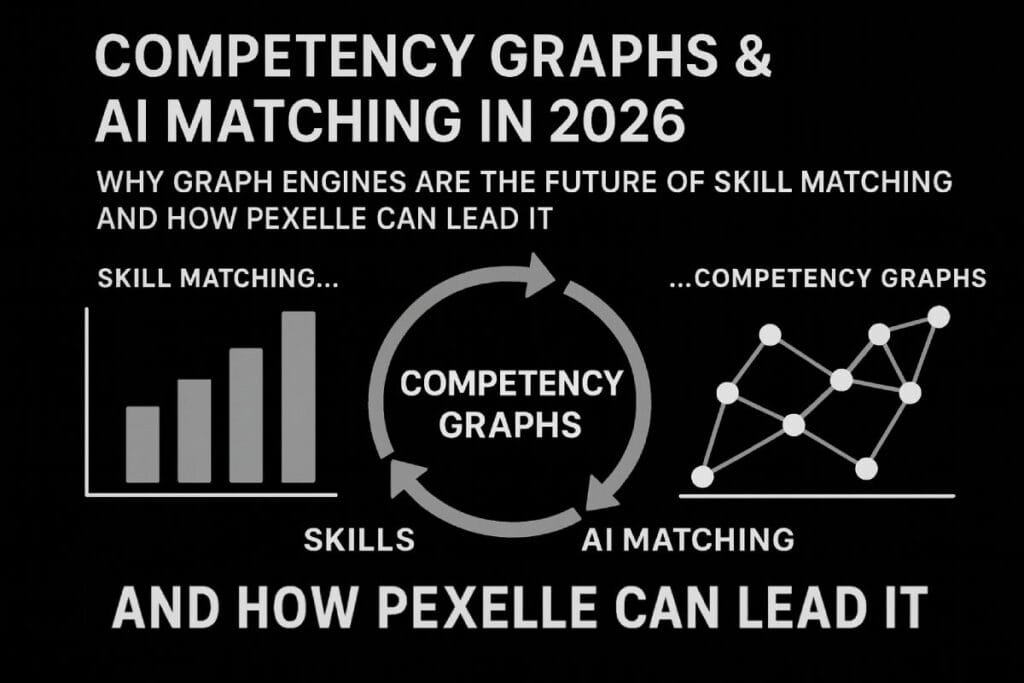
By 2026, AI-based job matching is undergoing a fundamental shift. Traditional matching systems built on keyword extraction, similarity scoring, or vector embeddings are no longer enough. They struggle with nuance, context, learning pathways, experience depth, and multi-dimensional competency structures.
This is why the industry is moving toward Graph-Based Skill Matching:
a model where skills, roles, competencies, experience, learning history, and organizational needs are represented as interconnected nodes rather than isolated data points.
The future of talent matching isn’t semantic.
It’s structural, relational, and graph-driven.
This article explains why Competency Graphs outperform every other matching method and how Pexelle can become the central engine powering this new generation of AI recruitment.
1. The Failure of Traditional AI Matching
Traditional AI models focus on text similarity or vector closeness. They evaluate:
- keyword frequency
- job description overlap
- semantic similarity
- résumé–JD matching
- embedding-based candidate scoring
But these models fail when reality becomes multidimensional.
Why?
A) Skills are relational, not linear
“Python” is meaningless without knowing:
- proficiency
- domain (ML, backend, automation)
- dependencies (Unix, Git, algorithms)
- complementary skills
- project context
Embeddings flatten these relationships.
B) Competency depth is not captured
Someone with 6 months of DevOps cannot be matched the same as someone with 6 years—yet embeddings often treat them similarly.
C) Career transitions follow patterns, not text similarity
A Data Analyst → Machine Learning Engineer is realistic.
A UX Designer → Cloud Security Engineer is not.
Vector systems don’t understand feasibility.
D) Skills decay
Semantic systems don’t model temporal relevance.
E) Context matters more than content
A skill may appear on a CV but never be used in real work.
Graph-based systems solve all these problems.
2. What Is a Competency Graph?
A Competency Graph represents:
- skills
- sub-skills
- competency clusters
- roles
- career pathways
- learning dependencies
- experience depth
- skill recency
- task-to-skill mappings
- evidence connections
Structured as an interconnected network.
This means:
🔗 “React” connects to “JavaScript” → “Frontend Engineering” → “UI/UX”
🔗 “Docker” connects to “DevOps” → “CI/CD” → “Kubernetes”
If a candidate claims React but has zero JS or Git evidence → the graph flags a mismatch.
A competency graph provides semantic meaning AND structural reasoning, something LLMs alone cannot achieve reliably.
3. Why Graph-Based Matching Is the Future (2026 → 2030)
A) Graphs understand dependencies
You can’t know Kubernetes without Linux.
You can’t know TensorFlow without Python.
You can’t be a Senior Engineer without years of validated practice.
Graphs detect impossibilities.
B) Graphs model skill depth
Edges and weights reflect:
- proficiency
- recency
- usage frequency
- evidence strength
- project complexity
This enables precision-level scoring.
C) Graphs evaluate career feasibility
They detect:
- realistic transitions
- probable learning paths
- natural progression
- invalid jumps
This prevents bad AI recommendations and incorrect candidate matches.
D) Graphs encode temporal dynamics
Skills evolve. Graphs track:
- skill volatility
- decay curves
- emerging skills
- obsolescence patterns
LLMs cannot handle this temporal dimension.
E) Graphs outperform embeddings in explainability
A recruiter can see why the system selected a candidate.
With vectors, the reasoning is a black box.
Graph reasoning is transparent.
4. Competency Graph + AI = Perfect Hybrid Matching
The most powerful system in 2026 is:
**LLM (semantic understanding)
Graph Engine (structural intelligence)**
LLMs are great at:
- interpreting job descriptions
- understanding nuance
- generating summaries
- mapping messy text to clean skill definitions
But they cannot enforce consistency, feasibility, or structural validity.
Graphs fix that.
AI Matching becomes reliable only when grounded in graph reasoning.
5. The Role of Pexelle: Becoming the Global Graph Matching Engine
Pexelle is uniquely positioned to lead this transformation.
Here’s how:
A) Unified Global Skills Graph
Integrating:
Into a single standardized ontology.
B) Verified Skills Layer
Matching must be based on:
- real evidence
- performance tasks
- portfolio artifacts
- project logs
- validated employment
- skill recency
This eliminates fraud and fake skill inflation.
C) Competency-Based AI Matching Engine
Matching is no longer CV → JD.
It becomes:
Competency Graph → Job Graph
This lets Pexelle match:
- internal mobility
- upskilling paths
- skill gap projections
- team capability modeling
- hiring priority simulation
D) Personalized Career Path Generation
Graphs allow Pexelle to create:
- realistic, evidence-backed career paths
- graph-consistent transitions
- personalized upskilling journeys
- future skill predictions
Unlike LLM-generated paths, graph-based paths are structurally correct.
E) Workforce Digital Twin Integration
Graph engines allow simulations:
- future demand
- workforce modeling
- risk forecasting
- hiring scenarios
This positions Pexelle at the center of enterprise talent infrastructure.
6. Why LLM-Only Matching Will Fail
LLMs hallucinate.
LLMs cannot enforce graph constraints.
LLMs do not handle skill decay or temporal shifts.
LLMs rely on surface-level semantics, not deep structure.
Without a graph layer, LLM-matching becomes:
- inaccurate
- prone to fraud
- biased
- non-explainable
- inconsistent
Graph engines eliminate these weaknesses.
7. The Future: Graph-Native Hiring Systems
By 2030:
- every major hiring platform will integrate Skills Graphs
- job descriptions will be automatically mapped to graphs
- CVs will be replaced by verified skill identities
- matching will be done by graph agents, not keyword systems
- workforce planning will run on graph simulation
- AI recruiters will require graph validation for every candidate
Pexelle can become the AWS of Skills Graph Infrastructure.
Conclusion
Competency Graphs represent the next evolution in talent intelligence.
They provide the structural backbone required to overcome the limitations of semantic AI.
Without a Graph Engine, AI matching is shallow, inconsistent, and vulnerable to fraud.
With a Graph Engine, AI matching becomes contextual, accurate, explainable, and future-proof.
Pexelle’s opportunity is massive:
to become the world’s leading Skills Graph + AI Matching platform
powering hiring, mobility, upskilling, and workforce simulation for the global talent ecosystem.
Source : Medium.com