Let’s be blunt.
A credential without evidence is no longer a signal of competence it’s a historical artifact. It may have worked in an era of slow change and stable job roles, but that era is dead. Today, skills expire faster than degrees are printed, and trust is no longer granted by institutions it is earned through verifiable proof.
This is not a philosophical shift. It’s an economic one.
1. The Credential Collapse (Reality, Not Opinion)
Degrees, certificates, and titles were designed as proxies for ability. Employers trusted them because verifying real skills was expensive, slow, and manual.
That logic no longer holds.
Three structural failures broke the credential system:
- Time lag
A degree reflects what someone studied, not what they can do now. - Uniformity illusion
Two people with the same credential can have radically different capabilities. - Zero execution proof
Credentials rarely show whether knowledge was applied, retained, or scaled.
The result?
Credential inflation with declining signal value.
2. Why AI Exposed the Lie Completely
AI didn’t create the problem. It revealed it.
When AI can:
- Generate essays
- Pass exams
- Solve textbook problems
…then the credential stops being proof of thinking.
What AI cannot fake at scale is:
- Real-world execution
- Longitudinal performance
- Contextual decision-making
- Applied problem-solving under constraints
In short: evidence.
This is why AI-first hiring pipelines are abandoning credentials and prioritizing:
- Work samples
- Git histories
- Project artifacts
- Measurable outcomes
3. Evidence vs Credential — A Hard Comparison
| Dimension | Credential | Evidence |
|---|---|---|
| Time relevance | Frozen in the past | Continuously updated |
| Verifiability | Trust-based | Proof-based |
| Skill depth | Implied | Demonstrated |
| Fraud resistance | Low | High |
| AI-resilient | ❌ | ✅ |
| Hiring signal strength | Weak | Strong |
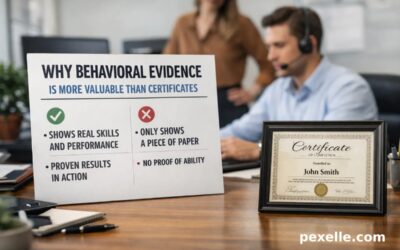
A credential claims.
Evidence shows.
4. What Counts as Real Evidence (Not Fluff)
Not all “proof” is evidence. Screenshots and buzzwords don’t count.
Real evidence has four properties:
- Observable
Someone else can inspect it. - Contextual
It shows why decisions were made, not just the output. - Outcome-linked
It connects actions to results. - Verifiable
It can be validated by a third party or system.
Examples:
- A deployed system with usage metrics
- A research artifact with reproducible results
- A product feature tied to business impact
- A skill demonstrated repeatedly across contexts
If it can’t be audited, it’s not evidence.
5. Why Employers Are Quietly Abandoning Degrees
Publicly, companies still list degree requirements.
Privately, they filter candidates by evidence density.
Modern hiring systems increasingly weight:
- Portfolio depth over CV length
- Skill recurrence over one-time achievements
- Proof of learning velocity over past education
Platforms like LinkedIn still show degrees but recruiters scroll past them fast. What stops them is demonstrated capability.
This is not ideological. It’s statistical.
Evidence predicts performance. Credentials don’t.
6. The Shift from Identity to Capability
The old system asked:
“Who are you?”
The new system asks:
“What can you prove you can do?”
This is a fundamental transition:
- From status to signal
- From identity-based trust to capability-based trust
- From paper credentials to living evidence
In this world, your value is not your background it’s your provable impact.
7. Evidence as Infrastructure (Not a Portfolio PDF)
The next evolution is not better resumes.
It’s evidence infrastructure.
That means:
- Evidence linked to skills
- Skills linked to outcomes
- Outcomes linked to trust systems
- Trust that compounds over time
Think less “CV” and more skill ledger.
This is where decentralized verification, audit trails, and long-term skill provenance matter not as hype, but as economic primitives.
8. The Uncomfortable Truth
If your value depends on a credential alone, you are exposed.
Not because education is useless
but because education without execution is invisible.
The market no longer rewards what you studied.
It rewards what you can prove.
Final Statement (No Soft Ending)
Credentials are dying slowly and politely.
Evidence is replacing them aggressively and silently.
Those who understand this early will compound trust.
Those who resist it will keep collecting paper while losing relevance.
Evidence is not the future of credentials.
Evidence is the end of them.
If you want, next we can:
- Deconstruct fake “portfolio evidence”
- Design a real evidence-based skill system
- Map this shift to hiring, education, or AI labor markets
But don’t mistake this for a trend.
This is a structural reset.
Source : Medium.com