
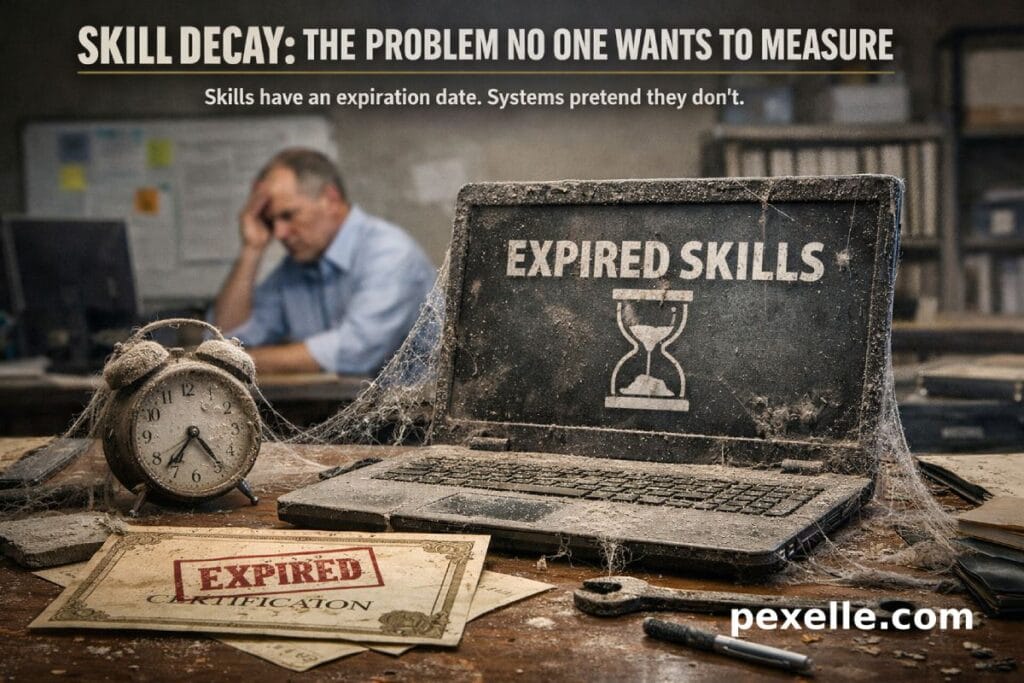
Skills have an expiration date. Systems pretend they don’t.
1. The Silent Failure in Modern Credentialing
We live in an economy obsessed with skills. Job posts list them. Platforms rank them. Certificates promise them.
And yet, one uncomfortable truth sits untouched at the core of all this infrastructure:
Skills decay. Constantly. Predictably. Invisibly.
Most systems behave as if a skill once learned, certified, or endorsed exists forever. A badge earned in 2016 still shines in 2026. A degree completed a decade ago is treated as current proof of competence. A LinkedIn endorsement never expires.
This isn’t just naïve.
It’s structurally dishonest.
2. Skill Decay Is Not a Theory It’s a Law
In every other domain, decay is assumed:
- Muscles atrophy without use
- Languages fade without practice
- Cryptographic keys expire
- Software rots without maintenance
Yet skills arguably more fragile than all of the above are modeled as permanent assets.
This contradiction isn’t accidental. Measuring decay is inconvenient. It breaks legacy assumptions. It exposes uncomfortable gaps between claimed capability and actual readiness.
So the system chooses denial.
3. Why Institutions Avoid Measuring Skill Decay
Let’s be precise: this is not a technical limitation.
It’s a governance choice.
Measuring skill decay would force systems to admit that:
- Credentials are snapshots, not guarantees
- Time without practice reduces trustworthiness
- Employers are hiring on outdated signals
- Education providers oversell permanence
- Platforms profit from static labels
Once decay is acknowledged, everything downstream must change: hiring, pay bands, compliance, regulation, even immigration policies.
So instead, we pretend skills are timeless.
4. The Credential Lie: “Once Skilled, Always Skilled”
A certificate answers one narrow question:
Did this person demonstrate something once, under specific conditions, in the past?
But it is routinely misused to answer a much broader and invalid question:
Can this person do this now?
This gap is where risk lives.
In safety-critical roles (engineering, medicine, security), this risk is catastrophic.
In fast-moving domains (AI, cybersecurity, Web3), it’s existential.
A skill unused for 24 months is not “inactive.”
It is unverified.
5. Endorsements, Likes, and Social Proof Are Worse
Social trust signals don’t just ignore decay they amplify illusion.
- Endorsements never expire
- Likes reward visibility, not validity
- Popularity outlives competence
- Reputation floats free from evidence
A developer endorsed for a framework that no longer exists looks trustworthy in UI—but dangerous in reality.
This is how confidence replaces competence at scale.
6. Skill Half-Life: The Metric No One Wants
Every skill has a half-life the time it takes for its reliability to drop by 50% without reinforcement.
Rough estimates (conservative):
- Frontend frameworks: 12–18 months
- Cybersecurity practices: 6–12 months
- AI/ML tooling: 3–6 months
- Regulatory knowledge: jurisdiction-dependent, but volatile
Yet resumes never ask: “When did you last prove this?”
They ask: “Where did you learn it?”
Wrong question.
7. The Real Cost of Ignoring Decay
Ignoring skill decay doesn’t preserve stability.
It manufactures systemic failure.
- Companies hire confidently and deliver poorly
- Teams overestimate readiness
- Training budgets misallocate
- Incidents are blamed on individuals, not signals
- “Talent shortages” are declared where verification shortages exist
The market isn’t lacking skilled people.
It’s lacking current proof.
8. Evidence Over Time, Not Claims Over History
A post-decay system must flip its core primitive.
Not:
- What do you say you know?
- Who endorsed you?
- What did you earn once?
But:
- What have you done recently?
- Under what constraints?
- With what measurable outcomes?
- How often is this re-validated?
Skills are processes, not possessions.
9. Why “Continuous Learning” Isn’t Enough
The industry response so far has been cosmetic:
“We encourage lifelong learning.”
Learning without verification is just consumption.
Courses completed ≠ capability maintained.
What’s missing is continuous evidence, not continuous content.
A system that tracks:
- usage frequency
- outcome quality
- context relevance
- time since last validation
…does more for trust than a thousand certificates.
10. The Hard Truth
If a system cannot model decay, it cannot model trust.
Static credentials belong to a static economy.
We no longer live in one.
The future does not belong to those with the most badges, titles, or endorsements—but to those whose skills are provably alive.
Anything else is nostalgia disguised as infrastructure.
Final Line (Hard Mode)
A skill that cannot decay in your system is not trusted it’s merely unchallenged.
Source : Medium.com