In 2026, the biggest risk in the job market is no longer unemployment.
It’s skill obsolescence.
Technologies evolve faster than people can retrain.
AI replaces tasks, frameworks expire, and entire roles transform within months.
Yet the economic risk of this change is pushed almost entirely onto individuals.
This imbalance is about to change.
A new concept is emerging at the intersection of AI, workforce analytics, and risk management:
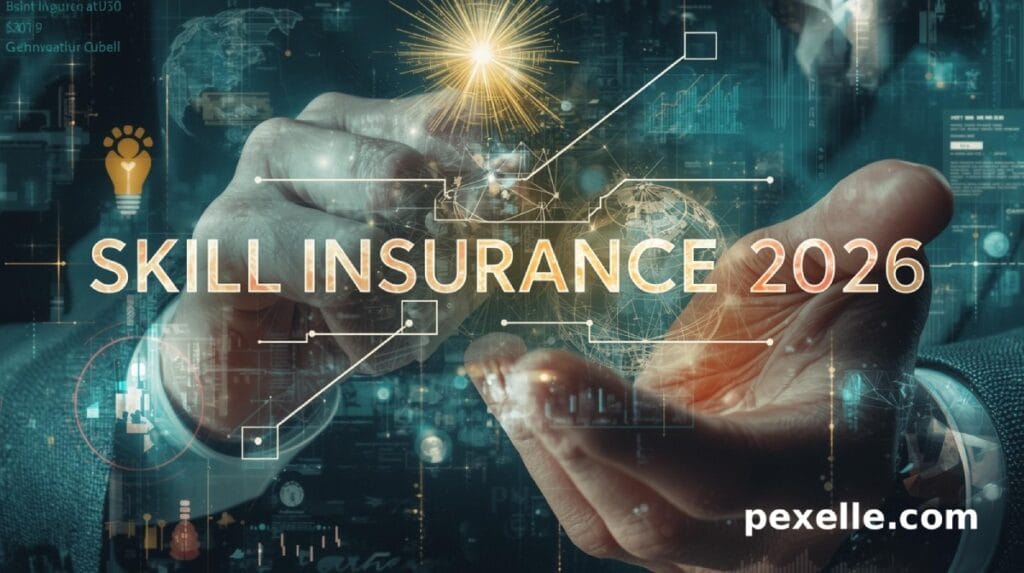
Skill Insurance.
Skill Insurance doesn’t protect jobs.
It protects skills.
And in doing so, it may fundamentally reshape how people learn, work, hire, and invest in talent.
1. The Problem: Skills Are High-Risk Assets
In the modern economy, skills behave like financial assets:
- they require investment (time, money, effort)
- they have volatility
- they can depreciate
- they can become obsolete
- they determine income
But unlike financial assets, skills have no risk protection.
If a technology becomes obsolete:
- the worker absorbs the loss
- employers move on
- governments react too late
In 2026, this model is unsustainable.
2. What Is Skill Insurance?
Skill Insurance is a system that provides economic protection against skill decay or obsolescence.
At a high level, it means:
If you invest in learning a skill that becomes irrelevant or unusable due to market or technological shifts, the system compensates you.
Compensation may include:
- funded reskilling
- tuition reimbursement
- income protection during retraining
- guaranteed transition pathways
- employer-backed skill guarantees
Skill Insurance shifts risk away from individuals and distributes it across employers, platforms, and insurers.
3. Why Skill Insurance Becomes Possible in 2026
Skill Insurance was impossible before. Now it’s inevitable because of data.
Three breakthroughs enable it:
A) Skills Are Now Measurable
With Skill Graphs, Proof-of-Skill, and verified evidence, skills are no longer vague claims.
They have:
- definitions
- dependencies
- depth
- timelines
- recency
- usage patterns
You can’t insure what you can’t measure.
Now we can measure skills.
B) AI Can Predict Skill Risk
AI can model:
- skill volatility
- market demand trends
- technology replacement curves
- automation risk
- decay probability
Some skills are stable.
Others are ticking time bombs.
Skill Insurance prices risk accordingly.
C) Continuous Verification Is Now Possible
With real-time evidence and activity tracking:
- skill usage can be monitored
- decay can be detected early
- retraining can be triggered automatically
Insurance no longer reacts after failure it prevents it.
4. How Skill Insurance Actually Works
A realistic Skill Insurance model has five layers:
1) Skill Definition & Coverage
Each insured skill is:
- clearly defined
- versioned (e.g., Kubernetes v1.29)
- mapped in a Skills Graph
- linked to prerequisites
No vague “I know AI” policies.
2) Proof-of-Skill (Eligibility)
Insurance requires verified possession of the skill:
- evidence-backed
- cryptographically anchored
- time-stamped
You can’t insure a skill you never had.
3) Risk Scoring
AI calculates:
- market demand trajectory
- automation exposure
- replacement likelihood
- dependency fragility
- historical decay patterns
Each skill gets a risk premium, like insurance pricing.
4) Monitoring & Triggers
The system continuously tracks:
- skill usage
- version drift
- market shifts
If risk crosses a threshold:
- retraining is triggered
- compensation activates
- transition pathways unlock
5) Payout / Protection Mechanisms
Instead of cash-only payouts, Skill Insurance often provides:
- paid reskilling programs
- guaranteed learning credits
- employer redeployment
- income support during transition
- fast-track certification for adjacent skills
The goal is capability recovery, not passive compensation.
5. Why Skill Insurance Changes Worker Behavior
When skills are insured:
- people invest in learning earlier
- fear of obsolescence drops
- career experimentation increases
- lifelong learning becomes rational
- workers choose high-growth skills without betting their future
Skill Insurance encourages productive risk-taking.
6. Why Employers Will Support Skill Insurance
At first glance, it sounds expensive.
In reality, it reduces cost.
Employers benefit from:
- lower talent churn
- predictable reskilling pipelines
- reduced hiring risk
- faster internal mobility
- measurable ROI on training
- safer AI-driven workforce planning
Skill Insurance aligns employee growth with employer strategy.
7. Why Governments Will Care
Skill Insurance supports:
- workforce resilience
- automation transition
- reduced unemployment shock
- skills-based immigration
- economic stability
It’s cheaper to insure skills than to fix mass displacement later.
8. The Role of Platforms Like Pexelle
Skill Insurance only works with trustworthy skill data.
Pexelle can become the backbone by providing:
- standardized Skills Graphs
- Proof-of-Skill verification
- skill recency & decay detection
- market-aligned skill risk models
- portable skill identity
- explainable skill health metrics
Without verified skills, Skill Insurance collapses into fraud.
With Pexelle, it becomes viable infrastructure.
9. From Employment Insurance to Skill Insurance
The 20th century insured jobs.
The 21st century must insure capabilities.
Jobs are temporary.
Skills are the real economic unit.
Skill Insurance reflects this reality.
10. The Future: Skills as Insured Assets
By 2030:
- workers will insure key skills
- employers will underwrite strategic capabilities
- insurers will price skill volatility
- AI will forecast reskilling needs
- education will integrate with insurance triggers
- career paths will be dynamically protected
The labor market becomes adaptive, not fragile.
Conclusion
Skill Insurance is not a benefit.
It’s not a perk.
It’s not a slogan.
It’s a structural response to a world where skills change faster than humans can adapt alone.
By turning skills into measurable, verifiable, and insurable assets, Skill Insurance redistributes risk, stabilizes careers, and accelerates learning.
And platforms like Pexelle are uniquely positioned to make it real by providing the trust, verification, and intelligence layer the system depends on.
The future of work won’t promise lifelong jobs.
It will promise lifelong skill protection.
Source : Medium.com