
Introduction
For decades, the resume has been the standard document for presenting professional experience. However, changes in the labor market, digital transformation, and skills based hiring have exposed serious limitations in traditional resumes. Employers increasingly care less about job titles and more about what a person can actually do. In this context, the Skill Portfolio has emerged as a practical and more accurate alternative.
A Skill Portfolio focuses on verified abilities, real outputs, and continuous learning rather than static career summaries. This article explains what a Skill Portfolio is, how it differs from a resume, and why it is rapidly becoming the preferred model for modern hiring.
What Is a Skill Portfolio
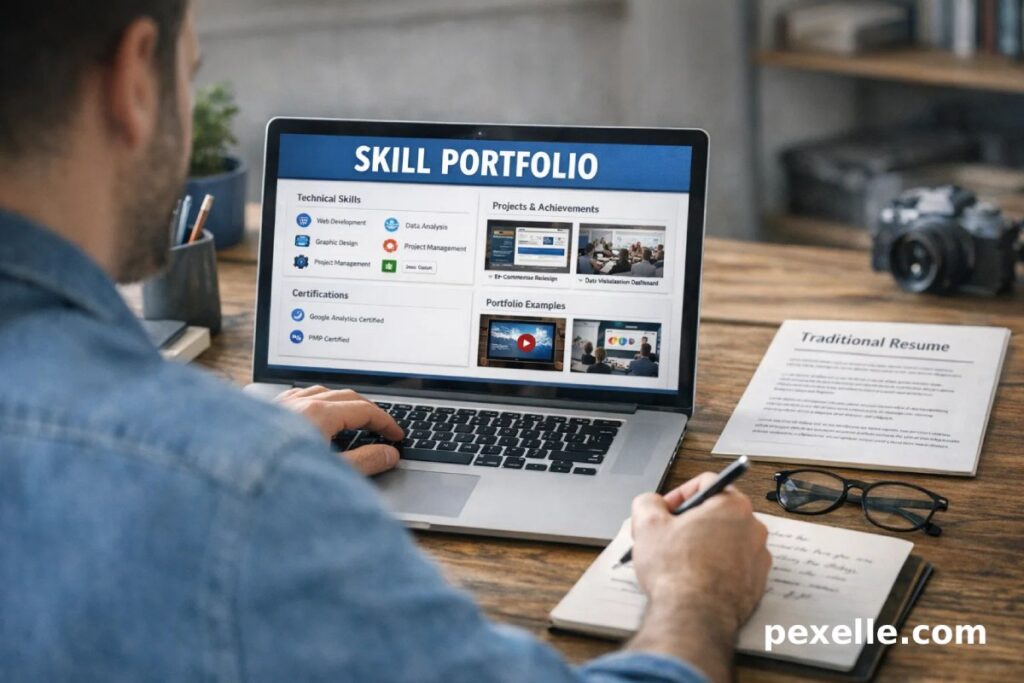
A Skill Portfolio is a structured and evidence driven representation of a person’s skills. Instead of listing roles or years of experience, it documents what the individual knows, what they can perform, and how those skills were acquired and applied.
A typical Skill Portfolio includes
- Clearly defined skills and competency levels
- Evidence such as projects, code samples, reports, designs, or case studies
- Certifications, assessments, or third party validations
- Learning paths and skill progression over time
- Context explaining how each skill was used in real situations
Unlike a resume, a Skill Portfolio is not limited to one or two pages. It can evolve continuously and adapt to different roles or industries.
Why Traditional Resumes Are No Longer Enough
Resumes were designed for a different era, one where career paths were linear and roles were stable. Today, careers are dynamic, interdisciplinary, and often non linear. This creates several problems.
First, resumes are heavily title driven. Two people with the same title may have completely different skill sets, yet the resume format hides this difference.
Second, resumes rely on self reported summaries. Phrases like “experienced in” or “familiar with” provide no measurable proof of competence.
Third, automated screening systems filter resumes based on keywords, not real capability. This excludes qualified candidates and rewards keyword optimization rather than skill depth.
Finally, resumes are static snapshots. They do not show how skills evolve, how fast someone learns, or how recently a skill was used.
How Skill Portfolios Solve These Problems
A Skill Portfolio directly addresses the weaknesses of resumes by shifting focus from history to capability.
Instead of job titles, it highlights concrete skills. Instead of vague descriptions, it provides artifacts and outcomes. Instead of static timelines, it shows continuous learning and improvement.
For employers, this reduces hiring risk. For candidates, it creates a fairer way to demonstrate value, especially for people who are self taught, career switchers, freelancers, or early career professionals.
Key Differences Between a Resume and a Skill Portfolio
| Resume | Skill Portfolio |
|---|---|
| Focuses on job history | Focuses on actual skills |
| Static document | Living and updatable profile |
| Title and degree centered | Competency and evidence centered |
| Limited space | Unlimited depth |
| Hard to verify | Built on proof and validation |
This shift mirrors how work itself has changed. Output matters more than position. Capability matters more than credentials.
Why Employers Are Moving Toward Skill Portfolios
Organizations face increasing pressure to hire faster, more accurately, and more inclusively. Skill Portfolios help in several ways.
They enable skills based hiring, which improves job performance prediction. They reduce bias linked to education pedigree or company prestige. They support internal mobility by mapping skills across teams. They also integrate well with digital talent platforms and AI driven matching systems.
In industries like software development, data science, design, engineering, and even policy analysis, portfolios already outperform resumes as hiring signals.
Benefits for Individuals
Skill Portfolios empower individuals to take control of their professional identity.
They make invisible skills visible, especially soft skills, hybrid skills, and emerging technical abilities. They help professionals reposition themselves when changing industries. They also encourage lifelong learning by making skill growth measurable and meaningful.
For freelancers and independent professionals, a Skill Portfolio functions as both proof of competence and a trust building tool.
Are Resumes Disappearing Completely
Not yet. Resumes are still widely used as entry documents. However, their role is shrinking. Increasingly, resumes act as gateways, while Skill Portfolios carry the real decision making weight.
In the long term, especially as digital credentials and verified skills become standard, Skill Portfolios are likely to become the primary professional record.
Conclusion
The Skill Portfolio represents a fundamental shift in how work and talent are evaluated. It aligns better with modern careers, modern technology, and modern organizational needs.
Resumes describe where you have been. Skill Portfolios show what you can do.
As hiring continues to move toward evidence, adaptability, and real capability, Skill Portfolios are not just an upgrade. They are a replacement whose time has arrived.
Source : Medium.com