
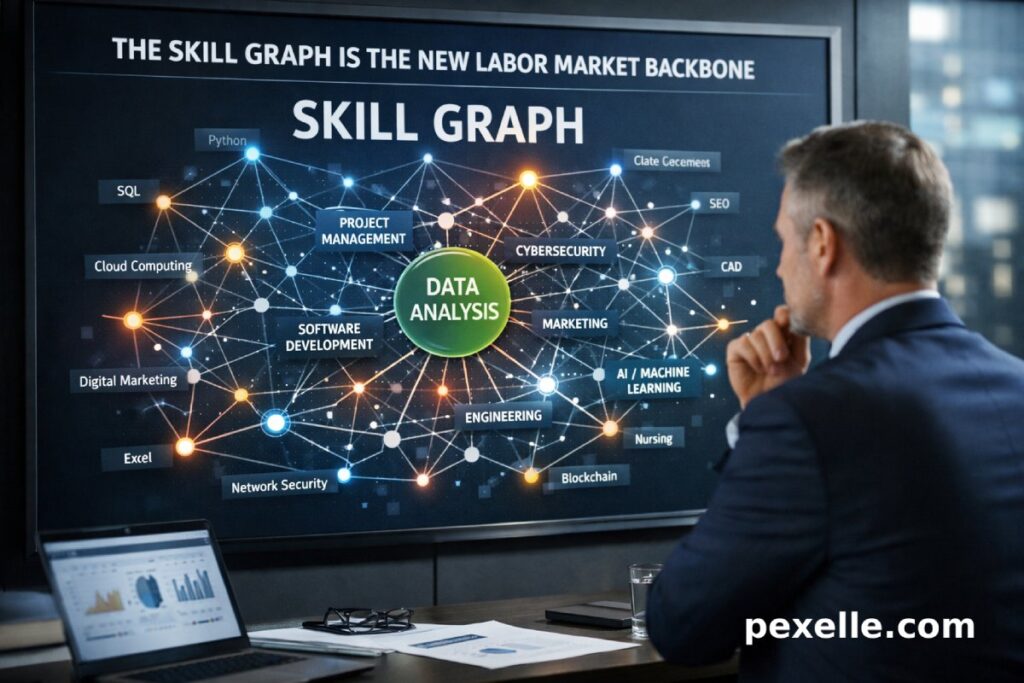
Why the Global Labor Market Collapses Without a Skill Graph
1. The Labor Market Is Already Broken — We Just Pretend It Isn’t
The modern labor market still runs on documents designed for the 20th century. CVs, job titles, degrees, and employer reputation act as proxies for something they cannot accurately represent: actual skills. This worked when jobs were static, careers were linear, and change was slow. That world no longer exists.
Today’s labor market is dynamic, fragmented, and global. Skills evolve faster than institutions can certify them. Roles mutate yearly. AI reshapes job requirements faster than hiring systems can update filters. Yet we still attempt to match humans to work using flat, static representations. The result is predictable: mis-hiring, underemployment, talent waste, and systemic inefficiency.
This is not a temporary mismatch. It is a structural failure.
2. Why Titles, Degrees, and CVs Fail at Scale
Job titles are not standardized. “Software Engineer” can mean radically different things across companies, countries, or even teams. Degrees signal exposure, not competence. CVs are self-reported, unverifiable, and optimized for persuasion rather than truth.
Worse, these artifacts are non-machine-readable in any meaningful way. AI systems trained on noisy proxies amplify bias instead of reducing it. Filtering becomes exclusion. Optimization becomes distortion.
Without a formal structure to describe skills, relationships, dependencies, and evidence, automation breaks the labor market instead of fixing it.
3. Skills Are Not a List — They Are a Network
A skill does not exist in isolation. It depends on prerequisites, context, proficiency levels, tooling familiarity, and applied experience. “Python” alone is meaningless without knowing whether it connects to data analysis, backend systems, ML pipelines, or automation scripts.
This is where the idea of a Skill Graph becomes non-negotiable.
A Skill Graph represents skills as nodes and their relationships as edges:
- prerequisite relationships
- similarity and transferability
- domain context
- proficiency gradients
- evidence and validation links
Once modeled this way, skills become computable, comparable, and portable.
4. Why the Market Cannot Function Without a Skill Graph
A labor market is a matching system. Matching systems fail when the signal-to-noise ratio collapses. Today’s hiring signal is overwhelmingly noise.
Without a Skill Graph:
- Employers cannot reliably assess real capability
- Workers cannot prove skills gained outside formal institutions
- AI systems cannot reason about human capability
- Reskilling becomes guesswork
- Workforce planning becomes statistical fiction
This leads to a paradox: simultaneous talent shortages and mass unemployment. Not because skills are missing but because they are invisible.
5. Centralized Skill Databases Are Not the Solution
Some attempts exist: taxonomies, keyword libraries, proprietary skill ontologies. Platforms like LinkedIn build internal graphs. Governments maintain datasets like O*NET or ESCO.
These are steps forward but structurally insufficient.
Why?
Because ownership matters. When skill graphs are platform-owned:
- Skills become platform assets, not personal capital
- Verification becomes opaque
- Portability disappears
- Lock-in replaces mobility
A backbone cannot belong to a single platform. The internet works because TCP/IP is not owned. GPS works because coordinates are public. Skills must follow the same rule.
6. Skill Graphs as Public Infrastructure
A true Skill Graph must be:
- open and interoperable
- verifiable but privacy-preserving
- evidence-linked, not claim-based
- machine-readable and human-auditable
This does not mean “free-for-all.” It means governed infrastructure, not corporate property.
In this model:
- Individuals own their skill nodes and evidence
- Employers query capability, not profiles
- AI reasons over verified structures, not guesses
- Education systems align with real demand signals
The labor market stops being a guessing game and becomes a capability network.
7. What Happens If We Don’t Build It
This is the uncomfortable part.
Without a Skill Graph:
- AI hiring systems will entrench bias at scale
- Credential inflation will accelerate
- Informal and self-taught talent will remain invisible
- Global mobility will fragment further
- Workforce reskilling initiatives will keep failing
In short: the labor market collapses under its own abstraction debt.
This is not a future risk. It is already happening.
8. The Shift Is Inevitable — The Question Is Who Designs It
Skill Graphs are not a trend. They are a structural necessity created by:
- AI-driven hiring
- remote and global work
- rapid skill decay cycles
- lifelong, non-linear learning paths
The only open question is whether this backbone will be:
- open or closed
- user-owned or platform-owned
- verifiable or gamified
- empowering or extractive
There is no neutral outcome.
9. Conclusion: No Graph, No Market
A labor market without a Skill Graph is like:
- finance without ledgers
- logistics without maps
- networks without routing tables
It cannot scale. It cannot self-correct. It cannot be fair.
The Skill Graph is not an enhancement to the labor market.
It is the backbone it can no longer survive without.
Source : Medium.com