
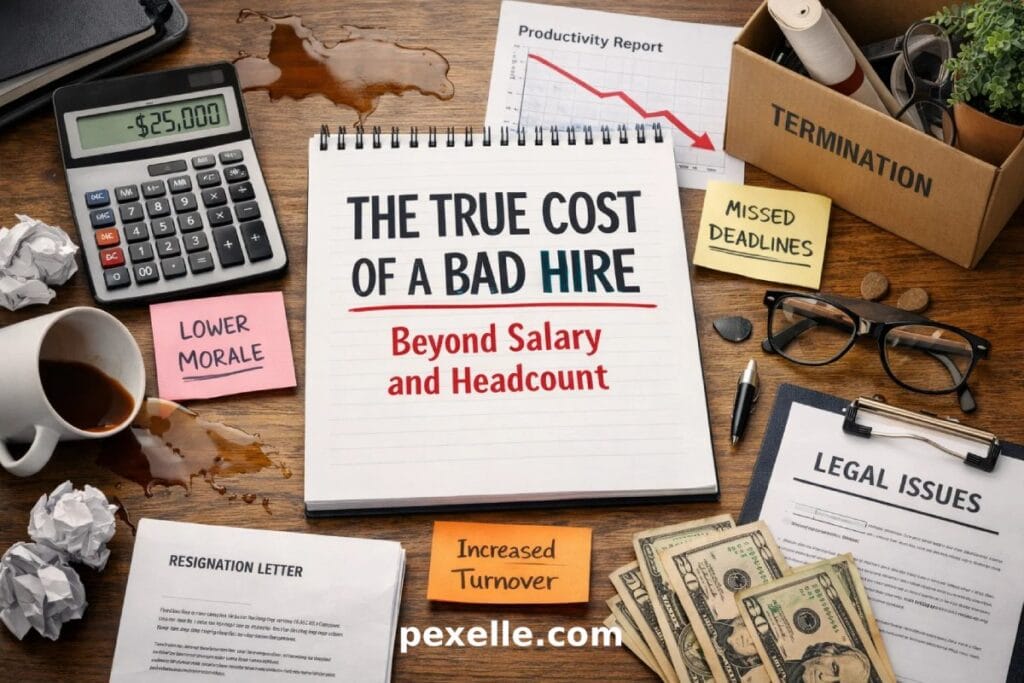
Hiring the wrong person is one of the most underestimated risks in modern organizations. While companies often focus on recruitment speed and cost-per-hire, the real financial and operational damage emerges after a poor hiring decision is made. A bad hire does not just fail to contribute value; it actively consumes resources, disrupts teams, and creates cascading inefficiencies across the organization.
At first glance, the cost of a bad hire may appear limited to salary and recruitment expenses. However, this is only the surface. The deeper impact spans productivity loss, team morale decline, management distraction, reputational damage, and missed business opportunities. In many cases, the total cost of a bad hire can reach 30% to 200% of the employee’s annual salary, depending on the role and level of responsibility.
Direct Financial Costs
The most visible costs are those directly tied to hiring and employment. These include recruitment expenses such as job postings, recruiter fees, interview time, onboarding, training, and salary paid during the employee’s tenure.
For example, if a company hires an employee with an annual salary of $80,000, the direct costs may include:
- Recruitment and hiring process: $5,000 to $20,000
- Onboarding and training: $10,000 to $30,000
- Salary and benefits during underperformance: $40,000+
Even before considering performance impact, the company may already be facing a loss exceeding $70,000 to $100,000.
Productivity Loss and Opportunity Cost
A bad hire rarely operates in isolation. Their underperformance affects the output of the entire team. Tasks take longer, errors increase, and other employees must compensate for gaps.
This leads to two critical forms of loss:
- Internal productivity loss: Colleagues spend time correcting mistakes or covering responsibilities
- Opportunity cost: Strategic initiatives are delayed or missed entirely
For leadership or technical roles, this impact can be severe. A poor engineering hire, for example, may introduce flawed architecture decisions that require months of rework. A weak manager can misalign an entire team, reducing performance across multiple individuals.
Impact on Team Morale and Culture
One of the most dangerous effects of a bad hire is its influence on team dynamics. High-performing employees are particularly sensitive to underperformance and unfair workload distribution.
Over time, this can lead to:
- Frustration and disengagement
- Increased employee turnover
- Loss of trust in leadership decisions
Replacing multiple employees due to one bad hire significantly amplifies the total cost. In extreme cases, a single poor managerial hire can trigger a chain reaction of resignations.
Management Time and Hidden Operational Costs
Managers spend a disproportionate amount of time dealing with underperforming employees. This includes additional supervision, repeated feedback cycles, performance improvement plans, and eventual termination processes.
This time is not free. It represents lost leadership capacity that could have been invested in growth, innovation, or strategic planning.
Hidden costs also include:
- HR involvement in conflict resolution
- Legal risks during termination
- Administrative overhead
These factors are often ignored in financial calculations but can significantly increase the total cost.
Reputational and Customer Impact
In customer-facing roles, a bad hire can directly affect brand perception. Poor communication, low-quality service, or mistakes can damage client relationships.
For example:
- A sales representative may lose key accounts
- A support agent may create negative customer experiences
- A developer may release unstable features affecting users
The long-term cost of lost customers or damaged reputation can far exceed internal financial losses.
Long-Term Strategic Damage
Some of the most severe consequences of a bad hire are not immediately visible. Strategic roles influence direction, priorities, and execution quality.
A poor decision at this level can result in:
- Misaligned product development
- Inefficient resource allocation
- Delayed market entry
These outcomes can cost companies millions in lost competitive advantage, especially in fast-moving industries like technology.
Why Companies Still Make Costly Hiring Mistakes
Despite these risks, bad hires remain common. The reasons are often systemic:
- Over-reliance on resumes instead of validated skills
- Rushed hiring processes under pressure
- Lack of structured evaluation frameworks
- Poor alignment between role requirements and candidate capabilities
In many organizations, hiring is treated as an administrative task rather than a critical strategic function.
Reducing the Risk of a Bad Hire
While it is impossible to eliminate hiring risk entirely, companies can significantly reduce it by improving their approach:
- Implement structured, skills-based assessments
- Use real-world task simulations instead of theoretical interviews
- Involve multiple stakeholders in evaluation
- Prioritize cultural and team fit alongside technical ability
- Continuously validate performance during probation periods
Modern approaches also include leveraging data, AI-driven assessments, and decentralized verification of skills to ensure more accurate hiring decisions.
Conclusion
The cost of a bad hire extends far beyond salary. It is a compound loss that affects finances, productivity, culture, and long-term strategy. Organizations that underestimate this risk often pay a much higher price than expected.
Hiring should not be viewed as a simple process of filling positions. It is a high-impact decision that shapes the trajectory of a company. Investing in better hiring practices is not an expense; it is a strategic safeguard against one of the most expensive mistakes a business can make.
Source : Medium.com