
1. The Collapse of Social Trust Signals
For more than a decade, the internet outsourced trust to social proof.
Likes. Followers. Endorsements. Badges. Stars. Recommendations.
These signals were never designed to measure truth only popularity.
They worked when:
- Scale was small
- Identities were semi-stable
- Bots were expensive
- Incentives were mostly human
That era is over.
Today, social signals are cheap to fake, easy to buy, and trivial to automate.
A single script can generate more “trust” than a decade of real work.
The result is predictable:
- Inflated credibility
- Hollow authority
- Reputation bubbles
- And institutional confusion about who to trust
Social trust didn’t fail morally.
It failed structurally.
2. Endorsements Are Narrative, Not Evidence
An endorsement answers only one question:
“Who says you’re good?”
It never answers:
- At what, exactly?
- Under what conditions?
- Based on which measurable outcome?
- Verified by whom?
- Reproducible where?
Endorsements are claims about claims.
They are narratives layered on narratives.
In an AI-saturated world, narratives are the easiest thing to fabricate.
What scales faster than human reputation?
→ Synthetic reputation
What collapses faster under scrutiny?
→ Narrative trust
3. Verification Is a Different Category of Truth
Verification does not ask who likes you.
It asks:
- What did you do?
- When did it happen?
- Under which constraints?
- With what measurable result?
- Can it be independently checked?
Verification is:
- Cryptographic, not emotional
- Deterministic, not interpretive
- Contextual, not global
- Composable, not binary
You don’t believe verified truth.
You compute it.
4. From Reputation to Proof
We are witnessing a fundamental transition:
| Old Model | New Model |
|---|---|
| Trust via popularity | Trust via proof |
| Centralized authority | Distributed verification |
| Static credentials | Event-based evidence |
| Identity claims | Action records |
| “Trust me” | “Verify this” |
Reputation was a shortcut when verification was expensive.
Now verification is cheaper than trust.
5. Evidence Is the New Credential
A credential without evidence is just a formatted claim.
Degrees. Certificates. Titles. Badges.
All meaningful only as long as institutions are trusted.
But institutions are:
- Slow
- Politicized
- Geographically bounded
- Increasingly disconnected from real-world skill execution
Evidence flips the model.
Instead of asking:
“Where did you study?”
We ask:
“Show me what you built, solved, shipped, or executed and prove it happened.”
Evidence is:
- Time-stamped
- Context-aware
- Skill-specific
- Outcome-linked
It doesn’t decay with time.
It compounds.
6. Why AI Accelerates the Death of Social Trust
AI didn’t just automate content.
It automated credibility fabrication.
- AI can write better bios than humans
- Generate perfect portfolios
- Simulate confidence
- Produce infinite endorsements
But AI cannot fake grounded evidence tied to real constraints:
- Hardware limits
- Network latency
- Economic cost
- Human interaction
- Physical systems
Verification anchors truth to reality friction.
That friction is where lies collapse.
7. Verifiable Trust Is Machine-Readable
Social trust is human-readable.
Verification is machine-verifiable.
This matters because:
- AI hires AI
- Algorithms filter humans
- Systems decide access, risk, and allocation
Machines don’t “trust vibes”.
They validate proofs.
Future trust systems must be:
- Queryable
- Auditable
- Interoperable
- Immutable or tamper-evident
Trust becomes infrastructure not opinion.
8. The Death of the Global Reputation Score
One number cannot represent:
- Multi-domain skill
- Contextual competence
- Ethical behavior under pressure
- Long-term consistency
Global reputation scores are reductionist fantasies.
Verification systems replace them with:
- Evidence graphs
- Skill-specific proofs
- Contextual trust zones
- Temporal confidence decay
You are not “trusted”.
You are verifiable in specific contexts.
That’s a feature not a limitation.
9. Trust as a Protocol, Not a Feeling
In the coming decade, trust will behave like:
- A protocol
- A graph
- A ledger
- A verification pipeline
Not like:
- A badge
- A like count
- A testimonial quote
Trust will be earned continuously, not granted once.
Lost trust won’t be scandal.
It will be cryptographically observable failure.
10. Hard Truth: This Is Uncomfortable
Verification is unforgiving.
- You can’t hide behind branding
- You can’t outsource credibility
- You can’t inflate impact
- You can’t lie at scale
That’s why many resist it.
But systems that resist verification don’t survive contact with reality.
11. The New Social Contract
We are moving toward a world where:
- Claims must be provable
- Identity is secondary to action
- Authority is emergent, not declared
- Trust is local, contextual, and revocable
This is not dystopian.
It’s post-naïve.
12. Final Thesis
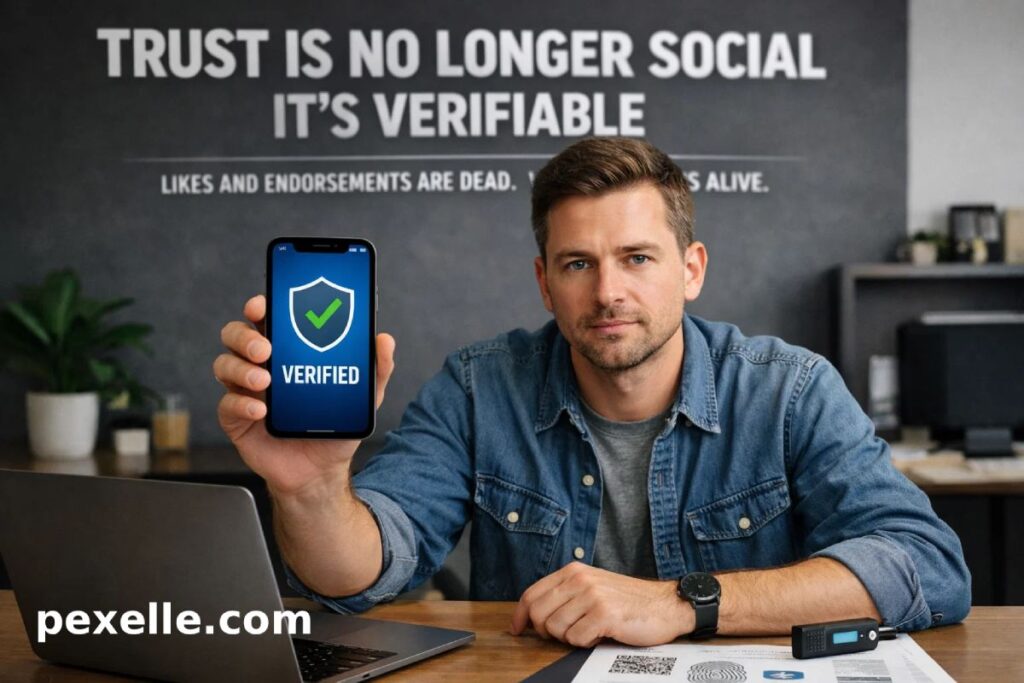
Trust is no longer social.
It is verifiable.
Likes are theater.
Endorsements are folklore.
Verification is math, evidence, and time.
And math doesn’t care who you are
only what you can prove.
Pexelle Hard Mode Takeaway
In the age of AI, unverifiable trust is a liability.
Systems that cannot prove truth will be gamed, collapsed, or ignored.
The future doesn’t ask:
“Who do you know?”
It asks:
“What can be verified right now?”
Source : Medium.com