1. The Hiring Model Is Already Broken
Let’s be blunt: traditional recruiting is inefficient, biased, slow, and expensive. Humans scan CVs written by other humans, filled with exaggerations, omissions, and keyword gaming. Recruiters rely on intuition masked as “experience,” and hiring managers confuse pedigree with competence. This system does not scale, and it collapses entirely in high-velocity, skill-driven markets like AI, blockchain, and advanced engineering.
AI did not enter hiring to “assist” humans. It entered because the human layer is the bottleneck.
Agent-to-agent recruiting is not a future concept. It is the logical correction of a structurally flawed system.
2. What “AI Hiring AI” Actually Means (Not the Buzzword Version)
This is not ChatGPT ranking resumes.
Agent-to-agent recruiting means:
- Candidate Agents represent individuals (or synthetic candidates) with verified skill graphs, performance traces, and learning histories.
- Employer Agents represent organizations with formalized capability demands, risk thresholds, budget constraints, and productivity targets.
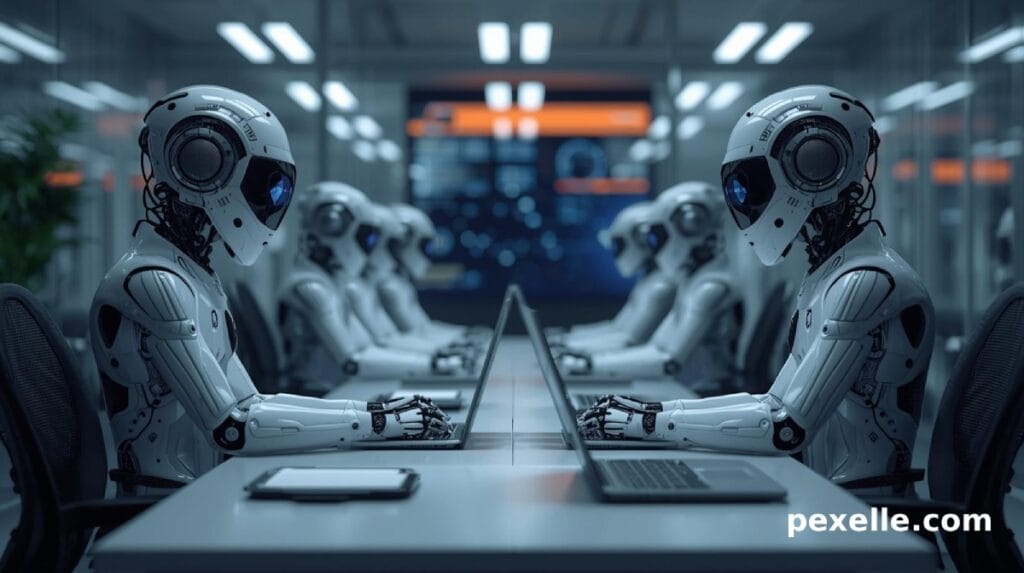
- Negotiation Agents match, validate, simulate, and contract—without human small talk.
Humans do not “apply.”
Agents prove.
The interaction is machine-native: structured signals, probabilistic confidence scores, and verifiable execution evidence. No fluff survives.
3. The Death of the CV and the Interview
CVs exist because humans cannot query reality directly. AI can.
In agent-to-agent recruiting:
- Skills are measured, not claimed
- Experience is validated, not narrated
- Interviews are replaced by task simulations
- References are replaced by cryptographic attestations
If your capability cannot be demonstrated in code, output, decisions, or traceable outcomes, it does not exist.
This is uncomfortable for humans who optimized for storytelling rather than competence. That discomfort is not a bug—it is the point.
4. Synthetic Candidates Will Outperform Humans and That’s Inevitable
Here’s the part most people avoid:
AI will not only hire humans. It will replace them as candidates.
Synthetic agents:
- Learn faster than humans
- Forget nothing
- Execute consistently
- Improve continuously via feedback loops
When an employer agent evaluates a human candidate agent versus a synthetic agent for a task-bounded role, the decision will often be rationally obvious.
The market does not care about your identity.
It cares about output per unit cost per unit risk.
Moral objections do not survive optimization.
5. Bias Does Not Disappear It Becomes Explicit
AI hiring does not eliminate bias. It formalizes it.
Instead of hidden prejudice, you get:
- Explicit weighting functions
- Transparent trade-offs
- Auditable decision paths
This is not “fairness.”
This is honesty.
If a system prefers reliability over creativity, speed over elegance, or cost over novelty, it will say so—numerically. Humans find this offensive because it removes plausible deniability.
That offense is irrelevant.
6. Regulation Will Lag. Markets Will Not.
Governments will attempt to regulate AI hiring using frameworks designed for human decision-makers. This will fail.
Why?
- Agents operate at machine speed
- Decisions are distributed, not centralized
- Jurisdiction becomes ambiguous
- Liability fragments across systems
While regulators debate definitions, companies will deploy agent-to-agent hiring quietly, internally, and cross-border. The productivity gap will make non-adopters uncompetitive.
Compliance will become a post-hoc translation problem, not a design constraint.
7. What Humans Must Do to Stay Relevant
This is the hard truth most articles avoid.
Humans who survive this shift will:
- Own rare, high-entropy skills
- Produce verifiable artifacts
- Collaborate with agents, not compete against them
- Accept continuous evaluation as normal
Humans who rely on:
- Titles
- Years of experience
- Soft narratives
- Static credentials
will be filtered out silently.
Not fired.
Not rejected.
Simply… never selected.
8. The Real Outcome: A Post-Narrative Labor Market
Agent-to-agent recruiting eliminates storytelling as currency.
The labor market becomes:
- Evidence-driven
- Simulation-tested
- Outcome-anchored
- Relentlessly comparative
This is not “dehumanization.”
It is post-romantic economics.
Work becomes what it always was beneath the myths: measurable contribution under constraints.
Final Reality Check
If AI is already writing code, trading assets, diagnosing disease, and negotiating contracts, believing it will politely stop at hiring decisions is naïve.
AI will hire AI.
Humans will either adapt or be abstracted away.
The question is not if this happens.
It is whether you enter the system as a represented agent… or as noise.
Choose carefully.
Source : Medium.com