
Introduction
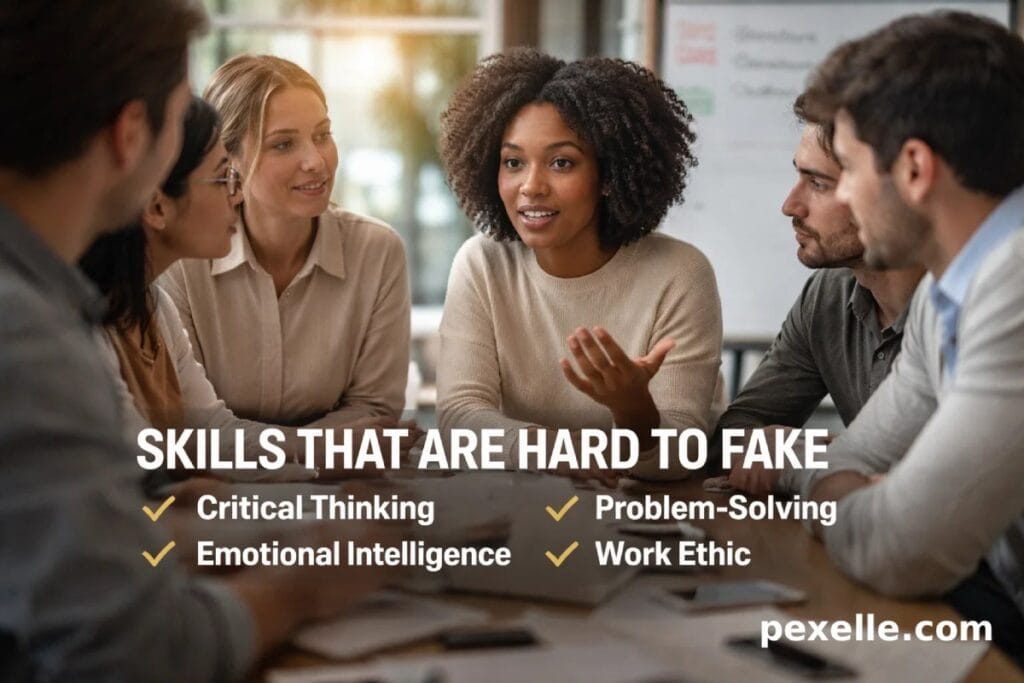
In modern hiring, education, freelancing, and entrepreneurship, one question matters more than ever: which skills can people truly trust? Resumes can be polished, interviews can be rehearsed, and online profiles can be carefully curated. Certifications may show exposure, but they do not always prove real capability. As a result, many claimed skills are easier to imitate than most organizations would like to admit. Yet not all skills are equally vulnerable to exaggeration. Some are difficult to fake because they only become visible through consistent action, pressure, results, and repetition over time.
Why Some Skills Are Easy to Pretend
Many skills are easy to claim because they sound impressive but remain vague. A person can say they are “strategic,” “innovative,” “hardworking,” or “a strong communicator” without being forced to prove it immediately. These labels often survive because the evaluation process is shallow. If employers rely only on self description, short interviews, or keyword matching, they often reward confidence more than competence. Skills become easier to fake when there is no direct evidence, no real world testing, and no need to demonstrate performance in a meaningful context.
What Makes a Skill Hard to Fake
A skill becomes hard to fake when it leaves traces. These traces may appear as outcomes, decisions, artifacts, peer recognition, or observable performance under real conditions. Hard to fake skills usually have three characteristics. First, they require application, not just explanation. Second, they are revealed over time rather than in one moment. Third, they tend to produce patterns that others can verify. The more a skill depends on sustained judgment, adaptation, and accountability, the harder it becomes to imitate convincingly.
Deep Problem Solving
One of the hardest skills to fake is deep problem solving. Anyone can repeat known answers or use familiar terminology, but real problem solving reveals itself when a person faces an unclear situation without a script. This kind of skill involves breaking down ambiguity, identifying root causes, testing assumptions, and making progress even when the path is uncertain. It is difficult to fake because surface level knowledge collapses when the problem changes shape. A true problem solver does not just provide answers. They frame better questions, eliminate noise, and move toward resolution with logic and discipline.
Sound Judgment
Judgment is far more difficult to fake than intelligence. A person may appear smart in conversation, but judgment is revealed in choices, tradeoffs, priorities, and timing. Good judgment means knowing what matters most, what can wait, what risk is acceptable, and what decision creates the strongest long term outcome. It is not simply about being correct once. It is about being reliably sensible across different contexts. Because judgment becomes visible in consequences, it cannot be convincingly simulated for long by charisma or memorized talking points.
Genuine Communication
Communication is often misunderstood as speaking confidently or writing elegantly. In reality, genuine communication is hard to fake because it is not only about expression. It is about clarity, listening, timing, interpretation, and mutual understanding. A person with strong communication skills can explain complexity simply, adapt their message to different audiences, and reduce confusion rather than increase it. This becomes especially visible in teamwork, leadership, conflict, and cross functional collaboration. Someone may sound polished for a few minutes, but sustained communication skill shows itself in whether people actually understand, align, and act effectively.
Consistency and Reliability
Reliability is one of the most underestimated hard to fake skills. Many people can perform well once, especially when conditions are favorable. Far fewer can deliver with consistency across deadlines, distractions, setbacks, and changing expectations. Reliability is difficult to fake because it is measured through patterns rather than promises. It appears in whether work is completed, whether details are handled carefully, whether others can depend on someone under pressure, and whether commitments are honored without constant supervision. Over time, reliability becomes one of the clearest indicators of professional maturity.
Real Leadership
Leadership is frequently imitated but rarely demonstrated in full. Titles, visibility, and confidence can create the appearance of leadership, yet authentic leadership is hard to fake because it depends on influence without illusion. Real leaders create clarity in uncertainty, steady teams during stress, take responsibility when things go wrong, and help others perform better. They do not merely talk about vision. They make tradeoffs, absorb pressure, and earn trust through conduct. Performative leadership may survive in presentations, but genuine leadership becomes obvious in difficult moments when morale, accountability, and direction are tested.
Adaptability Under Pressure
Adaptability is much harder to fake than flexibility in theory. Many people claim they can handle change, but true adaptability appears when plans break, information changes, or conditions become unstable. A truly adaptable person recalibrates without panic, learns quickly without defensiveness, and continues making progress despite uncertainty. This skill is difficult to imitate because stress exposes rigidity. Under real pressure, people often revert to habits. Adaptability becomes visible only when a person can stay composed, absorb new realities, and make practical decisions without losing effectiveness.
Craftsmanship and Attention to Detail
Whether in software, design, writing, operations, law, research, or engineering, craftsmanship is hard to fake because poor work leaves evidence. A person may talk fluently about a field, but the work itself reveals whether they care about precision, structure, and quality. Attention to detail is not perfectionism. It is disciplined care for what others may overlook. Strong craftsmanship appears in clean logic, thoughtful execution, coherent structure, reduced errors, and respect for standards. Because outputs can be inspected, this skill is much harder to imitate than broad claims of expertise.
Learning Agility
Learning agility is increasingly valuable in a world where tools, industries, and expectations evolve quickly. It is hard to fake because true learners do more than collect information. They integrate feedback, improve their models, abandon weak assumptions, and become measurably better over time. Someone can pretend to be knowledgeable for a short period, but it is far harder to fake the ability to learn continuously across new domains. Learning agility reveals itself through progression, curiosity, humility, and the speed with which a person turns unfamiliarity into competence.
Ethical Integrity
Integrity may be the hardest skill of all to fake over time. A person can appear ethical when nothing is at stake, but integrity becomes visible when honesty creates discomfort, when shortcuts are available, or when private choices carry public consequences. Ethical integrity is not only moral language. It is the alignment between words, decisions, and conduct. It is difficult to fake because it emerges under tension. People reveal integrity when they handle confidential information responsibly, admit mistakes, resist manipulation, and choose what is right even when it is inconvenient.
Collaboration That Produces Results
Many people claim to be team players, but effective collaboration is much harder to fake than friendliness. Real collaboration involves sharing credit, resolving friction, integrating diverse inputs, and moving collective work forward. It requires both competence and maturity. Someone who lacks this skill often becomes visible through defensiveness, poor coordination, or hidden inefficiency. Strong collaborators improve the quality of the whole system, not just their own part. Because this effect can be seen by peers, collaboration that produces real results is difficult to fabricate for long.
Domain Expertise With Depth
Superficial expertise can often be mimicked through jargon, trends, and borrowed ideas. Deep expertise is different. It is hard to fake because it includes pattern recognition, historical understanding, practical nuance, and the ability to distinguish signal from noise. Experts with depth can explain not only what works, but why, when, and under what constraints. They can identify hidden risks, foresee second order effects, and recognize common mistakes before others notice them. This level of understanding usually comes from repeated exposure and real consequences, which makes it resistant to imitation.
Resilience
Resilience is another skill that cannot be convincingly staged for long. It is easy to appear strong when things go well. Resilience becomes visible when progress is slow, effort goes unnoticed, or setbacks become personal. This skill involves emotional steadiness, disciplined recovery, and the refusal to collapse after disappointment. It does not mean ignoring pain or pretending everything is easy. It means continuing with perspective and self control. Because resilience is tested by adversity, not by self description, it is one of the clearest hard to fake capabilities in professional and personal life.
Why Organizations Often Miss These Skills
Organizations often fail to identify hard to fake skills because they overvalue presentation and undervalue evidence. Traditional hiring processes tend to reward polished resumes, prestigious signals, and fast verbal performance. Yet many of the most trustworthy skills appear through work samples, long term behavior, peer feedback, and contextual decision making. When evaluation remains too shallow, easier to fake traits rise to the top while more meaningful capabilities remain hidden. This creates poor hiring decisions, weak promotions, and a growing trust gap in talent systems.
Better Ways to Evaluate Hard to Fake Skills
To identify hard to fake skills, evaluation methods must move closer to reality. Employers, educators, and clients should use work based assessments, structured simulations, evidence of outcomes, peer validation, and longer horizon observation. Instead of asking people what they are like, better systems should examine what they have built, solved, improved, or sustained. Trust becomes stronger when claims are linked to artifacts, context, and repeatable proof. The goal is not to eliminate human judgment, but to support it with evidence that is harder to manipulate.
The Future of Trust in Skills
As digital profiles, AI generated content, and polished self branding become more common, the value of hard to fake skills will rise even further. In a world full of claims, trust will increasingly depend on demonstrated capability. The future belongs to systems that can distinguish between declared talent and proven performance. This does not mean reducing people to metrics alone. It means creating fairer ways to recognize what is real. Skills that survive scrutiny, pressure, and time will become the strongest foundation for trust in work, hiring, and collaboration.
Conclusion
The skills that are hardest to fake are usually the ones that matter most. Deep problem solving, sound judgment, real communication, reliability, leadership, adaptability, craftsmanship, learning agility, integrity, collaboration, expertise, and resilience all resist simple imitation because they reveal themselves through action and consequence. These skills are not proven by words alone. They are proven by patterns. In an age where appearances can be manufactured more easily than ever, the most valuable individuals and organizations will be the ones that learn how to recognize, develop, and reward what cannot be easily faked.
Source : Medium.com