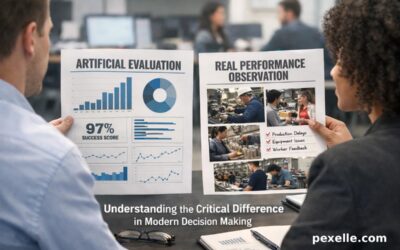

In many professional, academic, and creative environments, people assume that skill is something clearly observable in everyday performance. Tasks are completed, deadlines are met, and routines continue smoothly. Yet time and again, individuals who appear average or even underperforming in normal conditions reveal extraordinary capability when circumstances change. This raises a fundamental question: why does real skill so often remain hidden during ordinary situations?
The answer lies in how skill actually functions. True skill is not merely repetition, compliance, or familiarity with routine. It is adaptive intelligence: the ability to perceive, decide, and act effectively when variables shift, constraints tighten, or uncertainty appears. Normal conditions rarely demand this depth of capability, and as a result, they fail to surface it.
Routine Rewards Stability, Not Mastery
Most everyday environments are optimized for predictability. Workflows, educational systems, and organizational processes are designed to minimize risk and variance. While this creates efficiency, it also flattens the performance landscape.
Under routine conditions:
- Problems are already defined.
- Solutions are known or documented.
- Success depends on following established steps.
- Deviation is often discouraged.
In such systems, individuals who excel at compliance, memory, or repetition may appear highly skilled, while those whose strength lies in synthesis, judgment, or creative problem solving remain indistinguishable. True mastery is not required to function well when nothing unexpected happens.
Real Skill Is Context-Sensitive
Skill is not an abstract property that manifests uniformly across situations. It is deeply dependent on context. A person may show little distinction in calm, structured environments but demonstrate exceptional performance when facing ambiguity or pressure.
Real skill tends to activate when:
- Information is incomplete or contradictory.
- Time or resources are limited.
- Stakes are high.
- Rules no longer fully apply.
- Judgment matters more than procedure.
In normal conditions, these triggers are absent. As a result, the underlying capability remains dormant, much like an emergency system that never activates during routine operation.
Measurement Systems Favor the Visible, Not the Essential
Another reason real skill goes unseen is how performance is measured. Most evaluation systems focus on outputs that are easy to quantify: speed, volume, compliance, or surface correctness. However, these metrics rarely capture deeper abilities such as:
- Anticipation of second-order effects.
- Ability to redefine the problem itself.
- Long-term risk assessment.
- Ethical or strategic judgment.
- Creative synthesis across domains.
When metrics are shallow, behavior adapts accordingly. People optimize for what is measured, not for what actually matters. As a result, genuine skill becomes statistically invisible, while superficial performance is amplified.
Comfort Suppresses Cognitive Engagement
Normal conditions are often comfortable, and comfort reduces cognitive demand. When tasks feel safe and familiar, the brain conserves energy. There is little incentive to explore alternative approaches, question assumptions, or push mental boundaries.
True skill, however, is closely tied to:
- Deep focus.
- Active sense-making.
- Continuous hypothesis testing.
- Willingness to engage with uncertainty.
Without friction or challenge, these faculties remain underutilized. The environment does not ask for them, so they do not appear.
Expertise Emerges at the Edge, Not the Center
Historically and practically, real expertise reveals itself at the margins: during crises, transitions, failures, or moments of rapid change. These situations strip away procedural comfort and expose who can actually think, adapt, and lead.
This is why:
- Some leaders only emerge during collapse.
- Certain engineers shine only when systems break.
- Some thinkers are invisible until assumptions fail.
Normal conditions reward stability. Abnormal conditions reveal capability.
The Illusion of Fair Comparison
When everyone is operating within the same narrow band of routine, differences in true ability are compressed. Performance looks similar because the task demands are low relative to potential human variance.
This creates a false sense of equality or hierarchy:
- Highly capable individuals may appear average.
- Average performers may appear exceptional.
- Long-term potential is misjudged based on short-term normality.
Only when the environment changes does the spread widen and real differences become visible.
Implications for Organizations and Education
If real skill is rarely visible in normal conditions, then systems built solely around routine evaluation are fundamentally flawed.
More accurate approaches include:
- Stress-testing roles with novel scenarios.
- Evaluating reasoning processes, not just outcomes.
- Introducing ambiguity and open-ended problems.
- Observing behavior during failure, not just success.
- Designing environments that require judgment, not just execution.
Without these, organizations risk promoting those best adapted to routine rather than those capable of navigating change.
Conclusion
Real skill is not designed for comfort. It is designed for complexity, uncertainty, and transformation. Normal conditions hide it precisely because they do not require it. When systems are stable, true capability lies dormant. When systems are challenged, it surfaces.
Understanding this distinction is critical. Otherwise, we continue mistaking familiarity for competence, compliance for mastery, and visible performance for real ability.
Source : Medium.com