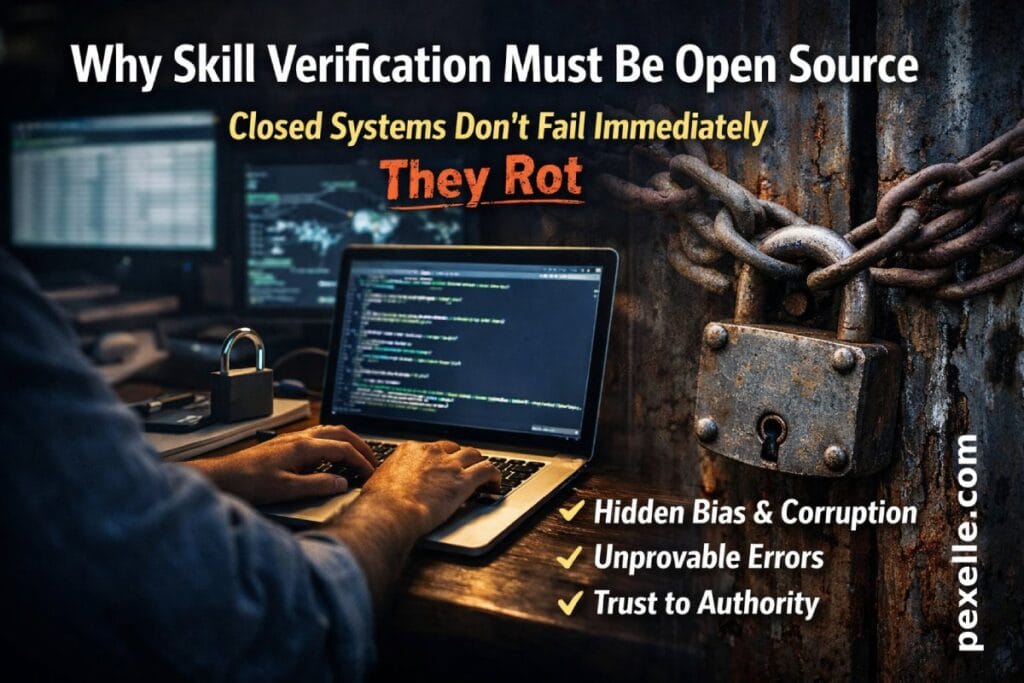
Closed Systems Don’t Fail Immediately They Rot
Closed = Corruption. Not always today. Always eventually.
Skill verification is becoming one of the most powerful coordination layers in the global economy.
Who gets hired.
Who gets trusted.
Who gets paid more.
Who is invisible.
When a system like that is closed, the question is not if it will be corrupted only when and how quietly.
This article explains why skill verification must be open-source by design, not as an ideological preference, but as a structural necessity.
1. Skill Verification Is Becoming Economic Infrastructure
We are no longer talking about:
- Diplomas
- Certificates
- CV PDFs
- Endorsements on professional networks
We are talking about machine-readable trust.
Skill verification systems increasingly feed into:
- Hiring pipelines
- Automated screening (ATS + AI)
- Global freelance marketplaces
- Cross-border labor compliance
- Pay bands, risk scoring, and access to opportunity
Once skills become inputs to automated decision systems, verification becomes infrastructure, not a feature.
And infrastructure that governs access to livelihoods cannot be opaque.
2. Closed Verification Systems Create Asymmetric Power
In a closed system:
- One entity defines what “skill” means
- One entity defines what “evidence” counts
- One entity controls validation logic
- One entity controls dispute resolution
This creates epistemic asymmetry:
- Users are judged by rules they cannot inspect
- Contributors generate value they cannot audit
- Errors are unprovable
- Bias is deniable
- Abuse is unverifiable
You don’t need bad actors for this to become dangerous.
You only need incentives + opacity + scale.
That combination always converges toward exploitation.
3. Corruption Rarely Looks Like Malice at First
Closed systems don’t start corrupt.
They start convenient.
Then:
- “Temporary” exceptions become policy
- Special access becomes monetized
- Edge cases get ignored
- Appeals become bureaucratic
- Metrics replace meaning
Eventually:
- Credentials inflate
- Gatekeepers emerge
- Pay-to-verify appears
- Visibility becomes purchasable
- Truth becomes secondary to throughput
This is not speculation.
This is the lifecycle of every closed trust system at scale.
4. Open-Source Is Not About Altruism It’s About Verifiability
Open-source skill verification does not mean:
- No businesses
- No monetization
- No governance
- No curation
It means:
- Verification logic is inspectable
- Scoring mechanisms are auditable
- Evidence standards are explicit
- Changes are traceable
- Disputes are reproducible
Open-source does not remove power.
It forces power to justify itself.
That is the point.
5. Trust Without Inspectability Is Not Trust It’s Authority
There is a critical distinction:
- Trust = “I can independently verify your claim”
- Authority = “You must accept my claim”
Closed verification systems do not create trust.
They demand submission.
In global labor markets especially for talent from the Global South authority without transparency is indistinguishable from exclusion.
6. Open Systems Reduce Bias by Making Bias Visible
Bias does not disappear because you hide it.
It disappears when it is measurable, contestable, and correctable.
Open verification systems allow:
- Community review of skill definitions
- Exposure of cultural or regional bias
- Forking of standards when consensus fails
- Parallel validation paths
- Evidence evolution over time
Closed systems freeze bias.
Open systems surface it.
7. Skills Are Dynamic Closed Systems Can’t Keep Up
Skills change faster than institutions.
New tools emerge.
New roles form.
Old titles become meaningless.
Learning becomes nonlinear and informal.
Closed systems respond slowly because:
- Updates are centralized
- Incentives favor stability over accuracy
- Backward compatibility protects legacy value
- Change threatens revenue models
Open systems evolve because:
- Anyone can propose improvements
- Evidence formats can diversify
- Validation logic can be modular
- Communities adapt in real time
In a fast-moving economy, closed verification systems become historical artifacts.
8. “But Open-Source Can Be Abused” Yes. And That’s a Feature.
Abuse visibility is not a weakness.
It’s the only way abuse can be fixed.
Closed systems don’t prevent abuse they hide it.
Open systems:
- Expose attack vectors
- Enable collective defense
- Improve through adversarial testing
- Make manipulation detectable
Security through obscurity is not security.
It is deferred failure.
9. Governance > Ownership
The real question is not:
“Who owns the system?”
It is:
“Who can change the rules, and under what constraints?”
Open-source allows:
- Transparent governance models
- On-chain or off-chain voting
- Multi-stakeholder oversight
- Forkability as a pressure mechanism
Forkability is not fragmentation.
It is accountability insurance.
If users can leave with the rules, abuse becomes expensive.
10. Closed Skill Verification Is a Single Point of Moral Failure
When a closed system decides:
- Who is “qualified”
- Who is “verified”
- Who is “trusted”
It becomes a moral choke point.
Every exclusion becomes political.
Every inclusion becomes suspect.
Every error scales harm.
Open systems distribute moral responsibility.
Closed systems concentrate it.
History is very clear about how that ends.
11. The Future Labor Market Demands Transparent Trust
AI will not make verification less important.
It will make it foundational.
When machines decide:
- Ranking
- Matching
- Compensation
- Risk
The verification layer must be:
- Inspectable
- Reproducible
- Explainable
- Contestable
Anything else is algorithmic feudalism.
12. Final Principle
If a system defines human value, it must be open to human scrutiny.
Closed skill verification is not neutral.
It is a delayed corruption mechanism.
Open-source is not ideology.
It is defensive architecture.
Because sooner or later:
Closed = Corruption.
Always.
Source : Medium.com