
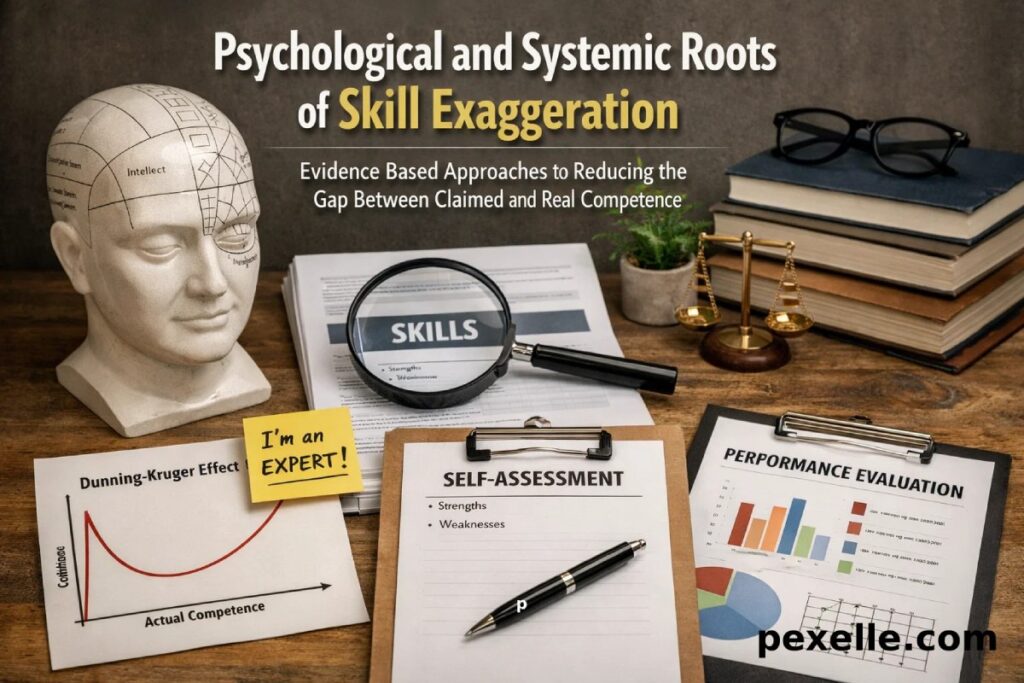
Evidence Based Approaches to Reducing the Gap Between Claimed and Real Competence
Introduction
Across many professional environments a persistent gap exists between claimed competence and actual capability. Job applicants frequently exaggerate skills on resumes, professionals inflate experience during interviews, and even organizations may overstate internal expertise. While some degree of self promotion is expected in competitive labor markets, systematic exaggeration creates significant problems. Employers struggle to evaluate talent accurately, teams face capability mismatches, and organizations invest resources in individuals who cannot deliver expected outcomes.
This phenomenon is not merely an issue of individual dishonesty. Research in organizational psychology, behavioral economics, and labor market systems suggests that skill exaggeration emerges from a combination of psychological biases and structural incentives. Understanding both dimensions is essential if organizations want to reduce the gap between perceived and actual competence.
This article examines the psychological mechanisms that drive skill exaggeration, the systemic factors that amplify it, and evidence based strategies that organizations and platforms can use to reduce the problem.
Psychological Roots of Skill Exaggeration
1. The Dunning–Kruger Effect
One of the most widely documented explanations for skill overestimation is the Dunning–Kruger effect, identified by psychologists David Dunning and Justin Kruger. Their research showed that individuals with low competence in a domain often lack the metacognitive ability to accurately assess their own performance.
As a result, people who know little about a subject may genuinely believe they are skilled, while highly competent individuals may underestimate their own abilities because they better understand the complexity of the field.
This cognitive bias produces two important consequences:
- Novices unintentionally exaggerate their abilities.
- Experts may communicate their skills more conservatively.
The outcome is a distorted skill landscape where confidence does not reliably correlate with competence.
2. Self Presentation and Social Signaling
Humans naturally attempt to manage how others perceive them. In professional settings this tendency manifests as strategic self presentation.
Applicants may exaggerate skills because they believe:
- Employers expect confidence
- Honest modesty may be interpreted as weakness
- Competitors are also exaggerating
In this environment exaggeration becomes a defensive strategy rather than deliberate deception. When individuals believe everyone else is overstating their abilities, the rational response becomes to do the same.
3. Identity Protection and Ego Defense
Admitting limited knowledge can threaten personal identity, especially in cultures that equate expertise with value. Professionals who have invested years building a reputation may subconsciously inflate competence to protect self esteem.
Psychological studies show that individuals frequently reinterpret their experiences to maintain a positive self image. For example:
- Partial familiarity may be remembered as expertise
- Limited exposure may be framed as experience
- Conceptual understanding may be mistaken for practical ability
This cognitive reframing allows individuals to maintain confidence while unintentionally misrepresenting their true capability.
4. Optimism Bias and Future Skill Projection
Another factor is optimism bias, the tendency to believe that future performance will exceed past performance.
Applicants often claim skills they believe they can quickly learn rather than those they already possess. In fast moving fields such as software engineering or artificial intelligence, professionals may justify exaggeration by assuming they will close the skill gap shortly after being hired.
While sometimes true, this behavior creates short term capability mismatches that organizations must absorb.
Systemic Drivers of Skill Inflation
Psychology alone does not explain the scale of skill exaggeration. Structural characteristics of modern labor markets actively encourage it.
1. Resume Based Hiring Systems
Traditional hiring processes rely heavily on resumes and self reported skill lists. These formats reward keyword density rather than verified competence.
Applicants quickly learn that listing more technologies or capabilities increases the likelihood of passing automated screening systems. As a result, resumes often evolve into marketing documents rather than accurate capability descriptions.
This systemic design unintentionally incentivizes exaggeration.
2. Platform Driven Skill Signaling
Professional networking platforms and talent marketplaces amplify this effect. Many platforms allow users to self assign skills without meaningful verification.
Common issues include:
- Endorsements exchanged socially rather than based on work
- Skill lists disconnected from demonstrable outcomes
- Algorithmic visibility based on skill quantity rather than evidence
The result is an inflationary ecosystem of skill signaling where profiles accumulate capabilities that may never have been practically demonstrated.
3. Competitive Labor Markets
When hiring processes are highly competitive, candidates face strong incentives to maximize perceived capability. If employers request unrealistic combinations of skills in job descriptions, candidates often respond by stretching their qualifications.
This dynamic creates a feedback loop:
- Employers publish unrealistic requirements
- Candidates exaggerate skills to qualify
- Employers become more skeptical of resumes
- Requirements increase further
Over time the hiring market becomes detached from actual skill measurement.
4. Lack of Standardized Skill Verification
Unlike fields such as medicine or aviation, many industries lack standardized systems for verifying practical competence.
In software development, digital marketing, data science, and many knowledge professions, the barrier to claiming expertise is extremely low. Without objective evaluation mechanisms, organizations must rely heavily on self reported capability signals.
This structural weakness allows exaggeration to persist.
Consequences of Skill Inflation
The gap between claimed and actual competence produces several negative outcomes.
Organizational Costs
Companies face significant costs when hiring decisions are based on inaccurate skill signals. These costs include:
- Reduced productivity
- Increased onboarding time
- Higher employee turnover
- Project delays and rework
In technical environments the impact can be particularly severe because under qualified employees may introduce architectural or security risks.
Team Friction
When team members possess mismatched capabilities, collaboration suffers. Highly skilled employees may need to compensate for underperforming colleagues, leading to frustration and reduced morale.
Labor Market Inefficiency
Skill exaggeration also harms workers. When signals become unreliable, employers invest more resources in screening and testing, increasing hiring friction for everyone.
Ultimately the labor market becomes less efficient at matching real talent with real opportunities.
Evidence Based Strategies to Reduce Skill Exaggeration
Reducing this gap requires interventions at both the psychological and systemic levels.
1. Evidence Based Skill Verification
One of the most effective approaches is shifting from self reported skills to evidence based skills.
Evidence may include:
- Completed projects
- Code repositories
- portfolios
- peer reviewed contributions
- verifiable work outcomes
Research shows that work sample tests are among the most predictive hiring methods. Instead of asking candidates what they know, organizations evaluate what they can actually produce.
2. Structured Skills Assessment
Structured evaluation methods reduce bias and exaggeration by measuring specific capabilities.
Examples include:
- Technical simulations
- Practical problem solving exercises
- Scenario based assessments
- standardized competency tests
Unlike interviews alone, structured assessments provide measurable indicators of competence.
3. Skill Evidence Platforms
Emerging digital infrastructure is beginning to address this problem through skill evidence ecosystems. These systems link claims of competence to verifiable artifacts such as:
- project histories
- code contributions
- validated certifications
- real world performance data
Instead of static resumes, individuals maintain evidence backed skill profiles that evolve with their work.
Such approaches can significantly reduce the reliance on unverifiable self descriptions.
4. Transparent Skill Taxonomies
Another systemic improvement involves the adoption of standardized skill frameworks such as ESCO, O*NET, and other occupational taxonomies. These frameworks help organizations define competencies more precisely and evaluate them consistently.
Clear definitions reduce ambiguity around what it actually means to possess a given skill.
5. Cultural Incentives for Honest Capability Signaling
Organizations can also reshape incentives by encouraging learning transparency rather than punishing skill gaps.
When teams reward:
- curiosity
- continuous learning
- honest reporting of limitations
employees become less likely to exaggerate abilities. Psychological safety allows professionals to acknowledge uncertainty without risking their reputation.
The Future of Skill Verification
The increasing complexity of modern work will likely accelerate the transition from claim based hiring to evidence based capability systems.
Advances in digital portfolios, decentralized credentials, and AI driven skill analysis may enable more accurate representations of professional competence. Instead of static resumes, workers may maintain dynamic skill evidence records that update automatically as they complete projects and contribute to organizations.
Such systems could dramatically reduce the psychological and structural incentives that currently encourage skill exaggeration.
Conclusion
Skill exaggeration is not simply a matter of individual honesty. It arises from a complex interaction between cognitive biases, identity protection, social signaling, and structural flaws in hiring systems.
Psychological mechanisms such as the Dunning–Kruger effect and optimism bias lead individuals to overestimate their abilities, while systemic factors including resume driven hiring, platform based skill signaling, and competitive labor markets amplify the problem.
Reducing this gap requires a shift toward evidence based skill verification, structured assessments, transparent competency frameworks, and cultural incentives that reward honest capability signaling.
By redesigning both the psychological and systemic environment surrounding professional skill representation, organizations can create labor markets that more accurately reflect real competence and enable better talent matching.
Ultimately the goal is not to eliminate self promotion, but to ensure that confidence and competence become more closely aligned.
Source: Medium.com