
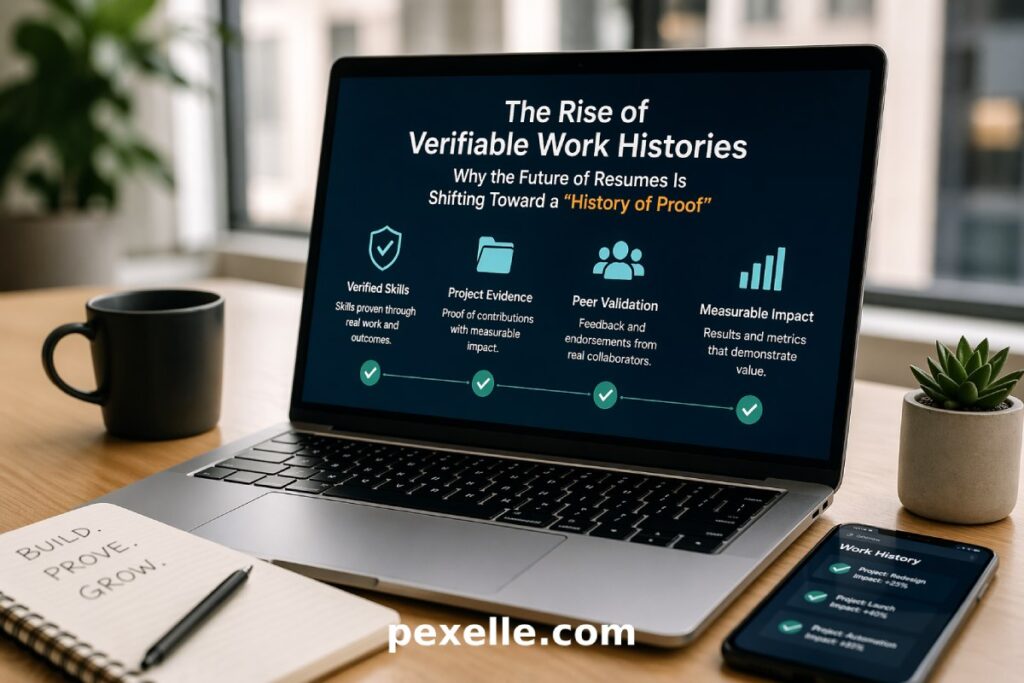
Why the Future of Resumes Is Shifting Toward a “History of Proof”
1. The Problem with Traditional Resumes
For decades, resumes have served as the primary interface between individuals and opportunities. They present a structured list of experiences, roles, and achievements. However, the core limitation has always remained the same: resumes are largely self-reported.
A candidate can claim impact, leadership, or expertise, but the resume itself rarely provides objective evidence. Recruiters and hiring managers are left to interpret credibility based on wording, formatting, and brand names rather than verifiable outcomes. In an era where information is abundant but trust is scarce, this model is increasingly insufficient.
2. The Trust Gap in Modern Hiring
As companies scale and hiring becomes more global and remote, the gap between claimed skills and actual capabilities continues to widen.
Hiring decisions are often based on signals such as job titles, company reputation, or keyword matching rather than demonstrated ability. This leads to several systemic issues:
- Misalignment between job requirements and actual performance
- Increased hiring risks and turnover
- Over-reliance on interviews as a subjective validation layer
The result is a fragile system where both employers and candidates operate with incomplete information.
3. From “Claims” to “Proof”
The emerging shift is simple but fundamental: moving from what people say they have done to what can be proven they have done.
A “history of proof” is not a static document. It is a dynamic, evidence-backed record of work, including:
- Projects with measurable outcomes
- Contributions to real systems or products
- Verified feedback from collaborators or stakeholders
- Time-stamped records of activity and impact
This transforms the resume from a narrative into a dataset.
4. What Verifiable Work Histories Look Like
In a proof-based model, each claim is supported by observable evidence. Instead of listing “Senior Backend Developer,” a candidate might present:
- Specific repositories or code contributions
- Deployment records or system metrics
- Issue tracking history showing problem-solving patterns
- Peer reviews and approvals
For non-technical roles, this could include:
- Campaign performance data
- Sales pipelines and conversion metrics
- Design iterations and user feedback
- Documented decisions and their outcomes
The key principle is traceability: every skill is linked to something that can be inspected.
5. The Role of Technology
This shift is being enabled by a combination of technologies:
- Version control systems that track contributions over time
- Collaboration tools that capture discussions, decisions, and workflows
- Blockchain and cryptographic systems for tamper-proof verification
- AI systems that can analyze and summarize large volumes of activity data
Together, these tools make it possible to build a structured, reliable representation of someone’s professional history.
6. Implications for Individuals
For individuals, this transformation changes how careers are built and presented.
Instead of optimizing resumes for keywords, the focus shifts to:
- Producing meaningful, observable work
- Documenting contributions in real time
- Building a portfolio of evidence rather than descriptions
This favors consistency over storytelling. A single strong proof can outweigh multiple unverified claims.
7. Implications for Companies
For organizations, verifiable work histories enable a more precise hiring process.
Companies can:
- Evaluate candidates based on real output rather than assumptions
- Reduce dependency on subjective interviews
- Identify high-signal contributors regardless of background or credentials
This also opens the door to continuous talent evaluation, where hiring is not a one-time decision but an ongoing assessment of demonstrated capability.
8. The Decline of Credential-Based Trust
Degrees, certifications, and job titles have traditionally acted as proxies for competence. However, their signaling power is weakening.
As access to education expands and credential inflation increases, these markers no longer guarantee ability. In contrast, verifiable work histories provide direct evidence of performance, making them a more reliable indicator of value.
9. Challenges and Open Questions
Despite its advantages, the shift toward proof-based histories raises important questions:
- How do we standardize what counts as valid proof?
- How do we ensure privacy while maintaining transparency?
- How do we prevent manipulation or selective presentation of evidence?
These challenges require new frameworks for validation, ownership, and interpretation of work data.
10. The Future: A Living Professional Graph
The resume is evolving into something fundamentally different: a living, continuously updated graph of work, skills, and impact.
In this model:
- Skills are inferred from actions, not declared explicitly
- Reputation is built through accumulated evidence
- Opportunities are matched based on verified capability rather than static profiles
This is not just a new format for resumes. It is a new infrastructure for trust in the professional world.
Conclusion
The transition from traditional resumes to verifiable work histories represents a deeper shift in how we understand value and credibility.
In a world where anyone can claim anything, proof becomes the only scalable foundation for trust. The future belongs to those who can demonstrate their work, not just describe it.
Source : Medium.com