Why “Self-Declared Skills” Are Collapsing and What Comes Next
Introduction
For more than a decade, the global labor market has relied heavily on self-reported skills lists of abilities that individuals claim on resumes, LinkedIn profiles, or job applications. These declarations have shaped hiring decisions, career progression, and even educational pathways.
However, this system is now rapidly losing credibility. Across industries, employers are realizing a fundamental truth: what people say they can do is no longer a reliable signal of what they can actually do.
The collapse of self-reported skills is not a temporary shift. It is a structural transformation driven by technological change, labor market evolution, and the emergence of more objective alternatives.
1. The Core Problem: Self-Reported Skills Are Inherently Unreliable
At its core, self-reporting suffers from a simple but critical flaw: it is subjective and easily manipulated.
Individuals naturally tend to:
- Overestimate their abilities
- Select socially desirable skills
- Optimize their profiles for algorithms rather than truth
Research shows that self-report measures are highly susceptible to bias and even intentional faking, which undermines their validity in real-world evaluation .
This creates a systemic issue:
- Two candidates with identical skill lists may have vastly different real capabilities
- Recruiters cannot distinguish signal from noise
- Skill inflation becomes inevitable
The result is a marketplace flooded with low-trust data.
2. Skill Inflation and the “Credential Noise” Problem
The second force accelerating the collapse is skill inflation.
Today, anyone can:
- Add dozens of skills to a profile
- Earn micro-certificates online
- Present themselves as “proficient” without standardized validation
This leads to what can be called credential noise.
Employers now face a paradox:
- More skill data than ever
- Less clarity than ever
As one industry observation notes, the explosion of credentials has made it increasingly difficult for employers to determine which ones are legitimate or meaningful .
This mirrors a broader phenomenon known as credential inflation, where traditional qualifications lose value as they become widespread .
In other words:
When everyone claims skills, claims stop meaning anything.
3. The Mismatch Between Declared Skills and Real Performance
Perhaps the most damaging issue is the weak correlation between self-reported skills and actual job performance.
Traditional hiring assumed that:
- Degrees signal knowledge
- Skills listed signal capability
But real-world evidence increasingly contradicts this.
Modern research shows that direct competency assessments and practical evaluations are significantly better predictors of job performance than proxies like credentials or self-declarations .
This mismatch manifests in organizations as:
- Poor hiring decisions
- Increased onboarding costs
- Low productivity in early employment stages
The conclusion is unavoidable:
Self-reported skills are not just noisy they are often misleading.
4. The Changing Nature of Work: Skills Are Dynamic, Not Static
Another reason for the collapse is that skills themselves are evolving faster than ever.
In modern economies:
- Skills become obsolete quickly
- New tools and frameworks emerge continuously
- Transferable skills matter more than static knowledge
Research highlights that adaptability, problem-solving, and collaboration are now core employability skills across industries .
Self-reported systems fail here because they:
- Capture a snapshot, not real capability
- Do not reflect learning velocity
- Ignore context and application
A person listing “AI” as a skill could range from:
- Basic prompt usage
to - Designing production-grade ML systems
The label is identical. The reality is not.
5. The Rise of Skills-Based and Evidence-Based Evaluation
As trust in self-reporting declines, a new paradigm is emerging:
Evidence-Based Skills
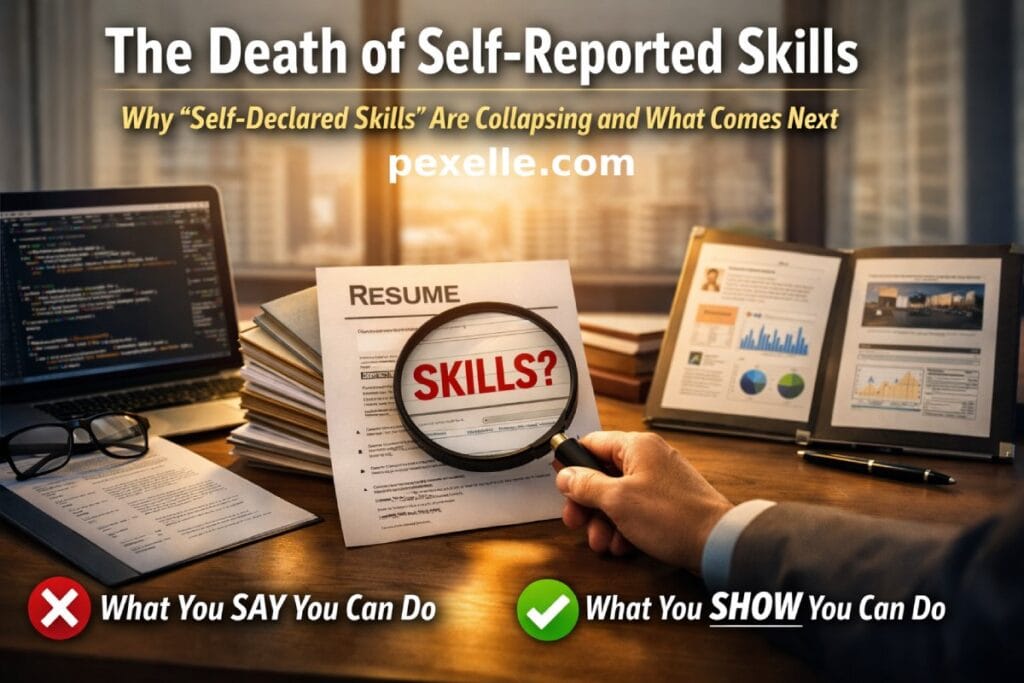
This model shifts focus from claims → proof.
Instead of asking:
“What skills do you have?”
Organizations now ask:
“Show us what you can do.”
This is driving the adoption of:
- Work sample tests
- Real-world simulations
- Portfolio-based evaluation
- Live problem-solving sessions
This approach, often called skills-based hiring, evaluates candidates based on demonstrated ability rather than declared qualifications .
The benefits are clear:
- More accurate hiring decisions
- Better job-performance prediction
- Broader and more inclusive talent pools
6. The Emergence of “Proof-of-Skill” Ecosystems
The next evolution goes even further:
Proof-of-Skill Infrastructure
We are entering an era where skills are:
- Verified
- Traceable
- Continuously updated
Emerging systems include:
- Digital portfolios with verifiable outputs
- GitHub-style contribution histories
- Blockchain-based credentialing
- AI-driven skill validation
In these systems:
- Skills are not statements
- They are evidence trails
This transforms skills into something closer to:
A measurable asset rather than a subjective claim
7. AI as the Catalyst for the Collapse
Artificial intelligence is accelerating this transition in two key ways:
1. Detection of Skill Authenticity
AI systems can now:
- Analyze portfolios
- Evaluate code quality
- Assess real outputs
2. Replacement of Low-Signal Data
AI models rely on high-quality input signals.
Self-reported skills, being unreliable, are increasingly excluded.
Instead, AI prefers:
- Behavioral data
- Performance metrics
- Real-world activity logs
This shift makes self-reporting obsolete in AI-driven hiring systems.
8. What Replaces Self-Reported Skills?
The future is not about eliminating skills—it is about redefining how they are represented.
The replacement model includes:
1. Demonstrated Skills
Skills proven through:
- Tasks
- Projects
- Simulations
2. Continuous Skill Signals
Instead of static lists:
- Real-time activity
- Learning progression
- Contribution history
3. Contextual Skill Graphs
Skills mapped to:
- Roles
- Outcomes
- Collaboration patterns
4. Verified Credentials
Credentials that are:
- Standardized
- Validated
- Hard to fake
Conclusion
The collapse of self-reported skills is not a failure of individuals it is a failure of the system.
A system built on:
- Subjective claims
- Weak validation
- Static representations
cannot survive in a world that demands:
- Precision
- adaptability
- accountability
We are moving toward a new paradigm where:
Skills are no longer what you say.
Skills are what you can prove.
And in that world, trust is no longer assumed it is earned through evidence.
Source : Medium.com