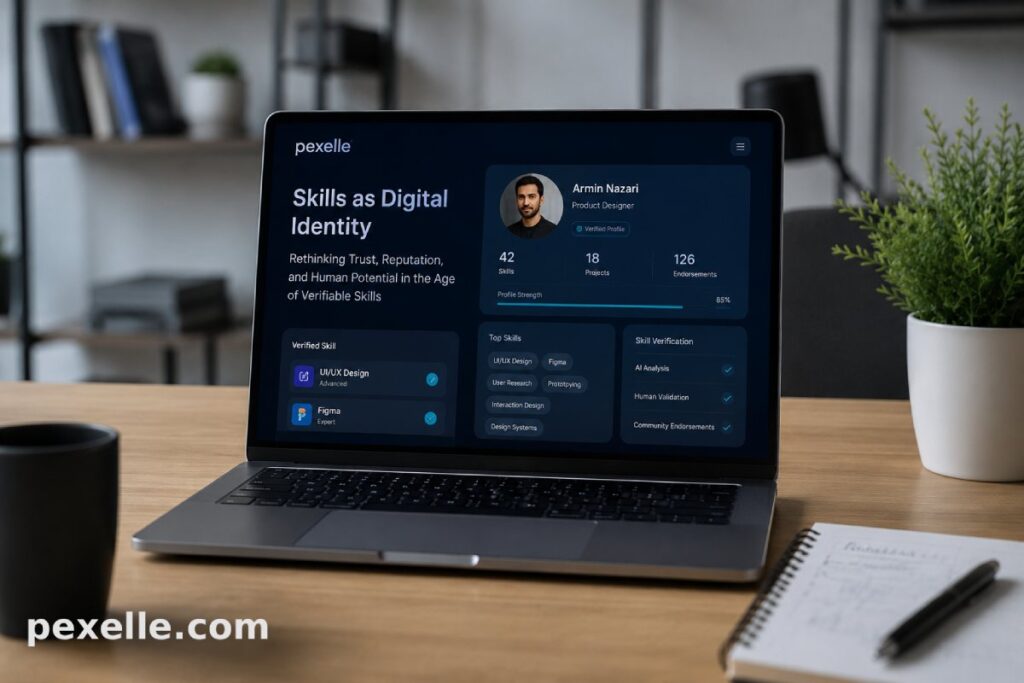
Rethinking Trust, Reputation, and Human Potential in the Age of Verifiable Skills
Introduction
For decades, digital identity has been built around static information such as names, resumes, job titles, university degrees, and social profiles. Most online systems still define people through documents rather than demonstrated capability. Yet the modern world increasingly values what people can actually do instead of what they claim.
This shift is creating a new model of identity where skills become one of the most important forms of digital representation. In this emerging model, an individual is not only identified by personal information, but also by verified evidence of knowledge, experience, collaboration, creativity, and real world contribution.
Pexelle explores this transformation by positioning skills as a living and evolving digital identity layer. Instead of reducing people to a PDF resume or a list of self reported competencies, the platform focuses on evidence driven profiles where abilities are continuously demonstrated, validated, and connected to real outcomes.
The Problem with Traditional Digital Identity
Traditional professional identity systems suffer from several major weaknesses:
- Resumes are self reported
- Job titles vary between companies
- Degrees do not always represent current capability
- Portfolios can be difficult to verify
- Social profiles prioritize visibility over accuracy
- Skills rapidly become outdated in modern industries
Two individuals may have identical resumes while possessing completely different levels of practical ability. At the same time, highly talented people are often overlooked because they lack traditional credentials or industry connections.
This creates a global trust problem in hiring, collaboration, freelancing, education, and online communities.
Modern economies increasingly require dynamic proof of competence rather than static declarations.
Skills Are Becoming More Valuable Than Credentials
The rise of AI, remote work, decentralized teams, and global digital collaboration is accelerating the importance of skills based identity systems.
Companies today frequently ask questions such as:
- Can this person actually solve the problem?
- Can they collaborate effectively?
- Can they adapt to new technologies?
- Can they demonstrate real experience?
- Can their expertise be validated?
These questions cannot be answered reliably through resumes alone.
A future oriented digital identity must include:
- Verifiable skills
- Demonstrated experience
- Community validation
- Evidence based learning
- Continuous evolution
- Real contribution history
This is where platforms like Pexelle introduce a fundamentally different perspective.
What “Skills as Digital Identity” Means in Pexelle
In Pexelle, skills are treated as active identity components rather than passive labels.
A user profile becomes a structured representation of:
- What the person knows
- What the person has practiced
- What the person has proven
- What communities recognize
- What evidence supports those claims
- How the individual evolves over time
This transforms a profile from a static page into a living professional identity graph.
Instead of saying:
“I am a blockchain developer.”
The identity becomes:
- Verified blockchain skill cards
- Linked project evidence
- Community endorsements
- AI assisted analysis
- Assessment results
- Learning history
- Real contribution records
The result is a much deeper layer of trust and transparency.
Skill Cards as Building Blocks of Identity
One of the most important concepts inside Pexelle is the idea of skill cards.
A skill card can represent:
- Technical abilities
- Soft skills
- Industry expertise
- Research knowledge
- Creative capability
- Leadership experience
- Communication proficiency
Each card may include:
- Evidence uploads
- Certifications
- Project references
- AI analysis
- Human assessments
- Attestations
- Reputation signals
- Progress tracking
Over time, these cards form a structured digital identity ecosystem around the individual.
This model is far more flexible than traditional resumes because identity is modular, expandable, and continuously updated.
Verifiable Identity Creates Higher Trust
One of the biggest internet problems today is trust.
Anyone can claim expertise online. Very few systems can reliably prove it.
Pexelle approaches this challenge through layered validation systems that combine:
- AI based analysis
- Human verification
- Evidence review
- Community attestations
- Structured assessments
- Skill relationships
- Reputation mechanisms
This hybrid approach creates stronger confidence in identity authenticity.
Instead of trusting only a statement, users can evaluate the evidence behind the statement.
That distinction becomes extremely important in fields such as:
- Hiring
- Freelancing
- Consulting
- Education
- Research
- Remote collaboration
- Open source communities
- Professional networking
Dynamic Identity Instead of Static Profiles
Traditional professional profiles are usually updated manually every few months or years.
A skill driven identity system behaves differently.
In Pexelle, identity can evolve continuously through:
- New evidence uploads
- Completed learning paths
- Community participation
- Assessments
- Verified projects
- Skill improvements
- Attestations
- AI generated insights
This creates a dynamic identity model where growth becomes visible over time.
The profile is no longer a snapshot.
It becomes a timeline of capability development.
AI and the Future of Skill Understanding
Artificial intelligence is changing how skills are analyzed and interpreted.
Modern AI systems can increasingly identify:
- Skill relationships
- Knowledge gaps
- Evidence quality
- Learning patterns
- Capability progression
- Industry alignment
- Transferable competencies
Platforms like Pexelle can use AI not merely for automation, but for understanding human capability at scale.
This creates opportunities for:
- Personalized learning paths
- Better hiring recommendations
- Intelligent skill mapping
- Career navigation
- Competency forecasting
- Community expertise discovery
AI becomes a bridge between raw human potential and structured digital identity.
The End of Resume Centric Reputation
The resume was designed for a slower industrial world.
Modern digital economies move too quickly for static documents to remain the primary source of professional trust.
A person may learn new technologies within weeks.
Communities evolve rapidly.
Industries continuously shift.
The future will likely prioritize:
- Real evidence
- Verifiable contribution
- Continuous learning
- Observable expertise
- Community reputation
- Skill evolution
In this environment, identity becomes increasingly tied to capability rather than credentials alone.
Pexelle represents part of this broader transition toward evidence based professional ecosystems.
Digital Identity Beyond Employment
The implications of skill based identity extend far beyond hiring.
In the future, skills may influence:
- Access to professional communities
- Research collaboration
- Decentralized governance participation
- Educational opportunities
- Expert networks
- AI agent personalization
- Trust scoring systems
- Team formation
- Mentorship ecosystems
A well structured skill identity may eventually function as a universal professional passport across digital ecosystems.
This could reshape how humans interact online.
Privacy and Ownership of Identity
As digital identity systems become more advanced, ownership and privacy become critically important.
A skill profile contains valuable information about:
- Intelligence
- Experience
- Work history
- Behavioral patterns
- Reputation
- Professional relationships
Users increasingly want control over:
- Who can access their data
- How evidence is shared
- What remains private
- How identity is verified
- How AI systems use personal information
Platforms that prioritize transparency, user control, and privacy aware infrastructure will likely gain stronger long term trust.
This is especially important in a future where AI systems may heavily rely on identity data for decision making.
The Emergence of Reputation Economies
The internet is gradually moving toward reputation based ecosystems.
In these systems:
- Trust becomes measurable
- Contributions become visible
- Expertise becomes portable
- Skills become economic assets
- Identity becomes programmable
Skill based reputation systems may influence future:
- Hiring markets
- Learning economies
- Creator ecosystems
- Open source collaboration
- DAOs
- Professional communities
- Knowledge marketplaces
Pexelle aligns closely with this direction by treating verified skills as a foundational layer of digital trust.
Conclusion
The future of digital identity is shifting from static information toward verifiable capability.
People are more than resumes, titles, or certificates.
Their real value lies in demonstrated skills, contributions, adaptability, and continuous growth.
Platforms like Pexelle are part of a broader movement that reimagines identity as something dynamic, evidence driven, and deeply connected to human potential.
In the coming years, skills may become one of the most important forms of digital currency and trust on the internet.
Not because people say they are capable.
But because their abilities can finally be observed, verified, and understood at scale.
Source : Medium.com