
Understanding the Foundations of Reliable Skill Validation in the Modern World
1. The Shift from Claims to Evidence
For decades, skills were presented as claims. A line on a résumé, a bullet point on LinkedIn, or a statement in an interview. These representations were rarely verified and often relied on trust without proof. Today, this model is breaking down.
A trustworthy skill is no longer defined by what someone says they can do, but by what can be observed, verified, and reproduced. The modern workforce is moving toward evidence-based validation, where skills must be demonstrated through real outputs rather than declared intentions.
2. Observable Outcomes as the Core
At the center of trust lies observability. A skill becomes trustworthy when it produces tangible, inspectable outcomes.
For example:
- A developer’s skill is reflected in deployed applications, GitHub commits, and system architecture decisions.
- A designer’s capability is visible through portfolios, usability results, and real user engagement.
- A marketer’s effectiveness appears in campaign metrics, conversions, and growth patterns.
If a skill cannot produce observable results, it becomes difficult to trust. Visibility transforms abstraction into proof.
3. Consistency Over Time
One successful output is not enough. Trust requires consistency.
A skill is trustworthy when:
- It produces reliable results across different contexts
- It maintains quality under varying constraints
- It demonstrates stability over time
Consistency separates luck from capability. A single achievement may indicate potential, but repeated performance establishes credibility.
4. Contextual Relevance
A skill cannot be evaluated in isolation. It must be assessed within its context of application.
For instance:
- Writing skill in academic research differs from writing in product marketing
- Programming skill in a startup environment differs from enterprise systems
- Leadership in a small team differs from leadership in a multinational organization
A trustworthy skill is one that proves itself within the relevant environment. Without context, evaluation becomes misleading.
5. Verifiability and Independent Validation
Trust grows when others can verify the skill independently.
This includes:
- Peer reviews
- Client feedback
- Third-party endorsements
- Transparent work histories
When a skill can be validated by external observers, it transitions from subjective belief to objective credibility. Independent validation reduces bias and increases confidence.
6. Traceability of Work History
A trustworthy skill has a traceable history. It is not a snapshot, but a timeline.
This means:
- You can track how the skill evolved
- You can see the decisions made along the way
- You can analyze the progression of complexity and impact
Traceability allows evaluators to understand not just what was done, but how and why. This depth is essential for real trust.
7. Resistance to Manipulation
A critical but often overlooked factor is tamper resistance.
Traditional skill representations can be easily manipulated:
- Résumés can be exaggerated
- Certificates can be misused
- Experience can be framed selectively
Trustworthy skills require systems that minimize manipulation. This may involve:
- Cryptographic proofs
- Immutable records
- Decentralized verification systems
The harder it is to fake a skill, the more trustworthy it becomes.
8. Alignment with Real-World Impact
Ultimately, a skill must connect to real-world outcomes.
A trustworthy skill:
- Solves actual problems
- Creates measurable value
- Impacts users, systems, or businesses
Skills that exist only in theory or controlled environments are less reliable than those tested in real-world conditions. Impact is the final validation layer.
9. The Role of Systems and Platforms
Trustworthy skills do not exist in isolation. They are supported by infrastructure.
Modern platforms are emerging to:
- Capture evidence automatically
- Link skills to real activities
- Create verifiable skill graphs
- Enable transparent validation workflows
These systems shift the burden from individuals proving their skills to platforms recording and validating them by design.
10. Toward a New Definition of Trust
The future of skills is not about credentials, but about proof systems.
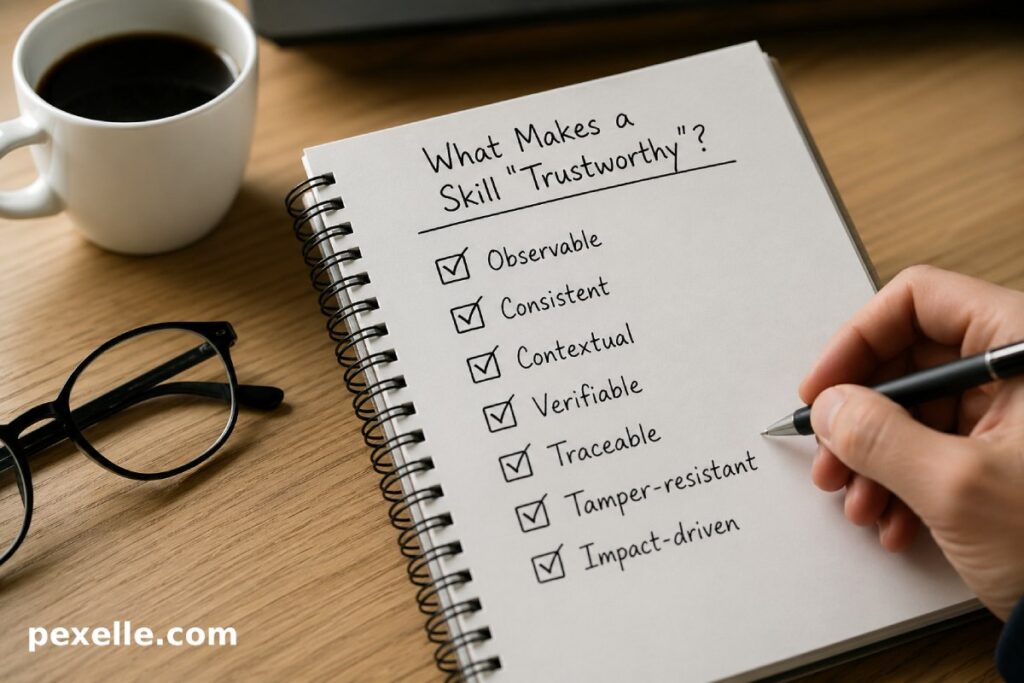
A trustworthy skill is one that is:
- Observable
- Consistent
- Contextual
- Verifiable
- Traceable
- Tamper-resistant
- Impact-driven
This new model transforms how we hire, learn, and evaluate talent. It replaces assumptions with data, claims with evidence, and trust with verification.
Final Thought
In a world increasingly driven by data and transparency, trust is no longer given—it is earned through proof.
The question is no longer: “What skills do you have?”
But rather: “What can you prove, and how reliably can you prove it?”
Source : Medium.com