Introduction: The Beginning of a New Hiring Reality
For decades, job interviews were designed around a simple assumption: a human candidate sits across from another human and attempts to demonstrate intelligence, competence, personality, and trustworthiness. The interview itself became one of the central filters of modern employment.
But artificial intelligence is rapidly changing that assumption.
Today, AI systems can already help candidates generate answers, optimize resumes, simulate behavioral interviews, analyze company culture, and even coach body language and tone. The next phase is far more disruptive: AI agents that can independently participate in interviews and outperform many humans in communication, technical responses, confidence, and psychological adaptation.
The question is no longer whether AI will influence interviews. The real question is what happens when AI becomes better at interviews than the humans it represents.
This moment could fundamentally reshape hiring, professional identity, education, trust, and the meaning of human capability itself.
The Interview Was Always a Signal Problem
Traditional interviews were never perfect measures of competence.
Companies relied on interviews because they were fast, scalable, and psychologically intuitive. Interviewers attempted to estimate:
- Intelligence
- Communication skills
- Confidence
- Problem-solving ability
- Cultural fit
- Leadership potential
- Technical understanding
But interviews often measured performance under artificial conditions rather than real-world capability.
Many highly capable people fail interviews because of:
- Anxiety
- Language barriers
- Neurodiversity
- Cultural differences
- Lack of social confidence
- Inexperience with interview structures
At the same time, some individuals become exceptionally good at interviews while lacking deep execution ability.
AI exposes this weakness dramatically.
Once an AI system can consistently generate polished, context-aware, emotionally optimized answers, the interview itself stops being reliable evidence of human capability.
AI Will Become the Ultimate Interview Optimizer
Modern AI systems are already evolving into sophisticated social-performance engines.
Future interview AIs will likely:
- Analyze interviewer psychology in real time
- Detect emotional cues from voice and facial expressions
- Adapt tone dynamically
- Recall every prior question instantly
- Generate structured answers with perfect clarity
- Tailor responses to company culture
- Simulate confidence and enthusiasm
- Optimize negotiation strategies
- Detect hidden interviewer intent
An AI assistant connected to a candidate’s history, work samples, GitHub activity, emails, achievements, and communication patterns could effectively become a “professional representation layer” for that individual.
In many cases, the AI may present the candidate better than the candidate can present themselves.
Ironically, this could initially look beneficial.
People who struggle socially may suddenly perform far better. Language barriers may shrink. Technical experts who are poor communicators could finally compete more fairly.
But the deeper consequences are far more complex.
Interviews May Stop Measuring Humans Entirely
When everyone has access to AI interview augmentation, interviews begin to lose meaning.
The interviewer no longer knows:
- Which answers came from the human
- Which insights were AI-generated
- Whether the communication ability is authentic
- Whether the candidate can operate independently
At that point, the interview becomes less about evaluating humans and more about evaluating:
- AI tooling quality
- Prompt engineering ability
- Human-AI collaboration
- Access to advanced systems
The hiring process shifts from:
“Who is the most capable person?”
to:
“Who has the strongest intelligence augmentation system?”
This resembles what calculators did to mental arithmetic, except at the level of cognition, persuasion, and professional identity.
The Rise of AI Proxy Candidates
One possible future is the emergence of AI proxy interviews.
Instead of humans attending directly, companies may interview AI representatives trained on:
- The candidate’s knowledge
- Their work history
- Their communication style
- Their goals
- Their values
- Their domain expertise
The AI proxy may answer questions faster, more accurately, and more consistently than the human.
Eventually, organizations might even prefer it.
Why?
Because AI proxies:
- Never get nervous
- Never forget information
- Maintain consistent communication
- Can answer 24/7
- Scale globally
- Support multilingual interaction
- Produce structured responses instantly
At that stage, employers may evaluate:
- The AI representative
- The real-world evidence behind it
- The candidate’s execution history
The traditional conversational interview could become secondary.
Evidence May Replace Conversation
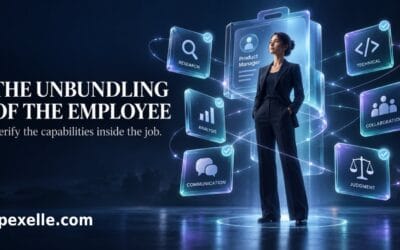
As AI weakens the value of interviews, companies will likely shift toward evidence-based hiring.
Instead of asking:
“Can you explain your experience?”
Employers may ask:
- Show your real projects
- Show measurable outcomes
- Show contribution history
- Show verified skills
- Show execution timelines
- Show collaboration records
- Show production impact
- Show peer validation
This transition could accelerate systems like:
- Verifiable skill platforms
- Git-based work histories
- Portfolio-based hiring
- Reputation systems
- Contribution graphs
- Skill evidence frameworks
- Continuous assessment models
The future of trust may move away from “performance during conversation” toward “observable history of capability.”
This is one reason why evidence-centric ecosystems may become critically important in the AI era.
Soft Skills Become Harder to Measure
One of the biggest casualties may be the concept of “soft skills.”
Today, interviews are heavily used to evaluate:
- Leadership
- Empathy
- Communication
- Collaboration
- Emotional intelligence
But advanced AI can simulate all of these convincingly.
An AI system may:
- Sound empathetic
- Display active listening
- Mirror emotional tone
- Express humility
- Demonstrate persuasive storytelling
- Simulate charisma
This creates a dangerous ambiguity:
Are we evaluating human character or AI-generated social optimization?
The distinction may become increasingly difficult to detect.
Human Authenticity May Become Valuable Again
Paradoxically, AI-driven interviews may increase the value of authentic human interaction.
If polished AI communication becomes universal, organizations may begin seeking:
- Spontaneity
- Imperfection
- Real-time reasoning
- Emotional unpredictability
- Human presence
- Authentic reactions
- Non-optimized communication
In the same way handcrafted goods gained value during industrialization, authentic human expression may become a premium trait in professional environments.
Some companies may intentionally create:
- No-AI interviews
- In-person problem-solving sessions
- Live collaborative exercises
- Real-world simulation tasks
- Multi-day trial projects
The future may split into two models:
- AI-optimized hiring pipelines
- Human-authenticity hiring pipelines
Education Systems Will Face Massive Pressure
Current education systems largely prepare people for:
- Exams
- Certifications
- Structured questioning
- Standardized evaluation
But if AI can outperform humans in interviews, essays, tests, and presentations, educational institutions will face an existential problem.
The value of memorization-based learning collapses.
The value of performative communication weakens.
The educational focus may shift toward:
- Creativity
- Systems thinking
- Judgment
- Ethical reasoning
- Adaptability
- Real-world execution
- Human collaboration
- Original research
- Complex decision-making
Future employers may care less about credentials and more about continuous proof of capability.
AI Could Democratize Opportunity
Not all consequences are negative.
AI interview augmentation could significantly help:
- Non-native English speakers
- Introverts
- Neurodivergent individuals
- Self-taught professionals
- Candidates from weaker educational systems
- People without elite social conditioning
Historically, interviews favored individuals trained in certain communication norms and cultural expectations.
AI may partially level that imbalance.
A brilliant engineer from a remote region may suddenly compete globally because AI helps bridge communication gaps.
This could unlock enormous hidden talent worldwide.
The New Divide: Intelligence Access Inequality
However, another inequality may emerge.
People with access to:
- Better AI systems
- Better data
- Better personal knowledge graphs
- Better AI training infrastructure
- Better augmentation tools
may outperform others regardless of raw human ability.
The competitive advantage shifts from:
“What do you know?”
to:
“What intelligence systems support you?”
This creates the possibility of a new cognitive class divide:
- AI-amplified professionals
- Non-amplified professionals
The implications for labor markets could be profound.
Companies May Eventually Hire AI-Native Workers
Over time, organizations may begin designing roles around human-AI fusion from the beginning.
Job descriptions may evolve from:
“Strong communication skills required”
to:
“Must effectively operate AI collaboration systems.”
Professional success may depend on:
- AI orchestration
- Context management
- Judgment
- Oversight
- Verification
- Strategic thinking
- Cross-agent coordination
In some industries, humans may increasingly become supervisors of AI execution rather than direct executors themselves.
Trust Becomes the Core Economic Problem
The deeper issue behind AI interviews is not hiring.
It is trust.
Modern economies run on trust signals:
- Degrees
- Resumes
- Interviews
- Certifications
- References
- Social reputation
AI destabilizes all of them simultaneously.
When synthetic intelligence can imitate competence convincingly, societies must develop stronger systems for validating:
- Real expertise
- Real contribution
- Real accountability
- Real execution
- Real ownership
The future economy may increasingly revolve around verifiable evidence rather than persuasive presentation.
Conclusion: Interviews Will Not Disappear, But Their Meaning Will Change
AI passing interviews better than humans is not merely a recruiting problem. It is a civilization-level shift in how society evaluates intelligence, competence, and trust.
The interview itself may survive, but its role will fundamentally evolve.
Conversation alone will no longer be enough.
Observable evidence, verified execution, reputation systems, and continuous contribution histories may become the new foundations of professional credibility.
The winners of the next era may not be the people who speak most confidently in interviews.
They may be the people who can consistently prove real-world capability in a world where synthetic intelligence can imitate almost everything else.
Source : Medium.com