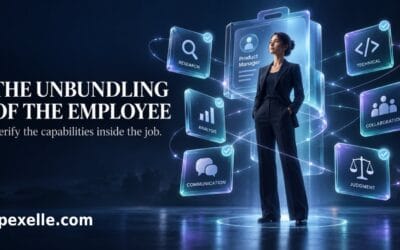

From “Skills = Power” to the Ownership War Over Human Capability
Introduction: Skills Are the Real Capital
For most of modern history, economic power followed land, then machines, then capital, then information.
That era is over.
Today, skills not degrees, not job titles, not resumes are the primary unit of economic value.
And whoever controls skill data controls:
- Who gets hired
- Who gets trained
- Who gets paid
- Who becomes economically invisible
This is not a philosophical debate.
It is an infrastructure war.
1. Skills ≠ Job Titles (And the Market Is Still Lying)
Job titles are a blunt, outdated proxy. They hide more than they reveal.
Two people with the same title:
- Can perform radically different tasks
- Can operate at entirely different levels
- Can have zero overlapping real capabilities
Yet labor markets, HR systems, visas, payroll, and AI hiring models still treat titles as truth.
This is not inefficiency. This is structural distortion.
When systems don’t resolve skills at the task level, power shifts to intermediaries who interpret skill on your behalf platforms, recruiters, credential vendors.
If you don’t own your skill resolution, someone else defines your economic value.
2. Skill Data Is Not Neutral — It Encodes Power
Skill data sounds technical. It isn’t.
Skill data determines:
- Which skills are “valuable”
- Which skills are “obsolete”
- Which skills are “certifiable”
- Which skills are “trainable”
Now ask the uncomfortable question:
Who decides this?
Today, the answer is:
- Platforms
- Vendors
- Governments
- Large employers
- Closed AI models
Not workers. Not learners. Not communities.
Skill data is governance.
3. Platform Ownership = Skill Extraction
Most platforms claim to “empower talent.”
What they actually do is extract skill signals.
You upload:
- Your work history
- Your projects
- Your learning paths
- Your assessments
They convert this into:
- Proprietary graphs
- Closed rankings
- Internal scores
- Platform lock-in
You can’t export it.
You can’t audit it.
You can’t reuse it elsewhere.
That is not empowerment.
That is economic enclosure.
4. AI Makes the Problem Worse — Not Better
AI hiring systems don’t solve bias.
They scale it.
If:
- Skill definitions are opaque
- Training data is platform-owned
- Evaluation logic is undisclosed
Then AI becomes a skill gatekeeper, not a neutral matcher.
The more AI intermediates labor markets, the more dangerous centralized skill ownership becomes.
An AI that evaluates skills you don’t control is an economic weapon pointed at you.
5. The Missing Layer: Skill as Public Infrastructure
We already understand this pattern.
- Roads are public
- GPS is public
- Internet protocols are public
Because private ownership of them would distort society.
Skills are no different.
A modern economy requires:
- Open skill taxonomies
- Verifiable, portable skill evidence
- Cross-platform skill identity
- User-controlled skill graphs
Without this, labor markets become:
- Fragmented
- Manipulable
- Exclusionary
6. Ownership vs Custody: A Critical Distinction
Let’s be precise.
Platforms can host skill data.
They must not own it.
Ownership means:
- You control access
- You control reuse
- You control revocation
- You control interpretation context
Anything less is digital feudalism.
7. What Happens If We Get This Wrong
If current trends continue:
- Skills become platform-bound assets
- Workers become algorithmically rated commodities
- Mobility collapses
- Reskilling becomes permissioned
- Economic power concentrates further
At that point, education reform won’t matter.
Labor rights won’t matter.
Even AI regulation won’t matter.
Because the economic substrate is already captured.
8. The Only Viable Path Forward
A sustainable future requires:
- Task-level skill resolution, not titles
- Decentralized skill evidence, not platform CVs
- User-owned skill graphs, not platform profiles
- Verifiable attestations, not self-claims
- Interoperable standards, not vendor APIs
This is not idealism.
It is infrastructure realism.
Conclusion: Skill Ownership Is the New Class Divide
In the 20th century, power followed capital.
In the 21st century, power follows skill data ownership.
If you don’t own your skill data:
- You don’t control your economic future
- Someone else prices your labor
- Someone else defines your worth
This is the quiet war shaping the next global economy.
And it is already underway.
Source : Medium.com