
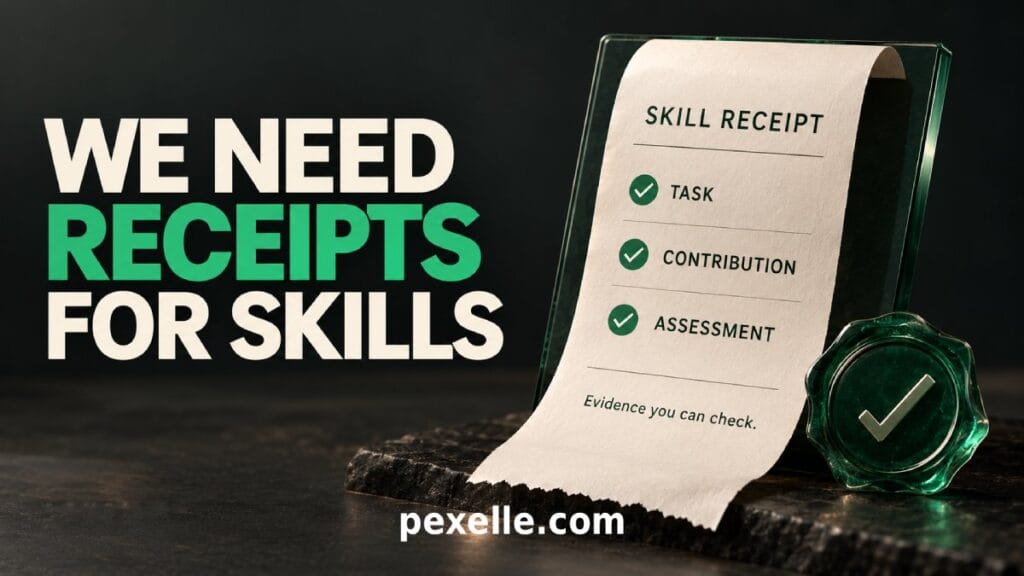
We Need Receipts for Skills
“I can actually do this” should come with something we can check.
Buy something online, and you receive a receipt.
Complete a course, and you may receive a certificate.
Prove your identity, and you present an ID.
But say, I can actually do this, and what do you show?
A job title? A polished profile? A list of tools? A portfolio whose production process nobody can see?
We have familiar ways to document transactions, education, and identity. Demonstrating capability is less straightforward.
There are already ways to assess skills: practical tests, work samples, references, professional licences, and observed performance. The problem is that the evidence is often scattered, difficult to interpret, or tied to one employer or institution.
A person can spend years developing a capability and still struggle to make it visible. Another person can describe that same capability convincingly without having demonstrated it.
We need a better way to connect a claim to the work that supports it.
We need receipts for skills.
What a Skill Receipt Would Actually Prove
A purchase receipt records a transaction. It tells you what was purchased, when, and from whom. It does not guarantee that the product will satisfy every future need.
A skill receipt should have similarly clear limits.
It would record a specific demonstration of capability: what someone did, under which conditions, with what support, and against which criteria.
It would not say:
“This person is an expert at everything related to project management.”
It might say:
“This person planned and coordinated a six-week delivery involving three teams, managed two scope changes, and met the agreed acceptance criteria. Their contribution was reviewed by the project lead.”
The second statement gives someone else a basis for judgment.
That is the purpose of a skill receipt: to make a claim inspectable without pretending that one successful task proves unlimited competence.
A Certificate and a Capability Claim Answer Different Questions
A certificate can be valuable. Depending on the assessment behind it, it may demonstrate attendance, knowledge, practical performance, or achievement against a professional standard.
But its meaning depends on what was actually assessed.
Someone evaluating a candidate needs to know more than the name of a course. Did the participant complete an independent practical task? Were they assessed under supervision? Did they demonstrate the skill once, or repeatedly? How closely did the assessment resemble the work they will be asked to do?
The same questions apply to experience.
“Five years in the industry” describes time. It does not reveal the range of problems someone handled, the decisions they owned, or the quality of their contribution.
A skill receipt could add that missing detail.
Education would remain part of the story. Experience would remain part of the story. Evidence would help explain what those experiences enabled the person to do.
A Portfolio Shows the Result. We Also Need to Understand the Contribution.
Imagine two candidates presenting excellent websites.
One designed the architecture, implemented the application, resolved security issues, and tested the deployment.
The other adapted a template, used AI to generate most of the implementation, and relied on a colleague to fix the production problems.
Both may have contributed useful work. Both may deserve credit. But they have demonstrated different capabilities.
A screenshot cannot tell you which is which.
The useful questions sit behind the finished product:
What did this person own? Which decisions did they make? What assistance did they use? Could they explain the choices? What happened when something failed?
A skill receipt would connect the visible outcome to the person’s actual role in producing it.
That distinction matters because hiring someone means trusting them with future work, including situations that will not look exactly like their portfolio.
AI Makes the Conditions of Performance More Important
AI can help people produce work that would previously have required more time, training, or specialist support.
That creates opportunity. It also makes the relationship between output and capability harder to interpret.
A strong result might demonstrate deep subject knowledge. It might demonstrate excellent use of AI. It might reflect careful review by another person. Often, it reflects a combination.
An assessment should make those conditions visible.
For example:
“Produced a working prototype using AI coding assistance, independently tested the main user flows, and explained the implementation and its limitations during review.”
That is a meaningful claim.
It tells us something about tool use, validation, and understanding. It does not imply that the person wrote every line unaided or could independently solve every problem in the same domain.
The ability to work effectively with AI deserves recognition. So does the ability to detect when its output is wrong.
A useful evidence system should distinguish between generating an answer, evaluating it, and taking responsibility for using it.
What Belongs on a Skill Receipt?
The format could be simple. The substance needs to be precise.
A useful skill receipt would answer six questions:
- What was demonstrated?
A specific capability, described in terms of work someone performed. - What was the task and context?
The problem, its scope, and the constraints that shaped the work. - What did the person contribute?
Their responsibility within an individual or team effort. - What tools and support were used?
Including AI assistance, collaboration, supervision, or provided resources. - How was the work evaluated?
The criteria, the result, and who reviewed it. - When was it demonstrated?
Along with any limitations that affect how the evidence should be interpreted.
Consider the difference between these two profile statements:
Excellent problem-solving skills.
And:
Diagnosed an intermittent integration failure in a test environment, isolated the cause using request logs, implemented a correction, and verified the expected behaviour across the agreed test cases.
The second statement still needs supporting evidence. But it identifies a claim that can be examined.
Precision makes trust possible.
Evidence Needs Its Own Credibility
Calling something “verified” does not make it trustworthy.
A skill receipt is only as useful as the process behind it.
Was the work genuinely performed by the person named? Was the reviewer qualified to judge it? Were the criteria clear? Does the evidence support the wording of the claim?
Different verification methods should remain distinguishable.
A self-submitted work sample, a manager-reviewed contribution, and an independently observed assessment can all provide useful information. They should carry clear descriptions of how they were produced and reviewed.
Likewise, a badge should give people access to the underlying claim and its assessment basis. A badge with no inspectable meaning risks becoming another decorative profile element.
The goal is to help people understand why they should trust a claim, and how far that trust reasonably extends.
Receipts Could Make Overlooked Capability Visible
Some people have strong capabilities and weak opportunities to demonstrate them.
A career changer may have relevant experience under an unfamiliar job title. A migrant may have worked in organisations a local employer does not recognise. A self-taught practitioner may have solved difficult problems without collecting formal credentials.
Clear evidence could help these people explain what they can contribute.
Instead of asking an employer to infer capability from background alone, they could present a specific, reviewed demonstration.
But this only improves access if the opportunity to generate evidence is itself accessible.
A system that requires expensive assessments, prestigious clients, or public disclosure of confidential work could reproduce the barriers it aims to reduce.
Practical alternatives might include supervised tasks, appropriately scoped simulations, redacted work samples, and attestations that describe a contribution without exposing sensitive material.
People should have more than one credible route to demonstrate a skill.
A Skill Receipt Should Have Boundaries
No one should need to expose an entire work history to prove a capability.
Client information, employer intellectual property, and personal data need protection. Evidence should reveal enough to support the claim while respecting those boundaries.
People also need a way to challenge inaccurate records.
If a receipt misstates their role, omits relevant support, or attaches an unfair assessment, there should be a correction process. Otherwise, the record could become a permanent source of misleading judgment.
Time matters too.
An old demonstration may remain relevant, particularly for durable skills. In other cases, tools, standards, or working practices may have changed substantially.
A timestamp gives the evaluator context. It should not automatically erase the value of past achievement.
The right question is whether the evidence still supports the capability being claimed today.
Capability Is Larger Than Any Single Receipt
One successful task is evidence of one successful task.
It may support a broader inference, but it cannot establish how someone will perform in every setting.
A person who can complete a familiar assignment may struggle with an unfamiliar one. Someone who performs well under supervision may need further development before taking full responsibility.
For that reason, skill receipts should accumulate into a richer picture.
Repeated demonstrations across different conditions can reveal consistency, adaptability, and growth. They can also help distinguish between completing a task, diagnosing a failure, and guiding others through the work.
These are different forms of capability. Each deserves to be described accurately.
The aim should be a useful record of demonstrated strengths, with enough context to make responsible decisions.
What This Means for Pexelle
For Pexelle, “receipts for skills” offers a clear principle for how capability could be represented.
A skill card could communicate the claim. Supporting evidence could explain why the claim deserves trust. A badge could identify the assessment or verification associated with it.
Together, they could help answer a practical question:
“What has this person demonstrated, and how do we know?”
The value would come from the quality of the evidence, the clarity of its limits, and the credibility of the review.
That would give a person more than another place to list skills. It would give them a way to carry meaningful evidence of their capability between opportunities.
It would also give employers and collaborators a stronger starting point for a conversation about responsibility, readiness, and fit.
“I Can Do This” Deserves a Better Follow-Up
We should still listen to people’s ambitions. We should still recognise education, experience, and potential.
But when a decision depends on demonstrated capability, we need something concrete to examine.
What did you do?
Under what conditions?
What was your contribution?
How was it assessed?
Those questions can turn a broad claim into a useful basis for trust.
“I can actually do this.”
Here is the evidence.
Source : Medium.com