
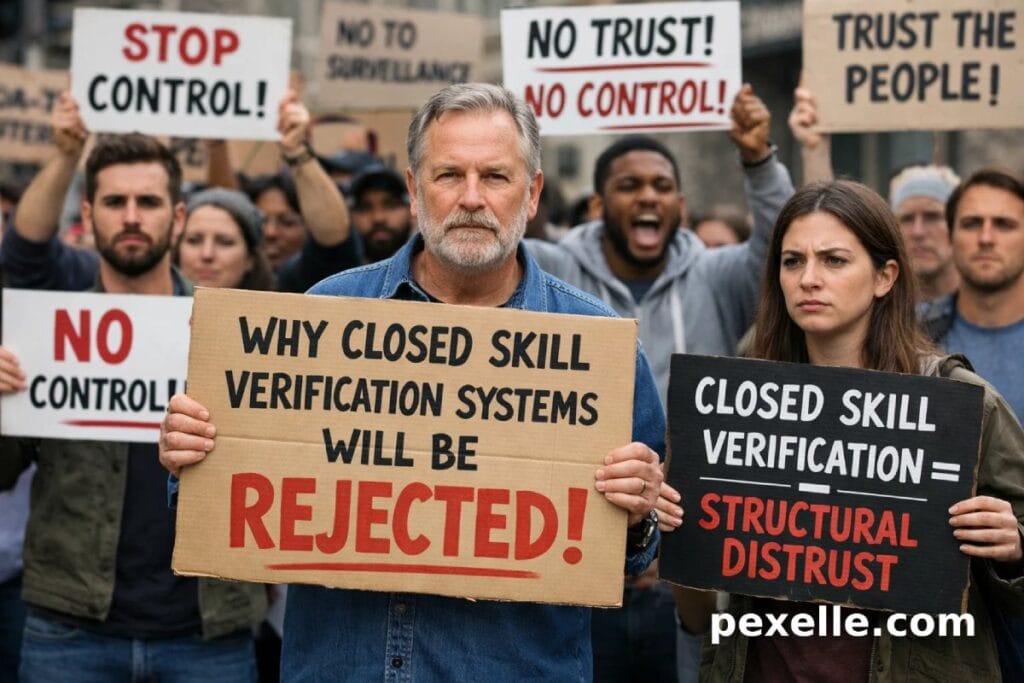
Closed Skill Verification = Structural Distrust
1. The Core Claim (No Soft Framing)
Closed skill verification systems are not “immature,” “early,” or “in need of better UX.”
They are fundamentally incompatible with how trust works in the future labor market.
This is not a design problem.
This is not a governance problem.
This is a structural trust failure.
Any system where:
- one organization defines validity,
- controls issuance,
- owns verification,
- and can revoke or reinterpret skills unilaterally
will be rejected by the market, regardless of branding, partnerships, or adoption tricks.
2. What “Closed Skill Verification” Actually Means
Let’s be precise.
A closed skill verification system has at least three of the following properties:
- Skills are verified only inside a proprietary platform
- Verification logic is opaque or non-auditable
- Skill definitions are controlled by a single authority
- Evidence cannot be independently validated
- Portability is restricted or conditional
- Revocation or mutation happens without user consent
Most current systems fall into this category even the ones claiming to be “open” or “industry-aligned.”
If the source of truth lives inside your database, the system is closed. Period.
3. Why Trust Cannot Exist in Closed Systems
Trust is not a brand promise.
Trust is an emergent property of architecture.
Closed systems ask the market to believe four impossible things:
- That the verifier will remain neutral
- That incentives will never change
- That rules will never be rewritten
- That access will never be weaponized
History shows the opposite every single time.
When incentives shift, closed systems recentralize power, because they can.
That’s not a bug.
That’s what they were built to do.
4. The Structural Asymmetry Problem
Closed verification systems suffer from an asymmetry that cannot be patched.
| Actor | Power |
|---|---|
| Platform | Defines skill reality |
| Employer | Must trust platform |
| Individual | Has zero leverage |
| Auditor | Depends on permission |
The individual the person whose skills supposedly matter most owns nothing.
No portable proof
No independent verification
No exit without loss
That is not a skill system.
That is platform dependency disguised as validation.
5. Skills Are Becoming Infrastructure, Not Credentials
This is where most founders get it wrong.
Skills are no longer “certificates” or “badges.”
They are becoming economic infrastructure.
Infrastructure has rules:
- It must be neutral
- It must be inspectable
- It must survive vendor death
- It must outlive institutions
We don’t build roads owned by one company.
We don’t build electricity grids behind login walls.
And we will not build the future labor market on closed skill ledgers.
6. The AI Pressure Point (This Is Where Collapse Accelerates)
AI doesn’t care about titles.
AI doesn’t care about resumes.
AI doesn’t care about certificates.
AI systems require:
- Verifiable capability signals
- Machine-readable evidence
- Proven skill execution history
Closed systems cannot satisfy this because:
- their logic is not auditable,
- their data is siloed,
- and their outputs are not composable.
AI will not integrate with systems it cannot independently verify.
That alone guarantees rejection.
7. Closed Verification Creates Systemic Risk
Closed systems introduce single-point-of-failure risk at the societal level.
If a platform:
- shuts down,
- changes policy,
- gets acquired,
- becomes politically captured,
then millions of skill records lose meaning overnight.
That is unacceptable risk for:
- governments,
- enterprises,
- global labor markets,
- or individuals planning 40-year careers.
The market will route around this risk whether builders like it or not.
8. The Inevitable Shift: From Authority to Verifiability
The future does not belong to:
- “trusted issuers”
- “industry panels”
- “platform endorsements”
It belongs to verifiable truth.
Skills will be validated by:
- cryptographic proofs,
- traceable evidence,
- multi-party attestation,
- and open verification rules.
Not because it’s ideological.
Because it’s the only model that scales without abuse.
9. Why Adoption Metrics Don’t Save Closed Systems
Closed systems often point to:
- user growth,
- enterprise pilots,
- government MoUs,
- or VC backing.
These are lagging indicators, not proof of viability.
The rejection happens later quietly, structurally, and irreversibly:
- Employers stop trusting outputs
- Individuals stop investing effort
- Integrations stop being built
- AI systems bypass them entirely
By the time metrics drop, the architecture is already obsolete.
10. Final Reality Check (No Escaping This)
You cannot fix a closed skill verification system by:
- adding APIs
- improving UX
- publishing whitepapers
- forming alliances
- rebranding as “open”
If the system cannot be verified without you, it will not survive.
This is not a competitive threat.
This is a law of system design.
Conclusion
Closed skill verification systems are not rejected because people are impatient.
They are rejected because they encode distrust at the structural level.
In a world moving toward:
- AI-driven hiring,
- borderless labor,
- verifiable capability markets,
any system that requires belief instead of proof becomes irrelevant.
Closed skill verification = structural distrust.
And markets always reject distrust eventually, and completely.
Source : Medium.com