
Introduction
For centuries, credibility was relatively easy to establish. A university degree, a respected employer, a published book, or years of professional experience often served as reliable indicators of expertise and trustworthiness. Society built institutions around these signals because producing knowledge, distributing information, and demonstrating competence required significant effort and resources.
Artificial Intelligence is rapidly changing that reality.
Today, AI can write articles, generate software, create realistic images, compose music, answer complex questions, and even imitate human communication styles with remarkable accuracy. As AI systems become increasingly capable, humanity faces an unexpected challenge: determining what and whom to trust in a world where intelligence can be generated on demand.
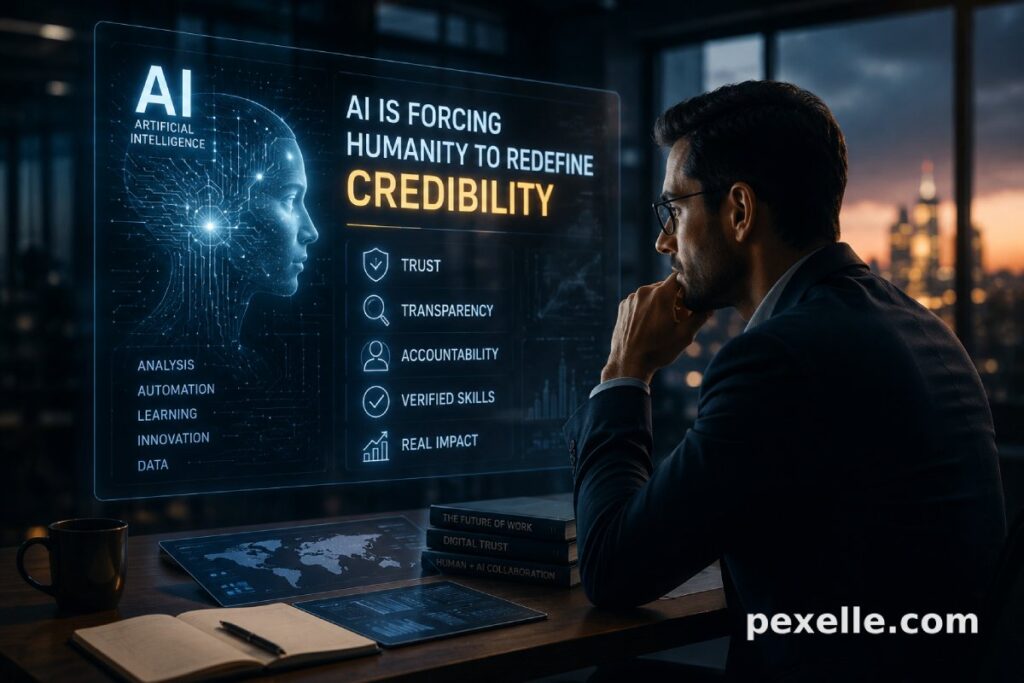
The rise of AI is not simply transforming industries. It is fundamentally forcing humanity to redefine credibility itself.
The Collapse of Traditional Signals
Historically, credibility was often linked to visible achievements and credentials.
A polished resume suggested competence. A well-written article suggested expertise. A professional website suggested legitimacy. A certification suggested mastery of a subject.
These signals worked because producing high-quality outputs required substantial human effort.
AI changes the equation.
A person with little expertise can now generate sophisticated reports, impressive presentations, persuasive marketing campaigns, professional code, and detailed research summaries within minutes. The output may appear indistinguishable from work created by experienced professionals.
As a result, traditional indicators of competence are becoming less reliable.
The question is no longer:
“Can this person produce impressive work?”
Instead, the question becomes:
“Can this person consistently create value, make sound decisions, and demonstrate genuine understanding?”
Intelligence Is Becoming Abundant
Throughout history, intelligence was relatively scarce.
Finding someone capable of writing effectively, analyzing data, solving technical problems, or creating professional designs often required years of education and experience. Organizations competed aggressively for these individuals because their skills were difficult to replace.
AI is dramatically increasing the supply of accessible intelligence.
Tasks that once required specialists can now be performed partially or entirely by machines. This does not mean human expertise becomes irrelevant, but it does mean that raw information processing is becoming increasingly commoditized.
When intelligence becomes abundant, credibility can no longer depend solely on knowledge possession.
Instead, it shifts toward judgment, wisdom, context, and responsibility.
Knowing an answer matters less when everyone can access the same answer instantly.
Knowing which answer matters, when to apply it, and understanding its consequences become far more valuable.
The Rise of Proof Over Claims
One of the most significant shifts AI introduces is the movement from claims to evidence.
In the past, people often relied on statements such as:
- “I am an expert.”
- “I have ten years of experience.”
- “I graduated from a prestigious university.”
- “I worked for a famous company.”
While these signals still hold value, they are becoming less decisive.
The AI era increasingly rewards demonstrable proof.
Can you solve real problems?
Can you show measurable outcomes?
Can you consistently deliver results?
Can others verify your contributions?
The future belongs to individuals and organizations capable of providing transparent evidence of competence rather than relying solely on credentials and reputation.
Digital Trust Is Becoming More Complex
AI-generated content is already flooding the internet.
Articles, videos, images, reviews, social media posts, customer testimonials, and even news reports can be created at massive scale. As generation costs approach zero, the volume of information grows exponentially.
The consequence is a credibility crisis.
Consumers, businesses, governments, and institutions must increasingly ask:
- Is this content authentic?
- Was it created by a human?
- Was it generated by AI?
- Is the information accurate?
- Who is accountable if it is wrong?
Trust is becoming harder to establish because appearance no longer guarantees authenticity.
A perfectly written article may contain fabricated facts.
A convincing image may never have existed.
A realistic video may depict events that never occurred.
The challenge of verification is becoming as important as the challenge of creation.
Reputation Is Becoming Dynamic
Traditionally, reputation was relatively stable.
A strong brand could maintain credibility for decades. A professional’s credentials could remain valuable throughout an entire career.
AI accelerates change.
Information moves faster. Public scrutiny is more intense. Expertise evolves rapidly. New technologies emerge continuously.
As a result, credibility becomes increasingly dynamic rather than static.
People and organizations will need to continuously demonstrate competence, transparency, and adaptability.
Past achievements remain important, but they become only part of an ongoing process of earning trust.
Human Qualities Become More Valuable
Ironically, the rise of artificial intelligence increases the value of uniquely human traits.
When machines can generate information, people seek qualities that machines struggle to replicate authentically:
- Integrity
- Accountability
- Empathy
- Ethical judgment
- Leadership
- Creativity with purpose
- Long-term thinking
These characteristics become critical credibility indicators.
The future may not reward those who simply know the most.
It may reward those who can responsibly apply knowledge while considering human consequences.
Trust increasingly depends on character as much as capability.
The Emergence of Verifiable Skills
Professional ecosystems are beginning to adapt.
Instead of relying solely on degrees and resumes, new systems are emerging that focus on verifiable evidence of skills and achievements.
Examples include:
- Portfolio-based hiring
- Skill verification platforms
- Blockchain credentials
- Public project histories
- Contribution records
- Performance-based assessments
These approaches emphasize observable outcomes rather than claimed expertise.
In an AI-enhanced world, demonstrating capability becomes more important than describing capability.
The future workforce may be evaluated less by what they say they know and more by what they can consistently prove.
Organizations Face the Same Challenge
Businesses are not immune to this transformation.
Companies must also establish credibility in an environment saturated with AI-generated marketing, content, and communication.
Customers increasingly demand transparency.
They want to know:
- How products are built.
- How decisions are made.
- How data is used.
- How AI systems operate.
- Who remains accountable.
Organizations that prioritize openness and verifiable performance will likely gain competitive advantages.
Those relying solely on branding and messaging may struggle as skepticism grows.
The Future of Credibility
The AI revolution is not destroying credibility.
It is redefining it.
Humanity is moving from a world where credentials were often enough to establish trust toward a world where proof, transparency, accountability, and demonstrated impact matter more than ever.
The most trusted individuals and organizations of the future may not be those with the most impressive claims, but those with the most verifiable evidence.
In this new era, credibility becomes less about what someone says and more about what can be proven.
Conclusion
Artificial Intelligence is forcing one of the most profound societal shifts of the digital age.
As machines become capable of generating knowledge, content, and expertise at unprecedented scale, traditional signals of trust are losing some of their power. Degrees, resumes, titles, and polished presentations will continue to matter, but they will no longer be sufficient on their own.
The future belongs to a new model of credibility built on transparency, evidence, accountability, and authentic human judgment.
AI is not merely changing how we work.
It is changing how we decide whom to believe.
And that may prove to be one of the most important transformations of all.
Source : Medium.com