
Why Social Connections Are Not Enough, and Why Skill Graphs Are the Future of Professional Decision Making
Introduction: A Shift in How We Measure Professional Value
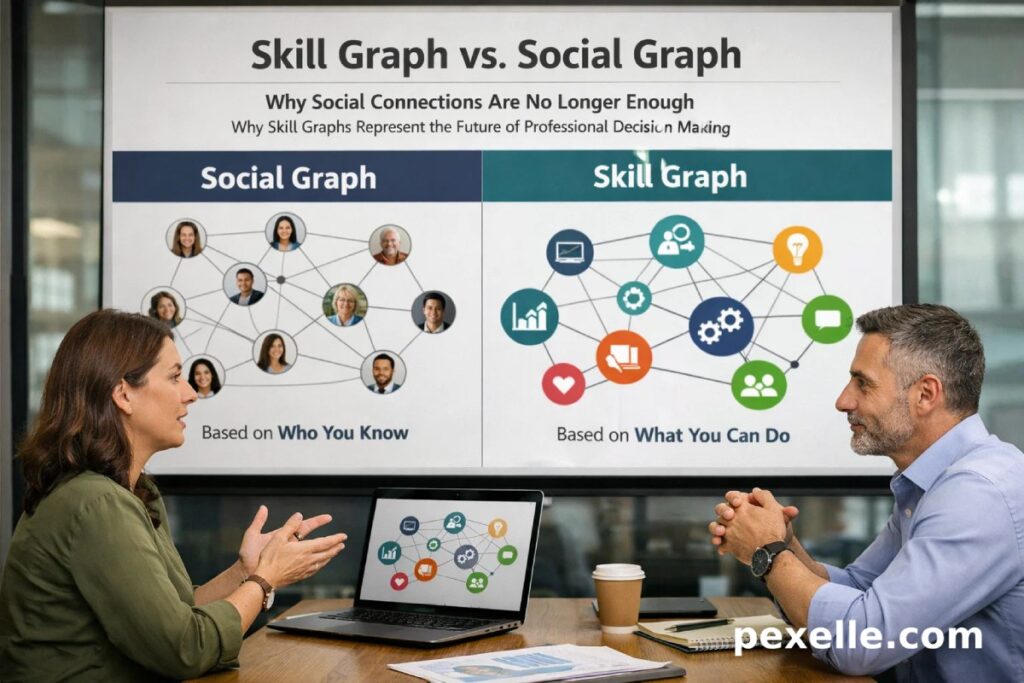
For many years, the professional world has been strongly shaped by the Social Graph. This model focuses on relationships between people, showing who knows whom, who interacts with whom, and who has access to influential networks. It has played a major role in hiring, recruiting, partnerships, and reputation building. In a world where access to opportunity was often tied to visibility and connections, the Social Graph appeared to be a powerful tool. However, the demands of modern work have changed. Today, organizations need to evaluate not only relationships, but also capability, readiness, and proof of performance. That is why the Skill Graph is becoming far more important in professional decision making.
Understanding the Social Graph
A Social Graph is essentially a map of human relationships. It reflects professional networks, followers, referrals, endorsements, and communities of influence. In many systems, it acts as a shortcut for trust. If someone is connected to respected people, works at well known companies, or is surrounded by strong social signals, they are often seen as more credible. This model helped build the early logic of professional platforms because it made discovery easier. It allowed recruiters, managers, and business leaders to identify visible people quickly. But visibility and competence are not always the same thing.
The Main Limitation of Social Connection Based Evaluation
The biggest weakness of the Social Graph is that it tells us more about access than ability. It may show that a person is well connected, highly visible, or socially trusted, but it does not necessarily show whether that person can actually perform a specific task at a high level. In real professional environments, this creates a serious problem. Many talented people remain unseen because they lack strong networks, while others gain opportunities because they are easier to notice. As a result, decisions may be shaped by social proximity rather than real skill.
Why Modern Work Requires More Than Networking
The nature of work has become more complex, more technical, and more dynamic than ever before. Companies now hire for hybrid roles that combine strategy, technology, communication, creativity, data literacy, and execution. In such an environment, broad reputation signals are not enough. A hiring manager needs to know whether a candidate can solve real problems, adapt to new tools, collaborate effectively, and deliver measurable outcomes. A founder building a team needs more than introductions and referrals. They need confidence in actual competence. This is where traditional social models begin to fail.
Defining the Skill Graph
A Skill Graph is a structured map of human capability. Instead of focusing mainly on relationships between people, it connects individuals to skills, skills to evidence, evidence to results, and results to opportunities. It helps answer more meaningful questions such as what a person can do, how well they can do it, where they have applied that skill, and what proof exists to support the claim. In this model, professional identity is not based only on titles or connections. It is based on demonstrated ability and verified readiness.
From Profile Based Identity to Capability Based Identity
Most professional systems today still rely heavily on profiles. These profiles often contain job titles, company names, educational backgrounds, short summaries, and a list of claimed skills. While useful at a surface level, they do not provide enough depth for serious decision making. They are often static, simplified, and self reported. A Skill Graph moves beyond this by creating a capability based identity. Instead of simply stating that someone is a product manager, for example, the graph can show whether they have actually demonstrated market analysis, roadmap planning, cross functional coordination, user research interpretation, and execution under business constraints.
Why Evidence Matters More Than Claims
One of the strongest advantages of the Skill Graph is its focus on evidence. In the modern labor market, claims are everywhere. People describe themselves as experts, leaders, strategists, specialists, and innovators. But professional systems are becoming less interested in labels and more interested in proof. A Skill Graph can connect each skill to evidence such as work samples, project outcomes, certifications, peer validation, assessments, repositories, client results, or documented achievements. This creates a stronger and more trustworthy basis for professional evaluation.
Better Hiring Through Skill Visibility
Hiring is one of the most obvious areas where Skill Graphs can create major value. Traditional hiring often depends on resumes, interviews, and referrals. These methods can be useful, but they are also vulnerable to bias, impression management, and incomplete information. A candidate may sound confident but lack depth. Another may have high capability but poor visibility. A Skill Graph helps employers see beyond polished profiles and focus on real ability. It makes it easier to identify fit, compare candidates more fairly, and reduce the cost of wrong hires.
Stronger Teams Through Skill Mapping
Professional success is not only about hiring the right individuals. It is also about building balanced and capable teams. A team may appear strong on paper because it includes experienced people from respected companies, but still fail due to missing capabilities. A Skill Graph helps leaders understand how skills are distributed across a team. It can reveal whether the team has enough technical depth, strategic thinking, communication strength, execution ability, or problem solving diversity. This allows organizations to build teams based on complementary strengths instead of assumptions.
Internal Mobility and Career Growth
Skill Graphs are also powerful for internal development. In many organizations, employees remain trapped within titles because managers only associate them with their current roles. Yet many people have hidden or underused abilities that are never fully recognized. A Skill Graph makes these strengths more visible. It can show that someone in operations is ready for product coordination, or that someone in customer support has developed strong process design and data interpretation skills. This creates better career mobility and helps companies use talent more intelligently.
Learning and Upskilling with Greater Precision
The future of learning is not just about taking courses. It is about understanding which skills are missing, which ones are adjacent, and which learning steps will create real professional progress. A Skill Graph supports this by mapping relationships between abilities and showing how one skill leads to another. Instead of telling someone to broadly improve themselves, it helps identify exact capability gaps. This makes reskilling and upskilling more practical, especially in industries where roles are evolving quickly and workers need continuous adaptation.
Fairness and Opportunity Beyond Elite Networks
Social Graph driven systems often reward privilege more than performance. People who come from well known institutions, major urban centers, or established professional circles naturally have stronger access to opportunity. Those with fewer connections may remain invisible despite having strong capability. Skill Graphs offer a path toward a fairer model. They do not remove inequality automatically, but they reduce dependence on social access by giving more weight to evidence and demonstrated competence. This helps surface talent that traditional systems frequently overlook.
Why AI Makes Skill Graphs Even More Important
The rise of artificial intelligence is making this shift even more urgent. As AI automates repetitive tasks and changes the structure of work, organizations need a clearer understanding of human strengths. Static profiles and social visibility are weak signals in a fast moving economy. What matters now is applied skill, judgment, adaptability, and evidence of value creation. Skill Graphs are better suited to this environment because they are dynamic. They can evolve as people learn, practice, produce results, and build new forms of proof.
Decision Making Based on Capability Intelligence
Professional decisions are becoming more data driven, but many of them still rely on weak proxies such as company brand names, interview performance, and network reputation. A Skill Graph introduces something more useful: capability intelligence. This means understanding not just who a person is connected to, but what they are ready to do, what problems they can solve, and how confidently a system can trust their ability. For leaders, this improves decision quality across hiring, promotions, team assignments, succession planning, and workforce strategy.
The Role of the Social Graph in the Future
Although the Skill Graph is gaining importance, this does not mean the Social Graph becomes irrelevant. Relationships still matter deeply in professional life. Trust, collaboration, mentorship, referrals, and communities are valuable and will remain so. But their role should change. The Social Graph should be one layer of context, not the main foundation of evaluation. In other words, relationships may open doors, but they should not be the only reason a person enters the room. A better system combines social trust with skill proof, while giving greater importance to evidence based capability.
The Strategic Advantage for Organizations
Organizations that adopt Skill Graph thinking will likely outperform those that continue relying mainly on profile based and connection based judgments. They will hire more accurately, identify hidden talent faster, build stronger teams, and design more effective learning pathways. They will also become more resilient in times of change because they will understand their real capability structure, not just their formal org chart. In competitive industries, this kind of insight can become a major strategic advantage.
The Professional Advantage for Individuals
For individuals, the Skill Graph creates a healthier and more meaningful path to growth. Instead of focusing only on visibility, personal branding, and networking, professionals are encouraged to build substance, produce evidence, and develop real capability. This does not reduce the value of relationships, but it changes the basis of credibility. In the future, the strongest professional advantage will come from being able to prove what you can do, how you have done it, and why your abilities matter in a changing world.
Conclusion: From Connection to Capability
The transition from Social Graph to Skill Graph represents a deeper change in how professional value is understood. It is a move from visibility to capability, from reputation to evidence, and from static identity to dynamic readiness. Social connections are still useful, but they are no longer enough for the complexity of modern work. The future belongs to systems that can understand real human skill in a clear, structured, and verifiable way. That is why the Skill Graph is not just a new concept. It is the future of professional decision making.
Source : Medium.com