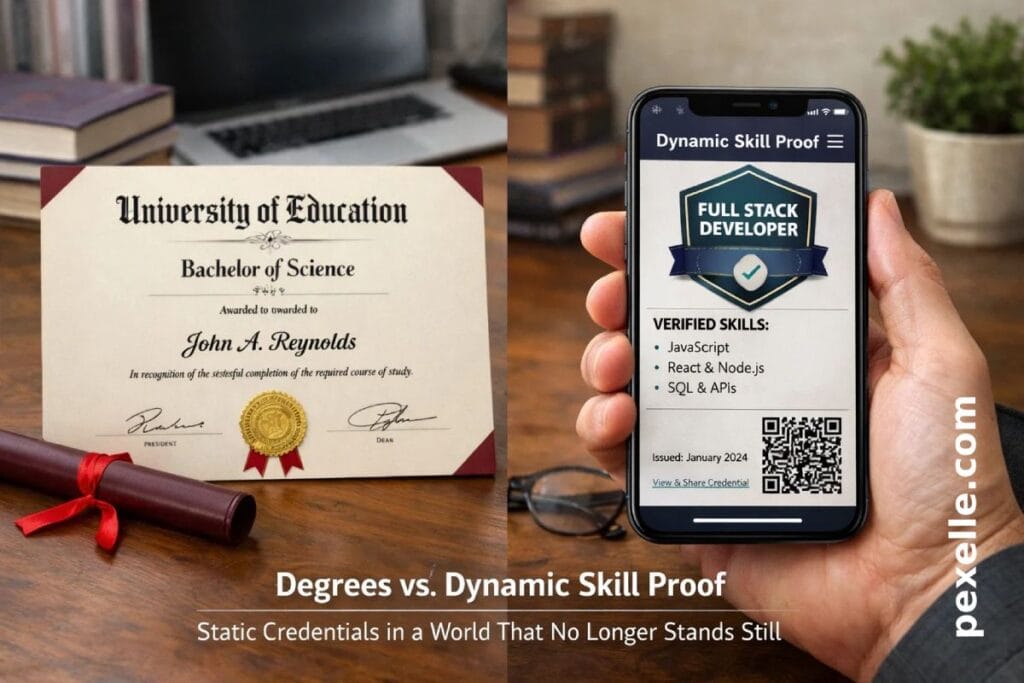
Static Credentials in a World That No Longer Stands Still
Introduction: The Credential Illusion
For decades, degrees have functioned as a proxy for competence.
A diploma, stamped and framed, implied readiness, capability, and trust.
But here’s the uncomfortable truth:
Degrees don’t prove skills.
They prove historical enrollment.
In a labor market shaped by AI acceleration, rapid tool turnover, and role hybridization, static credentials are becoming informationally obsolete. Yet institutions continue to treat them as ground truth.
This mismatch is not just inefficient it is structurally dangerous.
What a Degree Actually Represents
A degree is a snapshot taken at a single moment in time.
It typically certifies that:
- You completed a predefined curriculum
- You passed standardized assessments
- You met institutional requirements at graduation
What it does not certify:
- Whether you still retain those skills
- Whether those skills are still relevant
- Whether you can apply them in real conditions
- Whether you’ve evolved since graduation
A degree is a frozen artifact in a dynamic system.
The Velocity Problem
Skills decay faster than institutions update.
Programming frameworks change yearly
Marketing platforms shift quarterly
Cybersecurity threats mutate weekly
AI tooling evolves monthly
Yet degrees operate on multi-year revision cycles.
This creates a fundamental asymmetry:
- Skills evolve continuously
- Credentials update discretely (if at all)
The faster the world moves, the less signal a static credential carries.
Hiring’s Open Secret: Degrees Are Filters, Not Proof
Most employers already know this.
Degrees are rarely used as evidence of capability they’re used as:
- A filter to reduce applicant volume
- A liability shield for HR
- A proxy for social signaling
That’s why:
- Degree requirements disappear in practice
- Experience “substitutes” credentials
- Hiring managers rely on informal trust signals
The system survives not because it works but because it’s familiar.
Dynamic Skill Proof: A Different Primitive
Dynamic skill proof flips the model.
Instead of asking:
“What did you study?”
It asks:
“What can you demonstrably do right now?”
Dynamic proof is:
- Time-bound
- Evidence-backed
- Contextual
- Verifiable
- Continuously updateable
It treats skills as living assets, not historical claims.
What Counts as Dynamic Proof?
Dynamic skill proof is not self-reported confidence.
It is verifiable output.
Examples include:
- Versioned code contributions
- Production deployments
- Solved real-world incidents
- Audited work artifacts
- Performance metrics over time
- Peer-validated outputs
- Cryptographically verifiable evidence
The key difference:
Proof is tied to action, not assertion.
Skill Decay Is Not a Personal Failure
Traditional systems moralize skill decay.
They imply:
“If you have the degree, you should still know this.”
But decay is a property of reality, not individuals.
Dynamic systems accept decay as normal and measure freshness instead of permanence.
A skill unused for five years should not be trusted by default.
That’s not harsh.
That’s honest.
Why Institutions Resist Dynamic Proof
Dynamic skill proof threatens legacy power structures.
It undermines:
- Curriculum gatekeeping
- Degree monopolies
- Institutional branding
- Tuition-based signaling
- Credential rent-seeking
If proof is continuous and verifiable, authority shifts:
- From institutions → individuals
- From credentials → evidence
- From prestige → performance
Resistance is predictable.
Trust in the Age of Verification
Social trust is failing at scale.
Endorsements, references, and titles are increasingly gameable.
Dynamic skill proof enables verifiable trust:
- Claims are inspectable
- Evidence is auditable
- Histories are transparent
- Fraud is detectable
Trust becomes computational, not reputational.
The Future Hiring Stack
Degrees won’t vanish overnight but they will degrade.
The emerging stack looks like:
- Degrees → weak priors
- Evidence → primary signal
- Skill freshness → weighting factor
- Contextual performance → decision driver
Hiring becomes less about pedigree and more about provable capability.
Conclusion: Static Credentials Can’t Describe Dynamic Humans
Humans are not static.
Skills are not permanent.
Work is not linear.
Yet we keep using credentials designed for an industrial era to evaluate a post-industrial workforce.
Dynamic skill proof doesn’t devalue education
it demands accountability from it.
In a world that changes daily, the only credible proof is the one that evolves with you.
Static credentials describe who you were.
Dynamic proof shows who you are.
And in the future of work, that difference is everything.
Source : Medium.com