
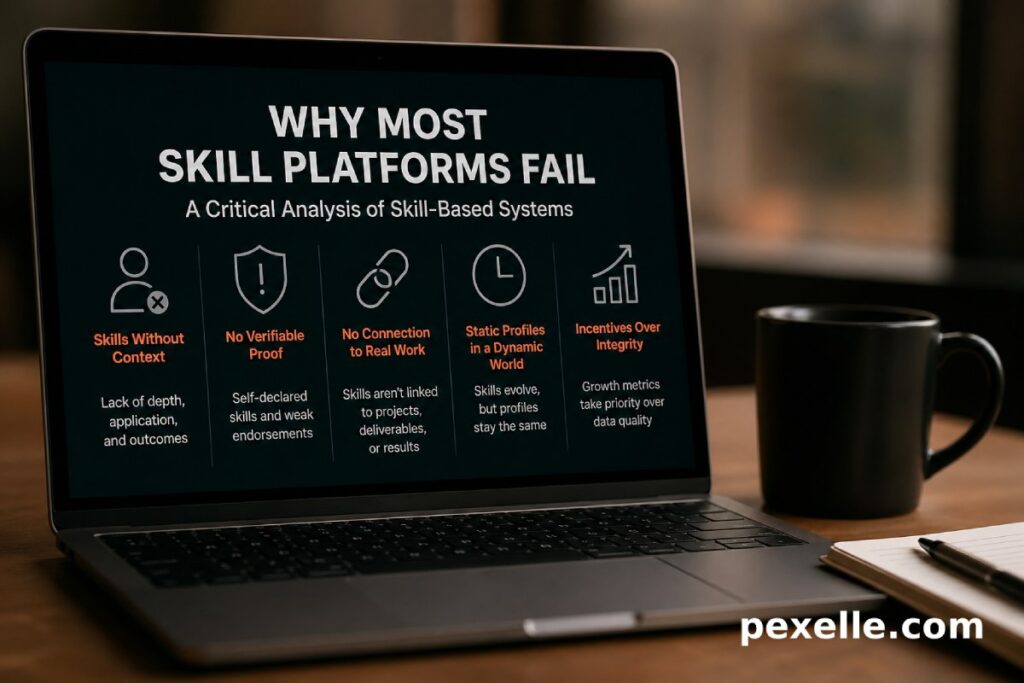
1. The Promise vs. Reality of Skill Platforms
Skill-based platforms emerged with a powerful vision: to replace outdated resumes with measurable, verifiable abilities. In theory, they should create a fair, merit-driven ecosystem where individuals are evaluated based on what they can actually do. However, in practice, many of these platforms fail to deliver meaningful outcomes. Instead of becoming trusted infrastructures for talent, they often degrade into shallow databases of claims, disconnected from real-world value.
The gap between intention and execution is not accidental. It stems from fundamental design flaws in how skills are defined, validated, and used across systems.
2. Skills Without Context Are Meaningless
One of the most critical failures is treating skills as isolated labels. Many platforms reduce a person’s capabilities to tags like “JavaScript,” “Project Management,” or “Marketing.” However, a skill without context has little meaning.
Key missing dimensions often include:
- Depth: Beginner vs. expert is rarely measurable
- Application: Where and how the skill was used
- Outcome: What results were achieved using the skill
- Environment: Real-world constraints vs. controlled conditions
Without these layers, skill data becomes ambiguous and unreliable, making it difficult for employers or collaborators to make informed decisions.
3. Lack of Verifiable Proof
Most platforms rely heavily on self-declared skills. Users list abilities without any strong mechanism to validate them. Endorsements and badges attempt to solve this problem, but they often lack rigor and can be easily gamified.
Common issues include:
- Endorsements exchanged without real evaluation
- Certifications disconnected from practical ability
- Assessments that test theory but not execution
As a result, trust erodes. When everyone can claim the same skills, differentiation disappears.
4. No Connection to Real Work
A major structural weakness is the disconnect between skills and actual work artifacts. Many platforms fail to link skills to:
- Projects
- Code repositories
- Deliverables
- Real business outcomes
Without this connection, skills remain abstract. A platform that cannot trace a skill back to real-world evidence cannot function as a reliable decision-making tool.
5. Static Profiles in a Dynamic World
Skills evolve rapidly, especially in fields like technology, AI, and digital systems. Yet most platforms treat profiles as static entities. Users create a profile once and rarely update it meaningfully.
This leads to:
- Outdated skill representations
- Misalignment with current capabilities
- Loss of relevance over time
A skill system that does not continuously evolve with the user becomes obsolete quickly.
6. Incentive Misalignment
Many platforms prioritize growth metrics over data quality. Their business models often depend on:
- Increasing user sign-ups
- Maximizing engagement
- Expanding skill listings
This creates incentives to lower validation standards, making it easier for users to add skills rather than ensuring those skills are accurate. Over time, this compromises the integrity of the entire system.
7. Poor Skill Taxonomy and Standardization
Another overlooked issue is the lack of standardized skill frameworks. Different platforms define and categorize skills inconsistently, leading to fragmentation.
Consequences include:
- Difficulty in comparing candidates
- Incompatibility between systems
- Redundant or overlapping skill definitions
Without alignment to structured frameworks such as ESCO or O*NET, skill data cannot scale across industries or geographies.
8. Weak Feedback and Evaluation Loops
Effective systems require continuous feedback. However, most skill platforms lack strong evaluation loops that:
- Update skill levels based on performance
- Incorporate peer or expert reviews
- Reflect real-world changes in capability
Without feedback, the system cannot learn or improve, and skill profiles remain disconnected from reality.
9. Overemphasis on UI Instead of Infrastructure
Many platforms focus heavily on user interface and experience while neglecting the underlying infrastructure required for trust. Features like sleek dashboards, badges, and gamification create the illusion of progress but do not solve core problems.
A true skill platform should function as infrastructure, not just an interface. It must:
- Ensure data integrity
- Enable verifiable connections between skills and outcomes
- Support interoperability across systems
Without this foundation, the platform cannot sustain long-term value.
10. Absence of Network Effects Around Trust
Successful platforms rely on network effects, but skill platforms often fail to build trust-based networks. Instead of creating ecosystems where:
- Experts validate skills
- Organizations contribute real data
- Systems interconnect seamlessly
they operate in isolation. Without a shared trust layer, the value of the network remains limited.
11. The Path Forward: From Claims to Proof
To overcome these failures, the next generation of skill platforms must shift fundamentally:
- From self-declared skills to evidence-backed capabilities
- From static profiles to dynamic skill histories
- From isolated data to interconnected ecosystems
This requires integrating:
- Real work data (projects, code, outputs)
- Continuous validation mechanisms
- Standardized skill frameworks
- Transparent trust systems
Only by treating skill verification as infrastructure rather than a feature can these platforms achieve their original promise.
12. Conclusion
Most skill platforms fail not because the idea is flawed, but because the execution lacks depth, rigor, and alignment with real-world complexity. Skills are not simple labels; they are dynamic, contextual, and evidence-driven constructs.
A platform that fails to capture this reality will inevitably lose trust and relevance. The future belongs to systems that can transform skills from claims into verifiable, actionable signals systems that organizations can rely on to make critical decisions with confidence.
Source : Medium.com