
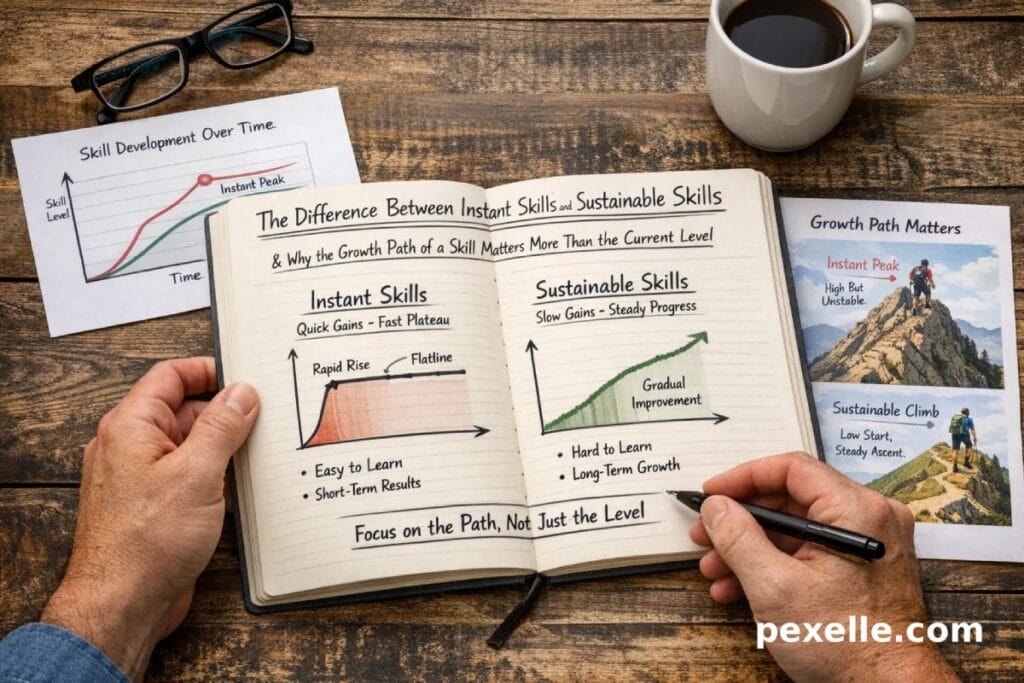
Why the Growth Path of a Skill Matters More Than the Current Level
Introduction
In modern professional environments, skills are often evaluated as if they were fixed points. A person is labeled as a beginner, intermediate, or expert based on their current level of performance. While this approach may appear practical, it overlooks an important reality: skills are not static conditions. They are evolving processes shaped by learning, repetition, failure, adaptation, and time.
Two individuals may display the same level of ability at a particular moment, yet their long-term potential can be completely different. One may have achieved their current capability through sustained learning and consistent practice, while another may possess only short-term familiarity. Understanding the difference between instant skills and sustainable skills helps reveal why the trajectory of growth often matters more than the current snapshot of ability.
What Are Instant Skills?
Instant skills refer to abilities that appear at a particular moment but lack long-term depth or durability. These skills may be acquired quickly through short courses, temporary exposure, or narrow repetition of specific tasks.
In many modern learning environments, instant skills are increasingly common. Online tutorials, short training programs, and accelerated bootcamps allow individuals to gain operational familiarity with tools or techniques within a short time frame. While this can be useful for rapid entry into a field, such skills often remain fragile if they are not reinforced through continuous practice and real-world application.
A developer who memorizes a specific framework for a project, for example, may demonstrate competence during that project. However, if the underlying principles are not fully understood, the ability may fade once the context changes. Instant skills therefore tend to be context-dependent, shallow, and easily forgotten.
What Are Sustainable Skills?
Sustainable skills develop through prolonged engagement, repeated application, and conceptual understanding. These skills are reinforced by experience across different contexts and challenges.
Unlike instant skills, sustainable skills are built gradually. They involve deeper comprehension of underlying principles rather than simple memorization of procedures. Over time, individuals who cultivate sustainable skills become capable of adapting their knowledge to new situations, tools, or environments.
For instance, a programmer who deeply understands algorithms, system design, and computational thinking can adapt to many programming languages or frameworks. Even when technologies evolve, the foundational capability remains valuable.
Sustainable skills therefore exhibit several characteristics:
• long-term retention
• adaptability across contexts
• resilience when conditions change
• continuous improvement through experience
These qualities make sustainable skills significantly more valuable in complex and rapidly evolving industries.
The Limitations of Snapshot Skill Evaluation
Traditional resumes, professional profiles, and hiring systems usually evaluate skills through static snapshots. They attempt to measure what someone can do at this exact moment. While this may provide a quick assessment, it often fails to reveal the deeper structure behind a person’s competence.
A snapshot evaluation ignores questions such as:
• How did the person reach this level?
• How quickly do they learn new skills?
• Have they consistently improved over time?
• Do they maintain their knowledge through real practice?
Two candidates may both claim the same level of proficiency in a skill, yet their learning histories may differ dramatically. One candidate may have spent years developing expertise through diverse projects, while another may have acquired the skill only recently.
Without considering the growth path, decision makers risk misjudging long-term potential.
Why the Skill Growth Path Matters More
The trajectory of skill development reveals information that a simple skill label cannot provide. It shows how individuals approach learning, how they respond to challenges, and how consistently they improve.
A person who demonstrates steady improvement over time often possesses important meta-skills such as curiosity, discipline, and adaptability. These traits enable continued growth even when technologies or industries evolve.
In contrast, someone who appears highly skilled today but lacks a history of sustained development may struggle when faced with unfamiliar problems.
The growth path therefore provides insight into learning capacity, which is often more valuable than current ability alone.
Growth Trajectory as a Signal of Potential
In many fields, the ability to learn quickly and continuously may matter more than existing knowledge. Technologies change, industries transform, and new tools emerge regularly. Professionals who can evolve alongside these changes remain valuable even as specific technical skills become obsolete.
When organizations evaluate the trajectory of a person’s development, they gain a clearer understanding of potential. A candidate who has progressed from beginner to advanced levels through consistent effort may continue to grow in the future.
By contrast, a person whose skills plateaued years ago may struggle to adapt in dynamic environments.
The growth path acts as a signal of future capability, not just present performance.
Implications for Hiring and Talent Evaluation
Recognizing the difference between instant and sustainable skills can improve hiring and talent evaluation processes.
Instead of focusing solely on current skill labels, organizations can analyze patterns of development. Indicators such as long-term project involvement, progressive responsibilities, and continuous learning activities can reveal deeper competence.
Employers who evaluate growth trajectories are more likely to identify individuals capable of long-term contribution. This approach also reduces the risk of hiring candidates whose abilities are limited to narrow or temporary contexts.
By prioritizing sustainable skill development, companies can build teams that remain effective even as technologies and strategies evolve.
The Role of Learning Systems and Professional Platforms
Modern learning platforms and professional ecosystems can benefit from representing skills as evolving timelines rather than static lists. Recording milestones such as education, project experience, certifications, peer recognition, and practical application can provide a clearer picture of how skills develop.
Such systems allow individuals to demonstrate not only what they know today but also how they arrived there. This information can help employers, collaborators, and automated recommendation systems make more informed decisions.
When skills are viewed through the lens of growth, professional identities become more transparent and meaningful.
Conclusion
The difference between instant skills and sustainable skills lies in depth, durability, and adaptability. Instant skills may provide short-term capability, but they often fade without continued practice and understanding. Sustainable skills, on the other hand, emerge from long-term engagement and allow individuals to adapt as circumstances change.
Because of this distinction, evaluating only the current level of ability can be misleading. The path of skill development reveals patterns of learning, resilience, and improvement that are critical indicators of future potential.
In a rapidly changing world, the most valuable professionals are not simply those who possess skills today, but those who consistently build and evolve their abilities over time.
Source : Medium.com