
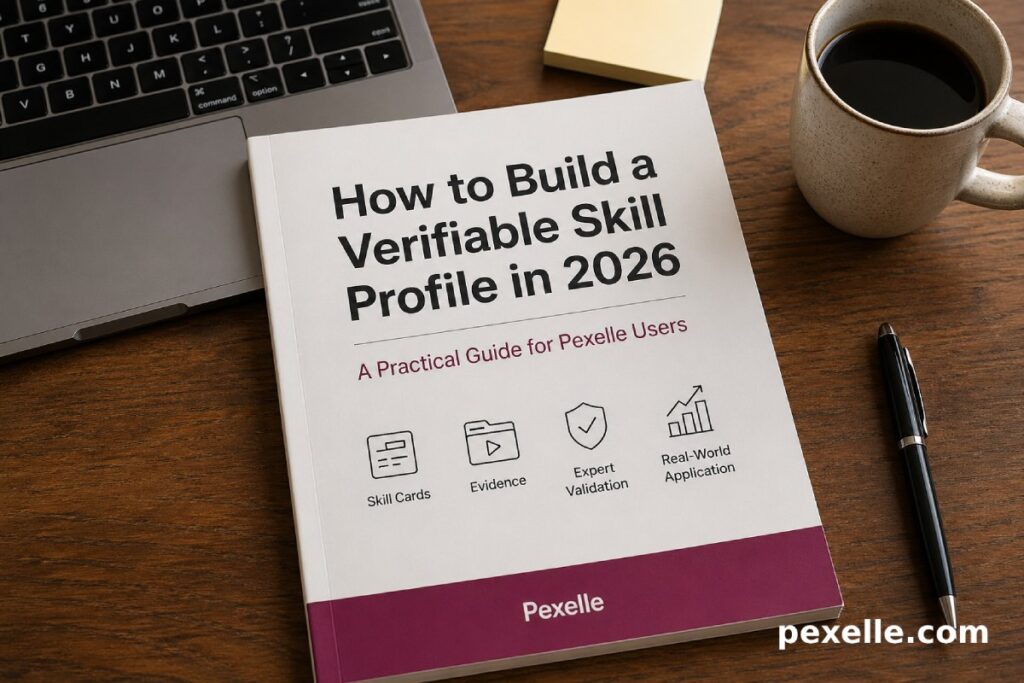
A Practical Guide for Pexelle Users
1. Introduction: From Claims to Proof
In 2026, the definition of a “skill” has fundamentally changed. It is no longer enough to list abilities on a resume or claim expertise in a profile. Employers, collaborators, and platforms now prioritize verifiable skills skills that are supported by observable evidence, structured validation, and real-world application.
Pexelle is designed around this shift. Instead of asking “What do you say you can do?”, it asks “What can you prove you have done?”. This guide walks you through the practical steps to build a strong, verifiable skill profile inside Pexelle.
2. Understanding the Structure of a Verifiable Profile
Before building your profile, it is important to understand its core components:
- Skill Cards: Each represents a specific, measurable skill
- Evidence Layer: Real proof such as videos, projects, or outputs
- Expert Validation: Feedback and scoring from qualified professionals
- Learning Path Context: The structured journey behind the skill
A strong profile is not just a collection of skills it is a network of validated capabilities.
3. Step One: Select the Right Skill Community
Your journey begins by choosing or creating a skill community aligned with your goals.
For example:
- Frontend Development
- AI Model Programming
- Carpentry
- Mechanics
Each community defines a structured set of skills (typically 100–150 skill cards). Selecting the right one ensures that your profile is built on a recognized framework rather than random skills.
Practical Tip:
Choose a community based on where you want to create value, not just what you already know.
4. Step Two: Build Skill Cards with Precision
Each skill card should represent a clear, observable capability.
Weak example:
“JavaScript”
Strong example:
“Implement asynchronous API calls using Fetch and handle error states in a production UI”
Your goal is to:
- Break skills into atomic, testable units
- Avoid vague or overly broad descriptions
- Focus on what can be demonstrated
Rule: If a skill cannot be observed, it cannot be verified.
5. Step Three: Attach High-Quality Evidence
Evidence is the backbone of your profile. Without it, your skills remain claims.
Types of strong evidence:
- Short implementation videos
- Screen recordings of real work
- GitHub repositories or live demos
- Before/after project results
On Pexelle, each skill typically requires at least two pieces of evidence. This redundancy increases trust and reduces manipulation.
Critical Insight:
Evidence should show process + outcome, not just final results.
6. Step Four: Align with Real-World Context
A skill without context is difficult to evaluate. You must connect your skill to a real-world use case.
For example:
- Instead of: “CSS Grid”
- Use: “Built a responsive dashboard layout using CSS Grid for a SaaS admin panel”
This helps:
- Experts evaluate relevance
- Recruiters understand applicability
- AI systems classify your skill accurately
7. Step Five: Request Expert Evaluation
Verification requires external validation.
In Pexelle:
- Experts review your evidence
- They provide scores and qualitative feedback
- Multiple experts reduce bias
Best Practice:
- Submit clean, well-documented evidence
- Provide context for what you built and why
- Avoid overloading experts with unclear submissions
Your goal is not just approval it is credible validation.
8. Step Six: Build a Skill Graph, Not a List
Traditional profiles are linear. Verifiable profiles are graph-based.
Instead of isolated skills:
- Connect related skill cards
- Show progression (beginner → advanced)
- Demonstrate dependencies
Example:
- HTML → CSS → Responsive Design → UI Systems → Frontend Architecture
This transforms your profile into a map of capability, not a checklist.
9. Step Seven: Maintain and Update Continuously
A verifiable profile is not static. Skills evolve, tools change, and standards improve.
You should:
- Update evidence regularly
- Replace outdated work
- Add new validations
- Remove weak or irrelevant skills
Important:
An outdated verified skill can lose trust over time.
10. Common Mistakes to Avoid
- Uploading low-quality or unclear evidence
- Choosing overly broad skills
- Ignoring expert feedback
- Focusing on quantity over quality
- Building skills without real-world application
Each of these reduces the credibility of your profile.
11. Strategic Advantage: Why This Matters
A verifiable skill profile gives you:
- Higher trust in hiring decisions
- Better matching with real opportunities
- Proof-based reputation instead of self-claimed branding
- Compatibility with AI-driven recruitment systems
In a market where automation is replacing routine work, proof of capability becomes the primary currency.
12. Conclusion: Your Profile as a Living Proof System
In 2026, your professional identity is no longer defined by what you say—it is defined by what you can prove.
Pexelle enables you to:
- Structure your skills
- Attach real evidence
- Validate through experts
- Build a dynamic, evolving skill graph
The result is not just a profile, but a verifiable system of trust.
If you approach it correctly, your Pexelle profile becomes more than a portfolio it becomes a credible representation of your real-world ability.
Source : Medium.com