
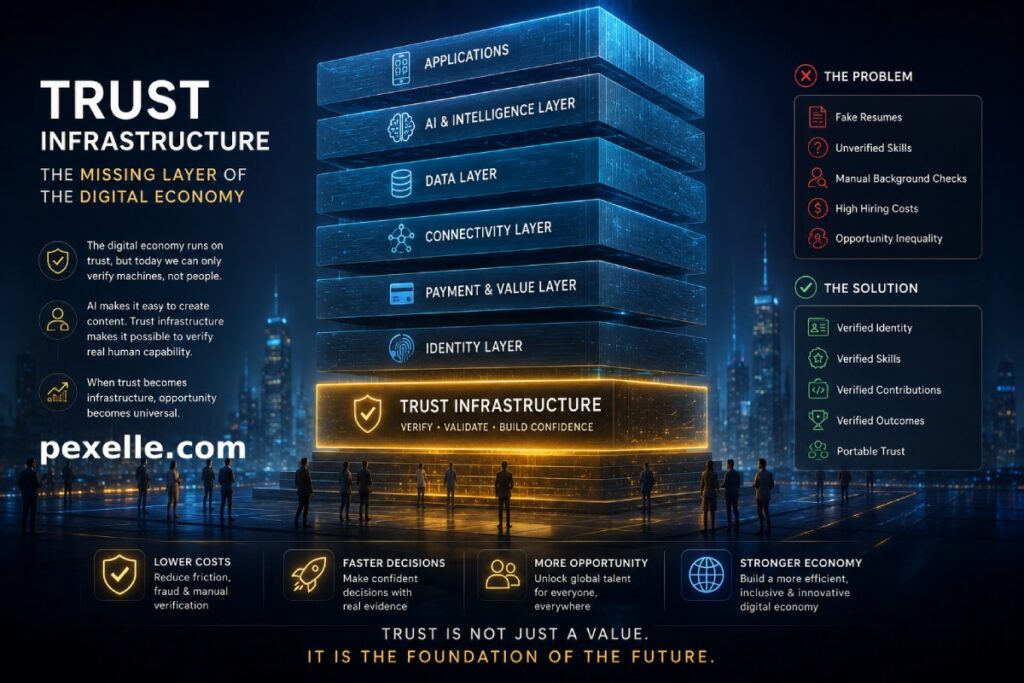
Why the Next Great Technology Revolution Is Not About Faster AI. It’s About Verifiable Trust.
Introduction
Every major technological revolution has been built on invisible infrastructure.
The industrial revolution relied on railroads, electricity, and standardized manufacturing.
The internet relied on TCP/IP, DNS, cloud computing, and broadband networks.
Modern finance relies on payment rails, clearing systems, identity verification, and cryptography.
These infrastructures rarely make headlines, yet they enable everything built on top of them.
Today, the world stands at the beginning of another transformation.
Artificial intelligence is becoming the engine of the digital economy.
But there is one foundational layer that remains largely undeveloped.
Trust.
Not social trust.
Not personal trust.
Digital, scalable, verifiable trust.
Without it, the next generation of AI driven economies will struggle to reach their full potential.
The missing layer of the digital economy is Trust Infrastructure.
Every Digital Revolution Needed a Foundation
When the internet emerged, websites could not communicate without common protocols.
When e commerce appeared, online payments required secure financial networks.
When cloud computing expanded, scalable data centers became essential.
Every breakthrough depended on infrastructure that most users never saw.
AI is following the same path.
The world is investing trillions into building increasingly capable models.
Yet surprisingly little attention is being paid to the infrastructure that determines whether humans can trust the outputs, the contributors, and the interactions surrounding those models.
Technology alone cannot create confidence.
Infrastructure does.
The Digital Economy Runs on Trust
Every online interaction involves an assumption of trust.
We trust that:
- A payment reaches the correct recipient.
- A document has not been altered.
- A website belongs to the organization it claims.
- A software update comes from the original developer.
- A digital signature is authentic.
These assumptions are not based on optimism.
They are supported by infrastructure.
- Protocols.
- Certificates.
- Encryption.
- Consensus mechanisms.
- Verification systems.
- Trust is engineered.
- Yet one critical part of the digital economy still lacks comparable infrastructure.
- Human capability.
The Missing Verification Layer
Today’s internet can verify machines far better than people.
Servers authenticate each other automatically.
Blockchains validate transactions without human intervention.
Payment systems process billions of secure operations every day.
But when it comes to people, we still depend on remarkably fragile methods.
Degrees.
References.
Interviews.
Social profiles.
Manual background checks.
Most of these were designed for a pre AI world.
They are increasingly vulnerable to automation, manipulation, and synthetic content.
The result is a growing verification gap.
Our technology evolves rapidly.
Our methods for verifying human capability do not.
AI Makes Trust More Valuable, Not Less
Many believe AI reduces the importance of human verification.
The opposite is true.
As AI lowers the cost of producing convincing work, it raises the value of proving genuine expertise.
A perfectly formatted resume is no longer meaningful.
An impressive portfolio may no longer indicate experience.
Even live conversations may soon provide limited evidence of actual capability.
The easier it becomes to imitate competence, the more valuable trusted verification becomes.
AI increases the supply of content.
Trust infrastructure protects the quality of decisions built on that content.
Trust Is Becoming an Economic Asset
Trust is often treated as an abstract social value.
In reality, it is measurable economic infrastructure.
High trust environments experience:
- Lower transaction costs
- Faster hiring
- Better collaboration
- Reduced fraud
- Higher productivity
- Greater innovation
- Stronger investment confidence
Low trust environments experience the opposite.
- Every additional interview.
- Every manual verification.
- Every compliance process.
- Every fraud investigation.
- Every unnecessary approval.
These are costs created by missing trust infrastructure.
The global economy spends billions every year compensating for uncertainty.
The Next Layer After Digital Identity
The last decade focused heavily on digital identity.
Governments introduced digital IDs.
Financial institutions strengthened Know Your Customer processes.
Biometric authentication became common.
Identity answers one important question:
Who are you?
But identity alone cannot answer another question that is becoming increasingly important:
What can you actually do?
Future digital economies require both.
Verified identity.
Verified capability.
Together, they create meaningful trust.
From Credentials to Evidence
Traditional credentials are static.
A university degree represents a single milestone.
A certification confirms one examination.
A recommendation reflects one person’s opinion.
Modern work is continuous.
People learn daily.
Contribute across multiple projects.
Develop new skills.
Adapt to changing technologies.
Future trust infrastructure must shift from credentials toward evidence.
Verified contributions.
Verified achievements.
Verified collaboration.
Verified outcomes.
Trust becomes dynamic rather than historical.
Building Trust by Design
Just as cybersecurity became part of software architecture, trust should become part of digital architecture.
Imagine platforms where:
Projects generate verifiable contribution histories.
Skills evolve through demonstrated work.
Professional growth becomes continuously measurable.
Employers evaluate evidence instead of assumptions.
Educational achievements integrate with real world performance.
Creators prove originality.
Researchers verify collaboration.
Freelancers demonstrate consistent delivery.
Trust is no longer an afterthought.
It becomes part of system design.
AI Needs Trusted Humans
Artificial intelligence will increasingly perform routine tasks.
But humans will remain responsible for judgment.
Ethics.
Leadership.
Creativity.
Strategic thinking.
Collaboration.
Decision making.
The more responsibility AI assumes, the more important it becomes to identify the humans capable of supervising it responsibly.
Verification therefore becomes complementary to AI, not competitive with it.
The Rise of Trust Networks
The next generation of platforms may not compete primarily through features.
They may compete through trusted ecosystems.
Networks where:
Professionals build verifiable reputations.
Organizations verify real contributions.
Communities establish reliable expertise.
Employers recruit with greater confidence.
Education connects directly to measurable outcomes.
Trust itself becomes portable.
Individuals carry trusted evidence across industries, countries, and careers.
Just as financial history became portable through credit systems, professional credibility may become globally portable through trust networks.
A New Digital Infrastructure
The internet connected computers.
Cloud computing connected services.
Blockchain connected value.
Artificial intelligence connects knowledge.
The next infrastructure will connect trust.
It will reduce uncertainty.
Accelerate collaboration.
Increase opportunity.
Lower verification costs.
Unlock global talent.
And create entirely new forms of economic participation.
History shows that infrastructure creates ecosystems.
The organizations that build tomorrow’s trust infrastructure will influence every industry that depends on human collaboration.
Conclusion
Every technological era has a defining layer that makes everything else possible.
Roads enabled industrial economies.
Communication protocols enabled the internet.
Payment infrastructure enabled digital commerce.
Artificial intelligence now demands its own foundational layer.
Not another model.
Not another chatbot.
Not another application.
It needs infrastructure that allows people, organizations, and intelligent systems to trust one another at global scale.
Because technology without trust creates uncertainty.
But technology built on verifiable trust creates progress.
The digital economy has already transformed how information moves.
The next transformation will redefine how credibility moves.
And when trust becomes infrastructure, opportunity becomes universal.
Source : Medium.com