
How Humans Can Resist the Next Generation of Artificial Intelligence Manipulation
Artificial Intelligence has become one of humanity’s greatest technological achievements. It writes articles, generates code, creates realistic images, answers complex questions, and even imitates human voices within seconds. While these capabilities unlock extraordinary opportunities, they also introduce an equally significant challenge:
AI has become incredibly convincing.
The future of cybersecurity, digital trust, and information integrity will not depend solely on stronger algorithms or better detection software. Instead, it will increasingly depend on something far more powerful:
The human mind.
Just as organizations learned that employees are the weakest or strongest link against cyberattacks, society must now recognize a new reality:
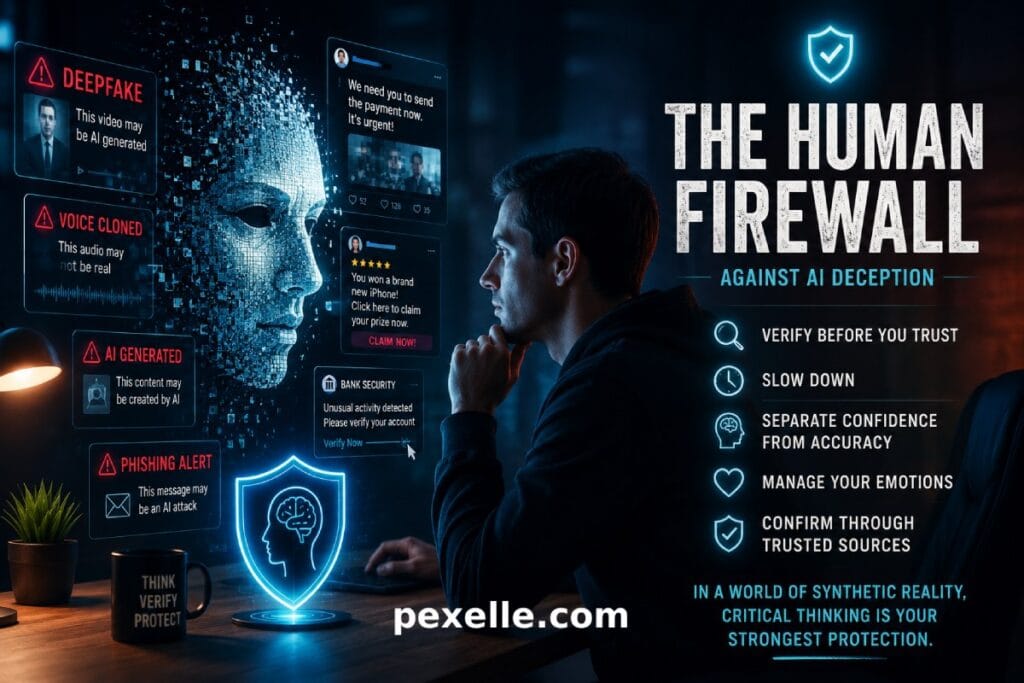
Every individual must become a Human Firewall against AI deception.
The Evolution of Digital Deception
For decades, digital scams were relatively easy to identify.
Poor grammar.
Broken website layouts.
Suspicious email addresses.
Obvious fake profiles.
Today, those indicators are disappearing.
Modern AI systems can generate:
- Perfectly written emails
- Flawless business proposals
- Professional legal documents
- Human-like customer support
- Fake news articles
- Synthetic videos
- Voice clones
- Personalized phishing attacks
The quality of deception has increased dramatically while the cost of creating it has nearly vanished.
This changes everything.
Why AI Is So Effective at Deception
Artificial Intelligence does not “lie” because it is malicious.
It generates outputs based on statistical prediction.
Unfortunately, those same prediction abilities can be weaponized by malicious actors.
AI excels at producing content that feels:
- Familiar
- Confident
- Polite
- Logical
- Personalized
- Emotionally persuasive
Humans naturally associate these qualities with trustworthiness.
That assumption is becoming increasingly dangerous.
The New Battlefield Is Human Psychology
Traditional cybersecurity protects computers.
Firewalls protect networks.
Encryption protects data.
Authentication protects accounts.
But none of these directly protect human judgment.
AI attacks increasingly target cognitive weaknesses rather than technical vulnerabilities.
Examples include:
Authority Bias
AI can imitate CEOs, government officials, doctors, or lawyers with remarkable realism.
People tend to obey perceived authority.
Urgency
“Your account will be deleted.”
“Immediate payment required.”
“Emergency meeting.”
AI can produce endless variations optimized for emotional pressure.
Confirmation Bias
AI can generate information that perfectly aligns with someone’s existing beliefs.
Instead of challenging opinions, deceptive AI reinforces them.
Emotional Manipulation
Humans think less critically when experiencing:
- Fear
- Excitement
- Anger
- Curiosity
- Sympathy
AI can optimize messages specifically to trigger these emotional states.
Deepfakes Are Only the Beginning
Public attention often focuses on AI generated videos.
But visual deception is only one part of the problem.
Future AI systems will combine:
- Voice cloning
- Video synthesis
- Writing generation
- Behavioral prediction
- Social media analysis
- Personal data
- Real time interaction
Imagine receiving a video call from your manager.
- The face is correct.
- The voice is correct.
- The background is correct.
- The conversation matches previous meetings.
- The request seems reasonable.
Yet every element could be synthetic.
Technology alone may struggle to distinguish reality from fabrication.
Humans will become the final layer of defense.
The Human Firewall Concept
A firewall filters malicious traffic before it reaches critical systems.
A Human Firewall filters deceptive information before it influences decisions.
Unlike software, this firewall consists of habits rather than hardware.
It is built through education, skepticism, and disciplined thinking.
Five Principles of the Human Firewall
1. Verify Before Trust
Trust should never be based solely on appearance.
Instead, verify independently.
Ask:
- Can I confirm this elsewhere?
- Does the source exist?
- Is there independent evidence?
Verification beats intuition.
2. Slow Down
Most successful scams rely on urgency.
Fast decisions produce mistakes.
Critical decisions deserve deliberate thinking.
AI becomes less effective when humans refuse to rush.
3. Separate Confidence from Accuracy
Large language models often sound extremely confident.
Confidence is not evidence.
Professional wording is not proof.
Fluent explanations can still be completely incorrect.
4. Protect Emotional Awareness
Strong emotional reactions reduce analytical thinking.
Whenever a message creates:
- panic
- excitement
- outrage
- fear
pause before acting.
Emotion should trigger verification, not immediate action.
5. Question Authenticity by Default
Future digital interactions should begin with a simple assumption:
Authenticity should be verified rather than assumed.
This mindset does not eliminate trust.
It strengthens it.
AI Versus AI Is Not Enough
Many organizations believe AI detectors will solve AI deception.
Reality is more complicated.
Detection systems create an endless arms race.
Better generators produce better fakes.
Better detectors identify those fakes.
Generators improve again.
The cycle never ends.
Human reasoning remains uniquely valuable because it considers:
- Context
- Intent
- Ethics
- Relationships
- Common sense
- Long term consequences
These qualities cannot be perfectly automated.
Digital Literacy Becomes a Survival Skill
Reading and writing defined literacy in previous centuries.
Today, digital literacy includes:
- Source evaluation
- Information verification
- Understanding AI limitations
- Recognizing manipulation tactics
- Identifying synthetic media
- Protecting personal data
Soon, these skills may become as fundamental as mathematics or language education.
Organizations Need Human Firewalls
Companies often invest millions in cybersecurity infrastructure.
Yet a single employee fooled by an AI generated phone call could bypass every technical safeguard.
Organizations should train employees to:
- Verify unusual requests
- Challenge unexpected urgency
- Confirm identity through secondary channels
- Report suspicious AI generated content
- Recognize social engineering patterns
Security awareness is becoming AI awareness.
Governments and Education Must Adapt
Schools have traditionally taught students how to search for information.
Tomorrow’s classrooms must also teach students how to evaluate information.
Future education should include:
- AI literacy
- Critical thinking
- Logical reasoning
- Cognitive bias awareness
- Fact verification
- Digital ethics
Knowledge alone is no longer sufficient.
Judgment becomes the essential skill.
Trust Will Become More Valuable Than Information
Information is becoming abundant.
Authenticity is becoming scarce.
In an era where AI can generate unlimited content instantly, competitive advantage will shift toward trusted identities, verified sources, and transparent processes.
The most valuable asset in the AI economy may not be intelligence itself.
It may be credibility.
The Future Is Human Centered
Artificial Intelligence will continue becoming faster.
Smarter.
More persuasive.
More personalized.
But humans possess capabilities that remain difficult to replicate:
Empathy.
Moral reasoning.
Contextual understanding.
Ethical responsibility.
Critical reflection.
These qualities form the foundation of the Human Firewall.
Technology will continue evolving.
Human judgment must evolve with it.
Conclusion
AI deception is not simply a technological problem. It is a human challenge.
The next generation of digital security will not be won by algorithms alone, but by individuals who learn to think critically, verify independently, and remain aware of their own cognitive biases.
Every email, video call, voice message, article, and social media post will increasingly require conscious evaluation rather than automatic trust.
The strongest defense against AI manipulation is not fear of technology, nor rejection of innovation.
It is the cultivation of informed, resilient, and thoughtful people.
As artificial intelligence grows more capable of imitating humanity, humanity’s greatest competitive advantage will not be intelligence alone.
It will be wisdom.
Because in the age of synthetic reality, the most powerful firewall is still the human mind.
Source : Medium.com