Rethinking Trust in the Age of Digital Credentials
For centuries, society has relied on signals to judge human ability. Degrees suggest education. Job titles imply experience. Certificates indicate training. Recommendations build confidence. Portfolios showcase examples. Interviews attempt to uncover competence.
Yet none of these truly prove one simple fact:
Can this person actually do the work?
As artificial intelligence accelerates content creation, resumes become easier to optimize, certificates easier to obtain, and portfolios easier to imitate. The gap between claiming a skill and proving a skill is growing larger every year.
Now imagine a different world.
Imagine if every skill carried a Proof Layer.
Not just a description.
Not just a badge.
Not just a certificate.
A living record of demonstrated capability.
How would education change?
How would hiring evolve?
How would trust itself be redefined?
The Problem With Skills Today
Today, skills are mostly invisible.
A resume may say:
- Python
- Leadership
- Communication
- Cybersecurity
- Project Management
But those words reveal almost nothing.
Questions immediately follow:
- At what level?
- Under what conditions?
- How recently?
- Verified by whom?
- Demonstrated how many times?
- Compared to whom?
Most hiring processes exist because organizations are trying to answer these questions manually.
Interviews.
Technical tests.
Reference checks.
Probation periods.
All of these are expensive attempts to reduce uncertainty.
The real problem isn’t a shortage of talent.
The real problem is a shortage of trusted evidence.
What Is a Proof Layer?
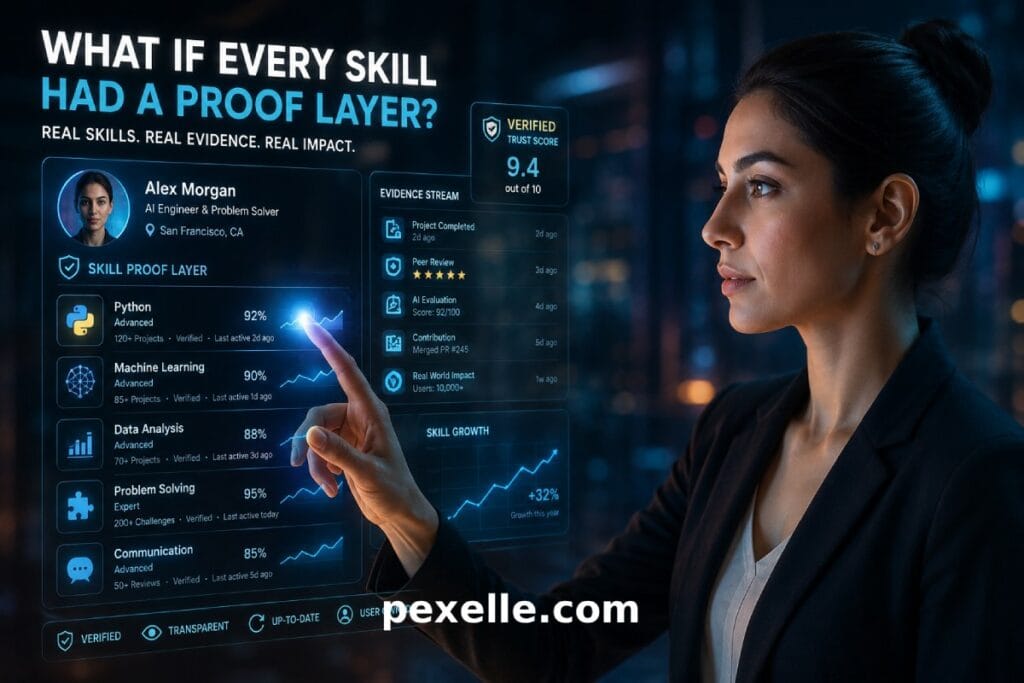
Think of a Proof Layer as a continuously evolving evidence system attached to every skill.
Instead of saying:
“I know JavaScript.”
The Proof Layer could show:
- Hundreds of completed projects
- Difficulty progression
- Code quality analysis
- Peer reviews
- AI evaluations
- Performance trends
- Error rates
- Collaboration history
- Learning improvements
- Recency of practice
Instead of one static credential…
You have dynamic proof.
Skills Become Living Objects
Today a certificate is frozen in time.
Someone earns it.
Then it never changes.
Ten years later…
The certificate still exists.
But does the skill?
A Proof Layer transforms skills into living entities.
Every project updates confidence.
Every challenge improves credibility.
Every contribution strengthens reputation.
Every period of inactivity slowly reduces confidence.
Skills become measurable over time rather than permanently assumed.
The Rise of Continuous Verification
Traditional verification happens once.
Proof Layers verify continuously.
Imagine an AI engineer.
Instead of showing a certificate from three years ago, their Proof Layer reveals:
- Models built this month
- Production deployments
- Performance improvements
- Community contributions
- Security practices
- Collaboration quality
- Documentation standards
Trust is no longer based on history alone.
It is based on current evidence.
AI Changes Everything
Artificial intelligence creates both opportunities and challenges.
AI can help people produce extraordinary work.
But AI can also make it difficult to know who actually possesses the underlying skill.
- Who wrote the code?
- Who designed the architecture?
- Who solved the difficult problem?
- Who merely prompted an AI?
Proof Layers shift the focus away from outputs alone.
Instead, they capture the entire journey:
- Decision making
- Iteration
- Problem solving
- Adaptation
- Collaboration
- Independent thinking
These signals are much harder to fake than finished documents.
Learning Becomes Visible
Education often measures completion.
Proof Layers measure growth.
Imagine two students.
Student A receives 95%.
Student B receives 82%.
Traditional grading suggests Student A performed better.
But what if:
Student A already knew the material.
Student B improved from 20% to 82% through persistence and consistent practice.
Who demonstrated greater learning?
Proof Layers reveal improvement curves.
Growth becomes measurable.
Potential becomes visible.
Hiring Without Guesswork
Recruitment is fundamentally a trust problem.
Companies spend enormous resources trying to predict future performance using limited information.
Resumes.
Interviews.
References.
Psychometric tests.
Imagine replacing much of that uncertainty with verified evidence.
Instead of asking:
“Tell us about your leadership.”
Recruiters could observe:
- Teams successfully managed
- Project outcomes
- Communication patterns
- Conflict resolution examples
- Decision quality
- Long-term consistency
Hiring becomes less about storytelling.
More about demonstrated capability.
Reputation Evolves Beyond Social Media
Today’s online reputation is often driven by visibility.
Followers.
Likes.
Views.
Engagement.
These metrics reward attention.
Proof Layers reward competence.
Someone with few followers but consistently excellent engineering work could build an extraordinary professional reputation.
Expertise becomes more valuable than popularity.
A Universal Skill Passport
Imagine every person carrying a secure digital skill passport.
Not controlled by one company.
Not owned by one university.
Not limited to one country.
Instead, it aggregates verified evidence from multiple sources:
- Employers
- Universities
- Open source projects
- Freelance platforms
- AI evaluations
- Certifications
- Research
- Peer validation
- Real-world outcomes
The result is a portable identity built around capability rather than claims.
Could AI Verify Skills?
AI is uniquely positioned to analyze evidence at scale.
It can review:
- Code quality
- Writing consistency
- Design evolution
- Communication effectiveness
- Learning speed
- Collaboration patterns
- Problem-solving approaches
However, AI should not become the sole authority.
The strongest Proof Layers combine:
- Human judgment
- Objective performance metrics
- Peer review
- Real-world outcomes
- AI-assisted analysis
Trust grows strongest when multiple independent sources reinforce one another.
Privacy Must Come First
A world of Proof Layers raises important ethical questions.
Who owns the data?
Who decides what counts as evidence?
Can people remove outdated records?
Can someone rebuild their reputation after failure?
Can evidence be shared selectively?
Without strong privacy protections, Proof Layers could become surveillance systems.
With thoughtful design, they can become tools that empower individuals.
Ownership must remain with the person whose skills are being represented.
The End of Resume Inflation
Today’s resumes often emphasize presentation.
Proof Layers emphasize verification.
Instead of trying to sound impressive…
People become motivated to become genuinely better.
Learning becomes more valuable than marketing.
Consistency becomes more valuable than exaggeration.
Evidence becomes more valuable than promises.
A Fairer Global Economy
Millions of talented people remain invisible simply because they lack access to prestigious universities or well-known employers.
Proof Layers could change that.
- A self-taught programmer in a small town.
- A designer from an emerging economy.
- A mechanic with decades of expertise.
- A nurse with exceptional patient outcomes.
- A translator with thousands of verified projects.
Their abilities become globally visible through demonstrated evidence rather than institutional prestige.
Opportunity becomes tied more closely to competence.
Challenges Ahead
Building a universal Proof Layer is far from simple.
Important questions remain:
- How do we standardize evidence?
- How do we prevent manipulation?
- How do we avoid algorithmic bias?
- How do we protect privacy?
- How do we ensure accessibility?
- How do we respect different learning paths?
- How do we keep verification transparent?
Technology alone cannot solve these problems.
Governance, ethics, and human oversight will be equally important.
The Future of Human Trust
Throughout history, trust has evolved.
We trusted families.
Then communities.
Then institutions.
Then digital platforms.
The next evolution may be evidence-based trust.
Not because machines replace human judgment.
But because they help organize and verify the evidence humans already create every day.
Proof Layers would not eliminate interviews.
They would not replace relationships.
They would not remove intuition.
Instead, they would strengthen decision making with transparent, continuously updated evidence.
Conclusion
Imagine a world where every skill tells its own story.
Not through claims.
Not through prestige.
Not through popularity.
But through verifiable, evolving evidence.
In such a world, opportunity becomes more merit-based.
Learning becomes lifelong.
Reputation becomes earned continuously.
And trust shifts from assumption to demonstration.
Perhaps the future of work is not simply about acquiring more skills.
Perhaps it is about making every skill provable.
Because in an AI-driven world where information can be generated instantly, the rarest and most valuable asset will not be knowledge itself. It will be trusted evidence of human capability.
Source : Medium.com