
If Billion-Dollar Companies Are Built by Tiny Teams, How Will Human Value Be Defined?
For decades, building a billion-dollar company required something that seemed unavoidable: people.
More customers meant more support teams. More products meant more engineers. More markets meant more managers, salespeople, recruiters, and entire departments dedicated to keeping the business running.
Growth was closely associated with headcount.
A company with thousands of employees was often considered more established, more powerful, and more capable than one with just a handful of people.
But that relationship is beginning to change.
Artificial intelligence, autonomous agents, cloud infrastructure, automation, and increasingly accessible technology are changing the economics of building businesses. A small team can now accomplish work that previously required entire departments.
The next billion-dollar company might not need thousands of employees. It might need ten exceptional people, a powerful technology stack, and the ability to coordinate intelligent systems.
And if that happens, one of the biggest questions facing the future of work will be:
When companies need fewer people to create more value, what makes a human employee valuable?
1. The End of Headcount as a Measure of Success
For much of modern business history, organizational growth was relatively predictable.
A growing company hired more people to handle increasing complexity. New customers required customer service representatives. New markets required regional teams. More products required additional engineers and operational specialists.
Human capacity was the primary constraint.
Technology is changing that equation.
A modern startup can use AI-powered tools to generate code, analyze information, produce marketing content, automate workflows, support customers, and coordinate repetitive operations.
Tasks that once required several specialized employees can increasingly be handled by a combination of software, automation, and a much smaller human team.
This does not mean every task can be automated or that human expertise is becoming unnecessary. It means the relationship between company size and business output is becoming less direct.
A ten-person company may eventually compete with organizations that employ hundreds of people, not because its employees work harder, but because each person operates with significantly greater technological leverage.
The traditional question was:
How many people do we need to grow?
The emerging question is:
How much value can each person create with the right tools?
2. From Employees to Multipliers
In traditional organizations, employees were often evaluated according to their responsibilities, working hours, and assigned output.
In a technology-enabled company, these measurements become less meaningful.
Imagine two employees.
The first completes ten tasks every day using conventional tools.
The second identifies a recurring operational problem, builds an automated workflow, connects several systems, and creates a process that eliminates thousands of repetitive tasks across the organization.
Both employees may have similar job titles.
Both may work similar hours.
But their economic impact is fundamentally different.
The second employee is not simply completing work. They are multiplying the organization’s ability to produce work.
This distinction could become one of the most important foundations of future employment.
Human value will increasingly depend on the ability to:
- Identify problems that matter.
- Make sound decisions under uncertainty.
- Design systems that create repeatable value.
- Coordinate people, technology, and intelligent agents.
- Turn knowledge into measurable outcomes.
- Improve existing processes rather than simply operate them.
The most valuable employee may not be the person who completes the most tasks.
It may be the person who makes thousands of tasks unnecessary.
3. The Rise of the Ten-Person Enterprise
Consider what a future ten-person company might look like.
It could operate globally, serve millions of customers, and manage complex products without building traditional departments.
Its structure might include:
- The Founder: Defines the company’s vision, identifies opportunities, and makes strategic decisions.
- The Product Architect: Converts market problems into products and experiences.
- The Engineers: Build the core technology, maintain infrastructure, and develop automated systems.
- The Growth Strategist: Understands customers, distribution, positioning, and market opportunities.
- The Operations Specialist: Designs workflows and coordinates the company’s digital infrastructure.
- The Customer Experience Lead: Handles complex customer relationships and improves the overall experience.
- The Security and Trust Specialist: Protects systems, data, and organizational integrity.
- The Remaining Specialists: Bring complementary expertise in finance, partnerships, research, or other critical areas.
AI agents and software systems support these individuals by handling repetitive execution, information processing, monitoring, and routine coordination.
This is not necessarily a prediction that every future company will have ten employees. Some industries will always require significant human work, physical infrastructure, regulation, and specialized operational capacity.
But it illustrates a fundamental possibility: organizational capability may become increasingly independent of organizational size.
The competitive advantage of a company could shift from how many people it employs to how effectively it combines human judgment with technological capabilities.
4. When One Person Can Do the Work of an Entire Department
The transformation is not simply about replacing employees with AI.
It is about changing what one person can accomplish.
A software engineer can use AI coding assistants to accelerate development. A marketing specialist can analyze customer behavior, generate campaigns, and test different strategies. An operations manager can automate reporting, coordinate workflows, and identify bottlenecks.
However, access to the same tools does not produce the same results.
Two people can use identical AI systems and achieve dramatically different outcomes.
One may generate large amounts of content without creating meaningful business value.
Another may understand a difficult customer problem, select the right tools, validate the results, and build a system that solves the problem consistently.
The difference is not simply technological knowledge.
It is judgment.
AI can expand the range of tasks a person can perform, but deciding which tasks matter, understanding the consequences, and knowing when an output is wrong remain critical human capabilities.
In this environment, technological fluency becomes important, but it is not enough.
The valuable employee is someone who knows how to turn technology into outcomes.
5. The Hidden Risk: More Productivity, Less Human Opportunity
There is an uncomfortable side to this transformation.
If a company can generate the same output with ten employees instead of one hundred, what happens to the other ninety?
For businesses, the economic incentive is understandable. Smaller teams can mean lower operating costs, faster decisions, fewer management layers, and greater flexibility.
For workers, however, the consequences are more complicated.
Entry-level positions may become harder to find if companies automate the routine tasks through which people traditionally developed professional experience.
Entire career paths could change.
Junior employees once learned by preparing reports, writing basic code, analyzing information, handling routine customer requests, and supporting experienced colleagues.
If AI systems perform much of this work, organizations must find new ways to develop inexperienced talent.
Otherwise, businesses may face a long-term contradiction: they want highly experienced professionals but provide fewer opportunities for people to become experienced.
The future of work cannot be measured only by how much output technology creates.
It must also consider how people enter professions, develop expertise, and build sustainable careers.
A more productive economy is not automatically a more inclusive one.
6. The New Competition: Proving Your Value
When organizations become smaller, hiring decisions may become more selective.
A company with ten employees cannot afford to make every hiring decision based on vague impressions, impressive job titles, or polished CVs.
Every person needs to contribute something meaningful.
This creates a new challenge for professionals.
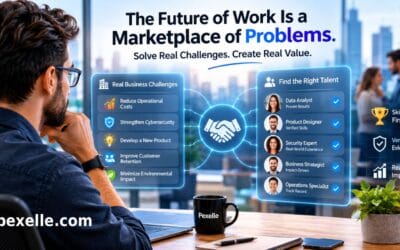
How can someone demonstrate that they are worth hiring?
Traditional hiring systems often rely on proxies:
- University degrees.
- Job titles.
- Years of experience.
- Previous employers.
- Professional certificates.
- Self-reported skills.
These signals can be useful, but they do not necessarily demonstrate what someone can actually do.
A degree does not automatically prove practical capability.
Ten years of experience do not guarantee that someone can solve a particular problem.
A job title does not reveal the quality or impact of someone’s contribution.
As companies become more output-oriented, the distinction between claimed capability and demonstrated capability becomes increasingly important.
Employers will need stronger evidence of what people can do, how they apply their knowledge, and what results they have produced.
This is where the concept of verifiable professional identity becomes essential.
7. From Job Titles to Evidence of Capability
Imagine two candidates applying for a role in a ten-person technology company.
Both describe themselves as experienced product managers.
Their CVs look similar.
Their qualifications are comparable.
But one candidate provides only a list of previous responsibilities.
The other presents documented projects, verified skills, measurable outcomes, technical contributions, and evidence of successful collaboration.
The second candidate gives the employer something much more valuable than a professional claim.
They provide a way to evaluate capability.
This is a fundamental shift from traditional recruitment.
Instead of asking:
What position did this person previously hold?
Employers can ask:
- What problems has this person solved?
- What capabilities have they demonstrated?
- What evidence supports their experience?
- What measurable impact have they created?
This approach does not eliminate the importance of education, experience, or professional references. It makes those signals more meaningful when connected to real evidence.
In a world where small teams must make every hiring decision count, the ability to demonstrate capability could become a significant competitive advantage.
8. The Rise of the High-Impact Professional
The future workforce may become increasingly divided not by traditional job titles, but by the scale and nature of individual contribution.
Consider three different professional profiles.
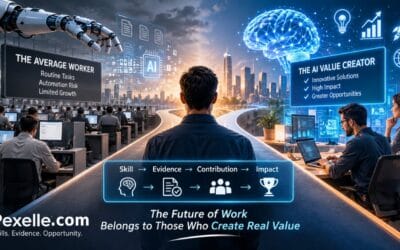
The Task Executor
Completes assigned responsibilities using established processes. Their value is primarily connected to the amount and quality of work they personally deliver.
The System Builder
Creates workflows, tools, and processes that improve how other people work. Their contribution extends beyond individual output.
The Value Creator
Identifies important problems, combines multiple capabilities, makes strategic decisions, and creates measurable business or social impact.
These are not fixed categories or a hierarchy of human worth. A reliable task executor can be essential to an organization, and not every valuable contribution needs to be revolutionary.
But they illustrate different ways of creating economic value.
As automation handles more predictable tasks, the ability to design systems, solve unfamiliar problems, and create meaningful outcomes may become increasingly important.
The future professional will need more than a collection of skills.
They will need to demonstrate how those skills work together.
9. Why Human Trust Will Become More Valuable
There is another consequence of smaller, highly automated organizations.
As more business operations depend on software and AI agents, the ability to trust the people behind important decisions becomes critical.
- Who designed the system?
- Who verified the information?
- Who is accountable when an automated decision causes harm?
- Who can demonstrate that a claimed achievement actually happened?
Technology can increase productivity, but it can also increase the scale of mistakes, misinformation, and unverified claims.
A company with ten employees may operate with enormous technological reach. That makes individual decisions more consequential, not less.
Trust becomes an operational requirement.
Professional credibility will increasingly depend on transparent evidence, verified contributions, accountable decision-making, and the ability to establish confidence in what someone claims to know or have achieved.
In this environment, a professional profile should become more than a digital summary of someone’s career.
It should become a continuously evolving record of demonstrated capability.
10. What Happens to the Meaning of a Career?
For generations, career progression followed a relatively familiar structure.
People entered an industry, gained experience, moved into more senior positions, managed larger teams, and eventually became leaders.
But what happens when companies have fewer management layers and smaller teams?
A person may no longer need to manage fifty employees to demonstrate leadership.
They may lead through technical expertise, strategic decisions, successful projects, or the ability to coordinate people and intelligent systems.
Career progression could become less dependent on climbing an organizational hierarchy and more dependent on expanding the scope of one’s contribution.
A professional might move between industries, combine previously separate disciplines, work with multiple organizations, and build a portfolio of verifiable achievements.
Their identity would not be defined by one employer or one job title.
It would be defined by what they can consistently demonstrate.
This could create a more flexible professional economy, where capability travels with the individual rather than remaining attached to an organization.
11. The New Responsibility of Employers
Businesses also need to rethink their responsibilities.
Building a smaller company should not mean treating employees as disposable resources.
If every individual becomes more important to organizational performance, companies must invest more carefully in their development, wellbeing, and long-term professional growth.
They must create opportunities for people to learn skills that automation cannot easily replace.
They must reward meaningful contributions rather than simply measuring activity.
They must establish transparent ways to evaluate performance without turning every human action into a productivity metric.
Most importantly, companies need to understand that technological efficiency and human development are not opposing objectives.
A business that continuously develops its people may build stronger capabilities, better judgment, and more sustainable competitive advantages.
The goal should not be to minimize the number of humans at any cost.
It should be to build organizations where technology amplifies human potential.
12. The Capability Economy Is Taking Shape
The emergence of highly productive small teams points toward a broader transformation.
For a long time, economic opportunity was closely associated with access to organizations.
People needed employers to provide infrastructure, teams, resources, distribution, and opportunities to participate in large-scale projects.
Technology is gradually reducing some of these barriers.
Individuals can access powerful development environments, global distribution channels, automated systems, and specialized digital tools without building a traditional organization around themselves.
This creates the possibility of an economy in which individuals compete and collaborate based on demonstrated capabilities.
In such an economy, the most important professional questions become:
- What can you actually do?
- What problems can you solve?
- What evidence demonstrates your abilities?
- How effectively can you work with other people?
- What impact have you created?
- How quickly can you adapt when the nature of work changes?
This is the foundation of what could be described as a Capability Economy.
An economy where professional value is increasingly connected to demonstrated ability, verified evidence, contribution, and impact rather than organizational position alone.
13. Why Pexelle Believes Proof Will Matter More
At Pexelle, we believe the future of professional identity must move beyond traditional CVs and job titles.
As organizations become smaller and expectations become higher, employers need better ways to understand the people they hire.
Professionals also need better ways to communicate their capabilities.
A list of skills is not enough.
A collection of certificates is not enough.
A professional headline is not enough.
What matters is the connection between a skill, the evidence supporting it, the contribution it enables, and the impact it creates.
This is why Pexelle focuses on making professional capabilities more visible, structured, and verifiable.
We believe professional identity should evolve into a living capability profile, where skills are supported by evidence and achievements can be understood beyond the boundaries of a single employer.
Because when companies become smaller, every hiring decision matters more.
And when technology makes execution easier, proving what you can genuinely contribute becomes even more important.
Conclusion: The Future Belongs to Those Who Can Prove Their Impact
The next unicorn might have ten employees.
Or twenty.
Or a completely different organizational structure that we cannot fully predict today.
The exact number is not the point.
The important transformation is that business value may become increasingly disconnected from workforce size.
Technology is expanding what small teams can accomplish, changing how organizations operate, and challenging traditional definitions of productivity, experience, and professional success.
For employees, this creates both opportunity and uncertainty.
Some traditional responsibilities will disappear. New capabilities will become essential. Career paths will change, and competition may increasingly revolve around demonstrated results rather than impressive professional labels.
The question is no longer simply how many years someone has worked or what position they have held.
It is what they can contribute, how they create value, and whether they can prove it.
The future of work will not be defined only by smaller companies. It will be defined by a new understanding of human capability.
Skill → Evidence → Contribution → Impact.
Because in a world where ten people can build a billion-dollar company, human value will no longer be measured by how much work someone performs.
It will be measured by the difference they make.
Pexelle | Verifiable Humans.
Building a future where skills are demonstrated, contributions are recognized, and professional credibility is backed by evidence.
Source : Medium.com